


Six months financial risk mitigation planning roadmap





Try Before you Buy Download Free Sample Product
 Impress Your
 Audience
 100%
100% Editable
 Save Hours
 of Time


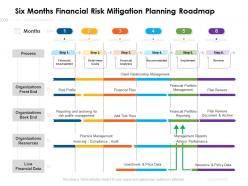
A cohesive work plan is essential for achieving the desired target. Communicate your vision and lay a firm ground in front of your audience with our PowerPoint layout. Align your project milestones, budgets, deliverables, deadlines, and all the requisite information for a dynamic presentation by employing this amazingly designed Six Months Financial Risk Mitigation Planning Roadmap. Maximize team efficiency and streamline a work plan efficiently by introducing our ready made roadmap PowerPoint theme. You can quickly establish coordination between different activities across the organization and present an insight to your colleagues by utilizing this useful business tool. Color code specific tasks, prioritize, and keep a close eye on the deadlines with the help of our eye catchy PowerPoint template. Download our Six Months Financial Risk Mitigation Planning Roadmap for excelling at productive management.
People who downloaded this PowerPoint presentation also viewed the following :
Six months financial risk mitigation planning roadmap with all 2 slides:
Give your audience a fulfilling experience. They will find our Six Months Financial Risk Mitigation Planning Roadmap elevating.

FAQs for Six months financial risk
**INPUT**: What are the primary types of financial risks that businesses face today? **OUTPUT**: Primary financial risks include credit risk, market volatility, liquidity constraints, operational disruptions, and regulatory compliance challenges. These risks increasingly impact organizations across sectors, with banks managing loan defaults, retailers navigating currency fluctuations, and manufacturers addressing supply chain financing issues, ultimately requiring strategic risk frameworks to maintain competitive advantage. [Word count: 52 words]
Organizations can effectively assess financial risk exposure through comprehensive risk mapping, stress testing scenarios, liquidity analysis, credit evaluations, and market volatility assessments. These methodologies enable companies to identify potential vulnerabilities across portfolios, operations, and market conditions, with many financial institutions finding that regular assessment cycles ultimately deliver enhanced decision-making capabilities and stronger regulatory compliance.
Derivatives serve as essential hedging instruments in financial risk mitigation, including futures, options, swaps, forwards, and credit default swaps. These financial tools enable organizations to transfer specific risks, lock in prices, and stabilize cash flows, with banks and corporations increasingly finding that strategic derivatives usage delivers greater predictability and competitive advantage in volatile markets.
Common financial risk management frameworks include COSO Enterprise Risk Management, Basel III for banking institutions, ISO 31000 risk management principles, Value-at-Risk (VaR) models, and stress testing protocols. These frameworks enable organizations to identify, assess, and mitigate risks systematically, with many financial services companies finding that integrated approaches deliver enhanced regulatory compliance, improved capital allocation, and ultimately stronger competitive positioning in increasingly volatile markets.
Insurance serves as a strategic financial buffer by transferring potential losses to insurers, protecting cash flow, preserving capital reserves, and maintaining operational continuity during unforeseen events. Through comprehensive coverage including property, liability, and business interruption policies, companies in manufacturing, healthcare, and retail sectors stabilize financial planning, reduce uncertainty, and ultimately preserve stakeholder confidence while enabling sustained growth investments.
Diversification is critically important for reducing financial risk, as it spreads investments across different asset classes, sectors, geographic regions, and time horizons to minimize portfolio volatility. Through strategic diversification, investors can significantly reduce unsystematic risk while maintaining growth potential, with many financial advisors finding that well-diversified portfolios deliver more consistent returns and better weather market downturns than concentrated investments.
Financial hedging techniques offer benefits including reduced exposure to market volatility, improved cash flow predictability, enhanced strategic planning capabilities, and protection against adverse price movements in currencies, commodities, or interest rates. However, these strategies present drawbacks such as upfront costs, complexity in implementation, and potential opportunity costs, with many financial institutions finding that successful hedging requires sophisticated risk management expertise and ongoing monitoring.
Regulatory compliance significantly enhances financial risk management by establishing mandatory frameworks for capital adequacy, liquidity requirements, and operational controls across institutions. These regulations enable banks and financial firms to identify potential vulnerabilities early, implement standardized reporting mechanisms, and maintain robust governance structures, ultimately delivering greater market stability and reduced systemic risk exposure.
Companies should monitor cash flow ratios, debt-to-equity ratios, current ratios, return on assets, and credit risk scores to gauge financial risk levels effectively. These indicators enable organizations to identify potential vulnerabilities early, optimize resource allocation, and maintain operational stability, with many financial institutions finding that comprehensive monitoring ultimately delivers enhanced decision-making and competitive advantage.
Technology and data analytics enhance financial risk mitigation through real-time monitoring, predictive modeling, automated compliance tracking, and advanced fraud detection systems. Banks and financial institutions leverage machine learning algorithms to identify suspicious patterns, assess credit risks more accurately, and automate regulatory reporting, ultimately delivering faster decision-making, reduced operational costs, and significantly improved risk management capabilities.
Foreign exchange risk significantly impacts multinational corporations through transaction exposure, translation exposure, and economic exposure, affecting cash flows, financial statements, and competitive positioning. These currency fluctuations create challenges in revenue predictability, cost management, and strategic planning, with many corporations finding that effective hedging strategies, natural hedging through operational diversification, and robust financial forecasting ultimately deliver greater earnings stability and enhanced investor confidence.
Cash flow forecasting mitigates financial risk by predicting liquidity shortfalls, identifying seasonal patterns, and enabling proactive resource planning before crises emerge. Through accurate forecasting models, organizations can secure credit lines during healthy periods, optimize working capital management, and make informed investment decisions, while many financial institutions find that systematic forecasting ultimately delivers enhanced stability and competitive positioning.
Small businesses can adopt strategies including diversified revenue streams, emergency cash reserves, comprehensive insurance coverage, regular financial monitoring, and strategic partnerships to manage financial risks effectively. These approaches streamline operations by reducing dependency on single income sources, ensuring liquidity during downturns, and protecting against unforeseen losses, with many small enterprises finding that proactive risk management ultimately delivers operational stability and competitive advantage in increasingly volatile markets.
Credit risk assessment directly influences lending and investment decisions by evaluating borrower creditworthiness, determining interest rates, and setting loan terms based on default probability. Through advanced analytics and comprehensive financial analysis, banks and financial institutions streamline approval processes, minimize potential losses, and optimize portfolio performance, while ensuring regulatory compliance and maintaining competitive advantage in an increasingly complex financial landscape.
Stress testing enables financial institutions to evaluate portfolio performance under extreme market conditions, regulatory scenarios, and economic downturns by simulating adverse events beyond normal volatility. Through comprehensive modeling, banks and investment firms identify vulnerabilities, optimize capital allocation, and strengthen risk frameworks, with many institutions finding that regular stress testing enhances regulatory compliance while delivering competitive advantage.
No Reviews