


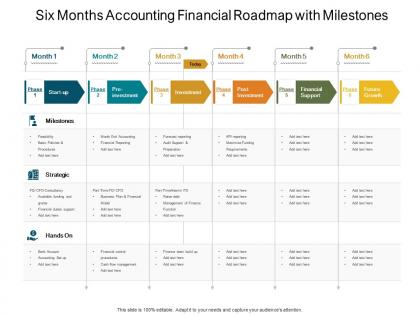
Six months accounting financial roadmap with milestones




Try Before you Buy Download Free Sample Product
 Impress Your
 Audience
 100%
100% Editable
 Save Hours
 of Time


Utilize our pre build Six Months Accounting Financial Roadmap With Milestones to present your plan of action in the most effective way. Reduce the paperwork and showcase how different activities are linked to each other by incorporating this attention grabbing PowerPoint theme. This completely editable roadmap PPT layout is suitable to fit all your needs and to have a structured outline of the entire process flow using color coding. Provide guidelines to your teammates about the progression process by employing our PPT theme. Team members can easily be designated into teams by accessing the work milestones to be accomplished within the timeframe. You can easily modify the PowerPoint slide according to real time situations. Download our stunning Six Months Accounting Financial Roadmap With Milestones, and you are good to go to prove your expertise in strategic planning.
People who downloaded this PowerPoint presentation also viewed the following :
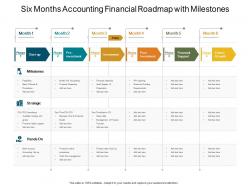
Six months accounting financial roadmap with milestones with all 2 slides:
Use our Six Months Accounting Financial Roadmap With Milestones to effectively help you save your valuable time. They are readymade to fit into any presentation structure.
FAQs for Six months accounting financial
So basically you've got four steps that keep repeating. First, record everything as it happens - every transaction, receipt, whatever. Adjusting entries come next and honestly, this is where most people get stuck because you're dealing with stuff like depreciation. Then you build your financial statements from all that data. Close out your temporary accounts last so you can start clean next period. Oh and definitely do this monthly if you can - I learned the hard way that waiting until December is a nightmare. Trust me on that one.
Honestly, just start with automating your most common stuff - don't try to do everything at once. QuickBooks or Xero are solid choices since they'll connect to your bank and handle most categorization automatically. Create templates for invoices and bills (trust me, you'll thank yourself later). Here's what really helped me though: do weekly reconciliations instead of waiting until month-end when it's total chaos. Oh, and snap photos of receipts right away - I used to stuff them in my wallet and forget about them for weeks. Weekly check-ins keep everything manageable instead of turning into a nightmare later.
Dude, accounting without tech is basically impossible now. Most firms run everything through cloud software - invoicing, bookkeeping, the whole deal. AI does data entry and catches fraud way better than we ever could manually. Automation handles all the boring stuff too. Real-time reporting is a game changer, and blockchain's starting to pop up for audit trails. The tricky part? Everything changes so fast. I try learning one new tool every few months just to keep up. Trust me, it beats doing reconciliations by hand like we used to - that was absolutely brutal.
So basically new regulations force accounting standards to change - FASB has to update everything when laws shift. Crypto's a perfect example right now, everyone's freaking out about disclosure rules. Revenue recognition, footnotes, all of it can get flipped upside down. The annoying part? Transition periods mean you're dealing with both old and new standards at once (which is honestly a nightmare). Watch for regulatory announcements since they're your heads up that changes are coming. Oh and speaking of crypto - my company's still figuring out half this stuff too.
QuickBooks Online or Xero are your best bets for sure. They're both great at invoicing, tracking expenses, and basic reports. Plus they connect to pretty much everything else you'll use. If you're service-based though, FreshBooks is worth checking out too. Look, don't stress about picking the "perfect" one right away - you can switch later if needed. QuickBooks handles US taxes better, but Xero's interface is way cleaner (honestly feels less clunky). Just grab whichever has the better promo deal running and get your books going. That's half the battle right there.
Dude, you gotta track actual cash moving in and out - forget just looking at profit/loss for a sec. Get some accounting software and categorize everything: what people owe you, what you owe others, all your expenses. I totally screwed this up once - had a "profitable" quarter that nearly destroyed us cash-wise! Project your cash position like 13 weeks ahead so you can see problems coming. Update weekly. Oh and reconcile your bank statements daily (boring but you'll instantly see where money's actually disappearing). Separate operating cash from financing stuff too - makes everything clearer.
Dude, you gotta watch five things like a hawk: cash flow (money actually coming in vs going out), gross profit margins, who owes you money and how old those debts are, your monthly burn rate, and debt-to-equity ratio. Cash flow will literally make or break you - I've seen good businesses die because they ignored it. Pull these numbers monthly at first, then weekly once you get bigger. Oh, and set up some kind of alert system when things get sketchy. These give you the real picture of what's happening, not just whether you're technically profitable on paper.
Yeah accounting totally depends on what industry you're in. Retail's pretty chill - just inventory, sales, basic transactions. Manufacturing though? That's where things get messy with all the cost accounting headaches. You've got work-in-process inventory, overhead allocation, the whole nine yards. SaaS companies are obsessed with recurring revenue (which honestly makes sense), and construction uses this percentage-of-completion thing. My buddy who does manufacturing accounting is always complaining about it lol. I'd say find an industry you actually care about first, then learn their specific standards. Makes it way less boring.
Ugh, don't mix your personal stuff with business expenses - that's like mistake
No Reviews