


Three months accounting financial roadmap with milestones




Try Before you Buy Download Free Sample Product
 Impress Your
 Audience
 100%
100% Editable
 Save Hours
 of Time


Utilize our pre build Three Months Accounting Financial Roadmap With Milestones to present your plan of action in the most effective way. Reduce the paperwork and showcase how different activities are linked to each other by incorporating this attention grabbing PowerPoint theme. This completely editable roadmap PPT layout is suitable to fit all your needs and to have a structured outline of the entire process flow using color coding. Provide guidelines to your teammates about the progression process by employing our PPT theme. Team members can easily be designated into teams by accessing the work milestones to be accomplished within the timeframe. You can easily modify the PowerPoint slide according to real time situations. Download our stunning Three Months Accounting Financial Roadmap With Milestones, and you are good to go to prove your expertise in strategic planning.
People who downloaded this PowerPoint presentation also viewed the following :
Content of this Powerpoint Presentation
Description:
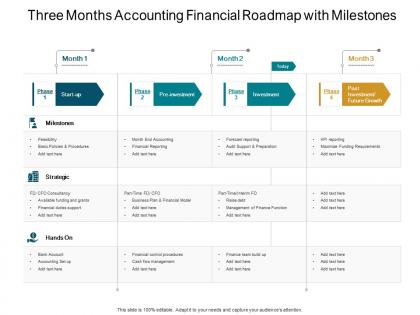
The image is a PowerPoint slide that outlines a three-month financial roadmap for a company with specific milestones. The roadmap is divided into four phases:
Month 1: Start-up
Milestones: Feasibility, Basic Policies & Procedures.
Strategic: FD/ CFO Consultancy, Available funding, and grants, Financial duties support.
Hands-On: Bank Account, Accounting Set up.
Month 2: Pre-investment
Milestones: Month End Accounting, Financial Reporting.
Strategic: Part-Time FD/ CFO, Business Plan & Financial Model.
Hands-On: Financial control procedures, Cash flow management.
Month 3: Investment
Milestones: Forecast reporting, Audit Support & Preparation.
Strategic: Part-Time/Interim FD, Raise Debt, Management of Finance Function.
Hands-On: Finance team build-up.
Post Investment/ Future Growth
Milestones: KPI reporting, Maximize Funding Requirements.
Strategic: Add text here (indicating customizable content).
Hands-On: Add text here (indicating customizable content).
Each section includes editable text fields where specific information can be added.
Use Cases
This type of slide can be utilized in various industries for planning and presentation purposes, including:
1. Startups:
Use: To plan and track financial milestones.
Presenter: Chief Financial Officer.
Audience: Investors, internal teams.
2. Banking:
Use: For advising business clients on financial planning.
Presenter: Financial Advisor.
Audience: Business clients.
3. Consulting:
Use: When creating financial strategies for clients.
Presenter: Financial Consultant.
Audience: Corporate clients.
4. Education:
Use: Teaching financial management and planning.
Presenter: Academic Instructor.
Audience: Business students.
5. Non-profits:
Use: Mapping out funding and financial management strategies.
Presenter: Finance Director.
Audience: Board members, donors.
6. Healthcare:
Use: Financial planning for new medical facilities or services.
Presenter: Healthcare Administrator.
Audience: Stakeholders, regulatory bodies.
7. Technology:
Use: Planning for product development and growth phases.
Presenter: Startup Founder/CEO.
Audience: Venture capitalists, angel investors.
Three months accounting financial roadmap with milestones with all 2 slides:
Use our Three Months Accounting Financial Roadmap With Milestones to effectively help you save your valuable time. They are readymade to fit into any presentation structure.

FAQs for Three months accounting financial
Essential components include standardized chart of accounts, automated reconciliation processes, integrated financial reporting systems, compliance tracking mechanisms, and performance measurement frameworks. These elements work together by streamlining data collection, enhancing accuracy, and enabling real-time financial visibility, with many organizations finding that strategic implementation ultimately delivers improved decision-making capabilities and operational efficiency.
Small businesses can tailor their accounting processes by implementing scalable software systems, establishing monthly financial reviews, creating cash flow forecasting models, and setting up automated expense tracking aligned with growth targets. These strategic approaches enable startups and growing companies to monitor key performance indicators, optimize resource allocation, and make data-driven decisions, ultimately delivering improved financial visibility and competitive advantage in an increasingly dynamic market environment.
Technology serves as the backbone of modern accounting roadmaps, enabling cloud-based systems, automated data processing, AI-powered analytics, real-time reporting, and integrated financial platforms. These innovations streamline compliance workflows, enhance accuracy through automated reconciliation, and deliver strategic insights, with many organizations finding that digital transformation reduces manual tasks by up to 70% while accelerating decision-making processes.
Common pitfalls include inadequate stakeholder consultation, unrealistic timelines, insufficient change management planning, poor technology integration strategies, and neglecting regulatory compliance requirements. Organizations often underestimate resource allocation needs and fail to establish clear success metrics, with many financial departments finding that phased implementation approaches and continuous stakeholder engagement ultimately deliver smoother transitions and sustained adoption.
An accounting roadmap ensures regulatory compliance by establishing standardized processes, automated monitoring systems, and regular audit trails that align with evolving financial regulations. Through systematic risk assessment frameworks and compliance checkpoints, organizations can proactively identify potential issues, streamline reporting requirements, and maintain transparency, ultimately reducing regulatory penalties while enhancing operational efficiency and stakeholder confidence.
Accounting roadmap KPIs include cash flow ratios, accounts receivable turnover, expense-to-revenue ratios, profit margins, and compliance accuracy metrics. These indicators enable organizations to monitor financial health, streamline reporting processes, and identify operational inefficiencies, with many companies finding that strategic KPI tracking ultimately delivers improved decision-making and enhanced competitive positioning.
Businesses should review their accounting roadmap quarterly and update it annually, with additional reviews triggered by significant changes like mergers, regulatory shifts, or technology implementations. Many organizations find that regular quarterly assessments enable them to adapt to evolving compliance requirements, market conditions, and operational growth, ultimately maintaining financial accuracy and strategic alignment.
Foundational accounting principles in the roadmap include revenue recognition, matching principle, materiality, consistency, and conservatism. These principles streamline financial reporting by ensuring accurate transaction recording, transparent disclosure standards, and regulatory compliance, with many organizations finding that strategic implementation ultimately delivers enhanced operational efficiency and stakeholder confidence.
An accounting roadmap enhances financial forecasting and budgeting by establishing standardized processes, integrating predictive analytics, and aligning departmental data flows with strategic planning cycles. Through systematic implementation of automated reporting tools and real-time data integration, organizations streamline budget accuracy, reduce forecasting errors by significant margins, and enable more agile financial decision-making across all business units.
Staff need comprehensive training in new accounting software, regulatory compliance updates, data analysis tools, and change management processes. Implementation succeeds when organizations provide hands-on workshops, certification programs, and ongoing support resources, with many companies finding that investing in cross-functional training and mentorship programs ultimately delivers smoother transitions and enhanced operational efficiency.
Businesses secure stakeholder buy-in by clearly communicating financial benefits, implementation timelines, and risk mitigation strategies, while involving key stakeholders in roadmap development and decision-making processes. Through transparent progress reporting and demonstrating quick wins, organizations build trust and momentum, with many finding that regular stakeholder meetings and showcasing improved accuracy ultimately deliver sustained support and organizational alignment.
Data analytics significantly transforms accounting roadmaps by enabling predictive forecasting, real-time financial reporting, automated reconciliation processes, and enhanced compliance monitoring capabilities. Through advanced analytics tools, organizations streamline month-end closures, identify cost optimization opportunities, and deliver more strategic financial insights, with many finance teams finding that data-driven approaches ultimately reduce manual processes while enhancing decision-making accuracy.
An accounting roadmap facilitates better executive decision-making by providing structured financial visibility, standardized reporting processes, clear performance metrics, and predictable cash flow forecasting. Through comprehensive financial frameworks, executives can evaluate strategic investments, assess operational efficiency, and identify growth opportunities more effectively, while streamlined accounting processes deliver timely insights that enable faster, data-driven decisions in competitive markets.
Best practices for integrating software tools into an accounting roadmap include establishing clear data flow protocols, ensuring seamless API connectivity, implementing standardized chart of accounts, conducting thorough compatibility testing, and maintaining robust security measures. These integration strategies streamline financial operations by eliminating data silos, reducing manual entry errors, and enhancing real-time reporting capabilities, with many organizations finding that strategic software integration ultimately delivers improved accuracy and operational efficiency.
International businesses adapt their accounting roadmaps by implementing flexible frameworks that accommodate multiple regulatory standards, establishing local compliance teams in each jurisdiction, and leveraging cloud-based accounting systems for real-time consolidation. These strategic approaches enable seamless operations across markets like Europe's IFRS requirements and US GAAP standards, while maintaining centralized oversight and reducing compliance costs, ultimately delivering operational efficiency and regulatory confidence in an increasingly globalized business environment.
No Reviews