

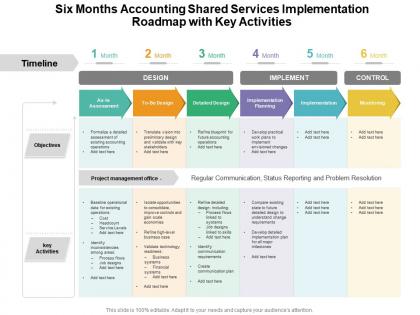
Six months accounting shared services implementation roadmap with key activities




Try Before you Buy Download Free Sample Product
 Impress Your
 Audience
 100%
100% Editable
 Save Hours
 of Time


Visualize your work plan and communicate your ideas impactfully with our pre designed Six Months Accounting Shared Services Implementation Roadmap With Key Activities. Showcase the detailed overview of the project, the key deliverables, and the milestones to be achieved with the help of our fully customizable PowerPoint layout. You can easily emphasize on the project goals and discuss all the activities involved in an easy to comprehend manner by utilizing our professionally designed PPT theme. This roadmap PowerPoint layout is a perfect strategic planning tool that can help in keeping the project on track. With our attractive PowerPoint theme, you can articulate the workflow, track the work progress, and have a clear vision of the goal to be achieved. Download this versatile Six Months Accounting Shared Services Implementation Roadmap With Key Activities and save your hours of work.
People who downloaded this PowerPoint presentation also viewed the following :
Six months accounting shared services implementation roadmap with key activities with all 2 slides:
Use our Six Months Accounting Shared Services Implementation Roadmap With Key Activities to effectively help you save your valuable time. They are readymade to fit into any presentation structure.
FAQs for Six months accounting shared services implementation roadmap
Start with cost reduction, process standardization, and better service quality. Centralize your accounting to cut out duplicate work and create scale - that's where the real wins are. Honestly, standardization is probably your biggest opportunity long-term, though it's not the sexy part everyone talks about. You'll also want to tighten controls and improve data accuracy. This frees up your business partners for strategic stuff instead of boring transaction work. Map your current processes first, then figure out which ones give you the most impact when centralized.
First things first - you gotta do a maturity check on your current setup. How standardized are your accounting processes? If different departments are doing their own thing completely, you're in for a rough ride. Data quality is huge too since shared services lives or dies by clean, consistent info flowing between systems. Oh, and definitely scope out the people situation early. Some folks will hate any change, so figure out who might push back. I'd create a basic scoring system across all these areas - gives you a clear starting point. Then you can map out your timeline and tackle the worst gaps first.
AP and AR are the obvious ones - super high volume and pretty straightforward to standardize. General ledger maintenance too. Most companies I've seen also move expense management and fixed assets to shared services, plus month-end close stuff. Payroll's trickier though, depends on your compliance headaches. Honestly, just start with whatever's eating up the most hours across your locations. Map that out first. High-volume processes give you the best ROI anyway. You want the standardized, repetitive stuff - not the weird one-off transactions that need local knowledge.
Honestly, tech is what makes or breaks shared services. Without solid ERP systems and automation tools, you're gonna have teams doing everything manually and getting pissed off about it. Cloud solutions are where it's at though - way more flexible than the old on-premise stuff we used to deal with. Data analytics platforms help standardize everything across departments too. Oh, and definitely audit what you already have before buying new systems. No point replacing something that actually works, you know? The integration piece is huge - that's what lets you scale without wanting to pull your hair out.
Track the obvious stuff first - cost per transaction, processing times, error rates, headcount changes. Monthly dashboards work great for comparing before/after performance. Also grab industry benchmarks if you can find decent ones (easier said than done sometimes). Don't skip the softer metrics though - employee satisfaction and stakeholder feedback matter way more than people think. They'll totally tank your whole model if ignored. Get your baselines locked down before transitioning or you'll have nothing meaningful to measure against later.
Get buy-in early - that's honestly half the battle right there. Find champions in each department who can actually sell the benefits to their teammates. Nobody wants work process surprises sprung on them, so communicate constantly. Training is huge - not just quick demos but real hands-on stuff before launch. Oh, and documentation that people will actually use, not some dense manual nobody reads. Start with a pilot group if you can swing it. Create feedback loops so people can complain (they will anyway). Scale up once you've worked out the kinks from round one.
Honestly, change management is gonna be your biggest headache - people absolutely hate learning new systems. Historical data migration is another nightmare since old data is usually a complete mess. Your team's productivity will tank temporarily during the switch, which sucks but it's normal. Business units will probably push back hard because they think you're taking away their control. Oh, and if your current systems don't integrate well, you're in for some serious technical headaches. I learned this the hard way - plan for way more time than you think you need and get everyone on board before you start.
Get everyone involved from day one - seriously, don't wait until you're halfway through and then wonder why people are pushing back. Map out who's really affected, including the folks actually doing the work, not just managers. Set up working groups so people have actual say in decisions. Two-way conversations beat boring status emails every time. When people help build the solution, they don't fight it later. I learned this the hard way on a project last year - wish someone had told me sooner! Treat them like partners, not roadblocks.
Honestly, start with process training so everyone's on the same page - that's like 80% of your headaches solved right there. Get them trained on your specific software and automation tools next. Communication skills are massive since they'll be dealing with different departments who all think their stuff is the most urgent (spoiler: it's not). Cross-training is clutch for when people are out or things get crazy busy. Oh, and set up proper onboarding first - don't just throw new people into the deep end. Then build ongoing training tracks based on where people are in their careers. Keep some budget for emerging tech training too.
First thing - get your access controls locked down with role-based permissions and multi-factor auth. Encryption for data in transit and at rest is a must. I know compliance frameworks seem like a total pain, but honestly they're pretty helpful as a guide. Your shared services team needs to get familiar with SOX requirements and whatever industry regs apply to you. Document where your security gaps are right now, then hit the riskiest stuff first. Oh, and don't forget regular training sessions - people are usually the weakest link. Audit trails for everything too.
Honestly, standardizing accounting processes is a game changer. Everyone follows the same workflows, so you get actual consistency across teams. Processing transactions becomes way faster too. The best part? Compliance gets so much simpler when you're not dealing with a million different methods for one task. You can finally compare metrics that actually make sense - which sounds boring but trust me, it's not when you see the results. Oh, and definitely map out what you're currently doing first. Can't fix what you don't understand, right?
Honestly, start with the basics - track efficiency stuff like how long invoices take to process and what each transaction costs you. Quality metrics matter too (accuracy rates, fewer errors). Don't forget service delivery - are you hitting your SLAs and keeping customers happy? Here's what I learned the hard way: get your baseline data BEFORE you switch over. I've seen too many people scrambling later trying to figure out their "before" numbers. Build some automated dashboards so your team can catch problems early. Oh, and resist the urge to track everything - pick 5-7 core metrics first.
Dude, communication is everything here - seriously. Keep everyone looped in on timelines, changes, all that stuff. Nobody wants to be blindsided about how their job's gonna change, you know? Don't just tell them what's happening either - explain WHY it matters. Finance people can be pretty territorial (learned that the hard way), so you need their buy-in. Set up regular meetings, send updates, make sure there's a clear way for people to escalate issues. Honestly, you can't communicate too much during these transitions. Better to annoy people with info than leave them guessing.
Honestly, you've gotta build this into people's actual job descriptions - can't just hope it happens naturally. Start with regular cross-functional meetings, maybe weekly or every other week. Joint KPIs work really well too since everyone's success becomes tied together. Oh, and those rotation programs where people spend a few months in different departments? Game changer. But here's what I'd do - don't try to fix everything at once. Pick two departments for a pilot program first, see what works, then expand. Also make sure there are clear escalation paths so people aren't just spinning their wheels when issues come up.
Honestly, the two big killers are rushing the timeline and not planning for how much people hate change. Clean your data first or you'll just be moving garbage into a shiny new system. Get everyone on board early - especially the business teams who actually have to use this thing daily. Communication breakdowns will tank your project way faster than any tech problems will. Oh, and training is huge. I'd build in way more time than you think you need, maybe find some internal champions in each department. Trust me, these projects always drag on longer than planned.
No Reviews