


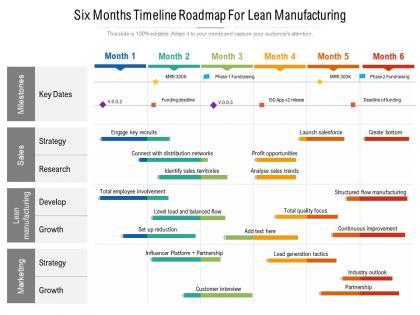
Six months timeline roadmap for lean manufacturing




Try Before you Buy Download Free Sample Product
 Impress Your
 Audience
 100%
100% Editable
 Save Hours
 of Time


The success rate of business plans is hugely dependent on the plan of action, and this editable Six Months Timeline Roadmap For Lean Manufacturing rightly serves the purpose. Encapsulate all the information related to the project in a well structured manner to obtain maximum efficiency by incorporating our stunning PowerPoint theme. State the critical deliverable, steps involved, time frame, workforce allocation, and lots more in an easy to understand manner by utilizing this pre designed roadmap PowerPoint layout. You can also prioritize your tasks and discuss the problem areas with your colleagues by incorporating this tailor made PPT layout. Empower your work plan by employing this professionally designed PPT theme. Entrepreneurs can download Six Months Timeline Roadmap For Lean Manufacturing as a beneficial communication tool that facilitates in collaborating with different tasks and achieve targets.
People who downloaded this PowerPoint presentation also viewed the following :
Six months timeline roadmap for lean manufacturing with all 2 slides:
Use our Six Months Timeline Roadmap For Lean Manufacturing to effectively help you save your valuable time. They are readymade to fit into any presentation structure.
FAQs for Six months timeline roadmap
So the five lean principles you'll want to hit are: figure out what customers actually value, map your whole process, smooth out the flow, set up pull systems, and keep improving constantly. Honestly, most companies think they know what customers want but they're usually wrong - start there first. Map out every single step to find waste (trust me, there's tons hiding). Remove bottlenecks so things flow nicely. Instead of building inventory and hoping it sells, let demand pull everything through. Oh and build in those improvement cycles or you'll just slide backward. I'd do them in that order since they kinda stack on each other.
Honestly, just grab a stopwatch and walk around your floor for like 30 minutes. You'll be amazed at how much time gets wasted on people hunting for tools or waiting around for materials. Map everything out visually, then sort it into those 8 waste categories - defects, overproduction, waiting, unused talent, transportation, inventory, motion, and extra processing. Your operators are gold mines for this stuff since they deal with the daily headaches you probably don't see from upstairs. I'd hit the biggest time-wasters first. Usually it's the waiting game that kills productivity.
Dude, you HAVE to get your frontline people involved in this - they're the ones who actually see where stuff breaks down every day. Management usually misses the real bottlenecks because they're not in the weeds. Your employees know which "improvements" will actually help versus the ones that just sound good in meetings. I've seen too many lean projects fail because nobody asked the people doing the actual work. Set up some regular feedback sessions before you lock in your roadmap. Makes a huge difference, and honestly, they'll buy into changes way more if they helped design them. Oh, and suggestion boxes are kinda old school but they work.
Honestly, I'd start with value stream mapping to see where all the waste is actually happening. You can't fix what you can't see, right? Then do 5S next - I know it sounds boring but you literally can't improve anything if it's a mess everywhere. Don't try to do everything at once though. Pick one small area and prove it works there first. Month 1, get your 5S going. Month 2, maybe add some standard work processes. The bigger value stream stuff comes later once people actually buy in. I made the mistake of going too big too fast before and it was... not great. Build it up piece by piece and you'll actually get somewhere.
Track both operational stuff (cycle time, defect rates, on-time delivery, OEE) and financial metrics like cost per unit and inventory turns. Customer satisfaction is another big one - people forget about that but it's really what matters at the end of the day. Don't get metric-crazy though. Pick maybe 5-7 that actually relate to your processes and check them weekly. Oh, and definitely measure your baseline first before changing anything. Otherwise you're just guessing if lean is working. My old manager tried tracking like 15 different things and it was a nightmare.
You've gotta tailor your roadmap to what each industry actually cares about. Automotive is all about supplier integration and those insane quality standards - they're obsessed with takt time for good reason. Electronics is totally different though. Their product cycles move so fast you'll get whiplash, so focus on quick changeovers and nailing your demand forecasting. Sure, 5S works everywhere. But automotive wants everything standardized while electronics needs to stay nimble. Map your current value stream first, then pick lean tools that fix your actual problems. Don't just copy what worked at Toyota - that's lazy thinking.
Honestly, getting people to actually change is the hardest part. Your team will resist new processes - I mean, who wants to learn different stuff when the old way works fine? Leadership might not fully commit either, which kills momentum fast. Different departments will implement things inconsistently, and when stress hits, everyone reverts back to familiar habits. The upfront costs are brutal too since you need training and process overhauls before seeing results. My advice? Start with small pilot programs first. Show some quick wins to get people excited, then expand from there.
Your leaders need to actually show up - not just talk about lean from their offices. Get them doing weekly gemba walks and joining kaizen events. Make them report on lean metrics monthly, not just the usual financial stuff. I've watched so many companies crash and burn because executives wouldn't get their hands dirty. Here's the thing though - you can't let them bail when things get crazy busy. Build it into their performance reviews. Oh, and make sure they're sharing failures too, not just the wins. People smell BS from a mile away. Start with weekly floor walks and see who's actually committed.
Look, build those improvements into your actual daily work from the start - don't treat them like side projects. Train multiple people on each process so you're not screwed when someone's out sick. Here's the thing though: most companies mess up the audit part. They make great changes then basically forget about them. Schedule those monthly gemba walks where managers actually walk around and check if stuff is still working. Oh, and let your team drive the improvements themselves instead of just telling them what to do. That ownership thing is honestly what separates the places that make lean stick from the ones that don't.
Look, tech is a game-changer for lean roadmaps. IoT sensors will show you exactly where things are getting stuck - your equipment, materials, the whole flow. Automation takes care of the boring repetitive stuff that doesn't add any real value. The best part? You get data instead of just guessing what's wrong. I mean, who has time for gut-feeling decisions anymore? Real-time visibility means you'll catch problems way faster. My advice: pick one small IoT project first, maybe track something you actually care about measuring, then expand from there once you see it working.
Honestly, skip the boring PowerPoint stuff and get people actually doing things. Have them practice 5S or value stream mapping right on the floor where the work happens. Gemba walks are gold for this - there's something about learning while you're actually in the thick of it, you know? I'd pair up your experienced people with newcomers for mentoring. Short training sessions work way better than those awful day-long workshops that make everyone's eyes glaze over. Start with just one department first and let their wins naturally spread to other teams.
Honestly, cross-functional teams are a game changer for lean roadmaps. Get people from operations, quality, maintenance, engineering - even finance if you can swing it. Different departments spot waste in totally different ways. Production might think they're being super efficient while creating a nightmare for inventory downstream. The real breakthrough comes when everyone works together to map out value streams across the whole process, not just their own little corner. Oh, and make sure you give your core team actual decision-making power - one person from each area should do it.
So basically, lean roadmaps are perfect for hitting sustainability goals because they cut waste everywhere - energy, materials, time, all of it. You stop overproducing stuff. Less inventory just sitting there doing nothing. Plus you streamline those processes that currently waste resources like crazy. Here's the thing though - lean and environmental goals are basically twins since both want you doing more with less. Your carbon footprint drops when you optimize shipping routes and reduce defects (which create tons of scrap). Just start by mapping where you're wasting stuff now. You'll spot the biggest environmental wins pretty fast.
Don't try to fix everything at once - pick one thing that's driving everyone crazy, like your inventory mess or those endless setup times. Honestly, your team already knows where the problems are, so just ask them. Skip the expensive software for now. Basic stuff like 5S or simple kanban boards work great. I'd watch how work actually moves through your place first - you'll spot the stupid waste pretty quick. Go for something you can improve in like 30-60 days max. Quick wins get people excited about bigger changes later. Sometimes the simplest fixes make the biggest difference.
Honestly, start with a readiness check first. How committed is leadership? Are employees actually engaged, or just going through the motions? Check your turnover rates and customer satisfaction - plus see if people are submitting improvement ideas (and if anyone's listening). I've watched companies dive into lean without buy-in and it's a disaster. Your finances matter too since there's upfront costs. Map out your processes to spot waste. Survey folks about their appetite for change. Real talk: if leadership's wishy-washy or you don't even have basic documentation, wait until those fundamentals are solid.
-
Best way of representation of the topic.
-
Very unique and reliable designs.
-
Informative presentations that are easily editable.