


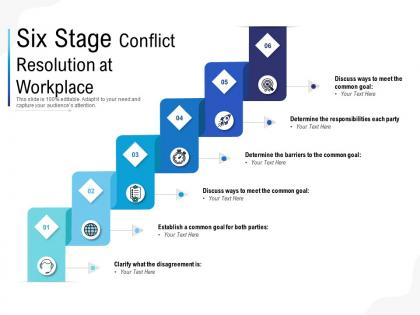
Six stage conflict resolution at workplace




Try Before you Buy Download Free Sample Product
 Impress Your
 Audience
 100%
100% Editable
 Save Hours
 of Time


Our Six Stage Conflict Resolution At Workplace are topically designed to provide an attractive backdrop to any subject. Use them to look like a presentation pro.
People who downloaded this PowerPoint presentation also viewed the following :
Six stage conflict resolution at workplace with all 2 slides:
Use our Six Stage Conflict Resolution At Workplace to effectively help you save your valuable time. They are readymade to fit into any presentation structure.
FAQs for Six stage conflict
The most common causes of team conflict include poor communication, unclear roles and responsibilities, competing priorities, personality clashes, and resource constraints. These issues often escalate when team members lack alignment on goals or processes, with many organizations finding that proactive conflict resolution training and clear governance structures significantly reduce workplace tensions while enhancing collaboration.
Active listening techniques improve conflict resolution by demonstrating respect, building trust, and ensuring all parties feel heard and understood. Through focused attention, reflective responses, and asking clarifying questions, mediators and participants can identify underlying concerns, reduce emotional tensions, and find common ground more effectively, ultimately leading to more sustainable agreements and stronger working relationships.
Emotional intelligence enables dispute managers to recognize, understand, and regulate emotions in themselves and others, facilitating more effective communication and problem-solving during conflicts. Through enhanced empathy and social awareness, mediators and team leaders can de-escalate tensions, identify underlying concerns, and guide parties toward collaborative solutions, ultimately delivering stronger relationships and sustainable resolutions.
Effective strategies for mediating conflicts include active listening, establishing ground rules, identifying underlying interests, facilitating open dialogue, and focusing on collaborative solutions rather than positions. These approaches work by creating neutral environments, encouraging perspective-sharing, and building mutual understanding, with many organizations finding that structured mediation processes ultimately deliver improved team dynamics and enhanced workplace productivity.
Cultural differences significantly impact conflict resolution by influencing communication styles, decision-making processes, hierarchy preferences, and relationship dynamics within organizations. While Western approaches often emphasize direct negotiation and individual accountability, many Asian and Latin cultures prioritize collective harmony and face-saving measures, with successful multinational companies finding that culturally adaptive mediation strategies ultimately enhance team cohesion and operational effectiveness.
Conflict resolution frameworks include mediation models, the Thomas-Kilmann assessment, interest-based negotiation, restorative justice approaches, and structured dialogue processes. These methodologies streamline disputes by identifying root causes, facilitating open communication, and creating collaborative solutions, with many organizations finding that systematic approaches ultimately deliver faster resolutions and stronger workplace relationships.
Leaders foster open communication cultures by establishing regular feedback channels, implementing transparent decision-making processes, encouraging diverse perspectives, and creating psychological safety for team members to voice concerns. Through active listening practices, scheduled one-on-ones, and team forums, organizations streamline conflict prevention while enhancing trust and collaboration, with many companies finding that proactive communication ultimately reduces workplace tensions and delivers improved productivity.
Unresolved workplace conflicts lead to decreased productivity, increased employee turnover, damaged team relationships, reduced morale, and potential legal issues. These disruptions create cascading effects throughout organizations, with many companies finding that persistent conflicts ultimately compromise customer service quality, innovation capacity, and competitive advantage while significantly increasing recruitment and training costs.
Constructive conflict focuses on issues rather than personalities, encourages open dialogue, and seeks collaborative solutions that benefit the organization. Destructive conflict becomes personal, creates hostile environments, and damages relationships without resolution. In workplace settings like project teams or board meetings, constructive disagreements ultimately enhance decision-making and innovation, while destructive patterns erode trust and productivity.
Positive conflict reframing techniques include perspective shifting, focusing on shared goals, separating people from problems, identifying underlying interests, and reframing positions as collaborative opportunities. These approaches transform adversarial situations by encouraging solution-oriented dialogue, building mutual understanding, and creating win-win scenarios, with many organizations finding that structured reframing ultimately enhances team cohesion and drives innovation.
Personal biases can significantly undermine conflict resolution by distorting perception of facts, favoring certain parties, misinterpreting communication styles, and limiting solution options based on preconceived assumptions. These cognitive barriers often lead mediators and participants to overlook viable compromises, escalate tensions unintentionally, and create unfair outcomes, with many organizations finding that bias-aware training ultimately enhances resolution effectiveness and workplace harmony.
Collaborative problem-solving in conflict situations delivers improved relationships, creative solutions, shared ownership of outcomes, enhanced communication, and sustainable resolutions. Through joint brainstorming and shared decision-making, organizations streamline workplace disputes, enhance team dynamics, and minimize recurring conflicts, with many businesses finding that collaborative approaches ultimately reduce costs while strengthening long-term partnerships.
Neutral language contributes to conflict resolution by reducing emotional triggers, preventing escalation, and creating space for productive dialogue between conflicting parties. This approach enables mediators and organizations to facilitate clearer communication, minimize defensive reactions, and build mutual understanding, ultimately delivering faster resolutions and stronger working relationships across teams.
Feedback serves as a crucial communication bridge in interpersonal disputes by clarifying misunderstandings, expressing underlying concerns, and creating mutual awareness of different perspectives. Through structured feedback sessions, organizations enable employees to address issues directly while maintaining professional relationships, with many HR departments finding that regular feedback mechanisms significantly reduce workplace conflicts and enhance team collaboration.
Conflict resolution training enhances team dynamics by improving communication skills, building emotional intelligence, establishing clear problem-solving frameworks, and fostering collaborative approaches to disagreements. Through structured workshops and role-playing scenarios, organizations streamline workplace tensions, reduce project delays, and ultimately deliver stronger team cohesion, with many companies finding significantly improved productivity and employee satisfaction.
No Reviews