

Strategic Plan Template For Business Success





Try Before you Buy Download Free Sample Product
 Impress Your
 Audience
 100%
100% Editable
 Save Hours
 of Time


Looking for the perfect designs for your business presentation if yes then we have this business strategic plan PowerPoint templates. This wonderful crafted presentation slide has been designed by our team of skilled designers with the knowledge of delivering the best when it comes to meet your presentation need. Strategy is the most important aspect of any business as you have to formulate a strategy, implement it and then evaluate and control. Using this business strategic plan PPT layout, you can manage the work effectively. Some crucial facets such as purpose, key objectives, initiatives, key performance indicators are provided in this PowerPoint shape which you can share as available or can make changes according to your need. A company that is growing needs to have a set of strategies that make them achieve their objectives. Strategic plan enables you to let your stakeholders understand the organization in a better way i.e. the challenges, opportunities etc. Today every organization is cautious against strategic planning as this is the way to develop the business. So, download this PowerPoint layout and make some of the best business strategies and see the difference. Frauds get exposed with our Business Strategic Plan Template Powerpoint Guide. Folks will believe the facts that emerge.
People who downloaded this PowerPoint presentation also viewed the following :
Content of this Powerpoint Presentation
Description:
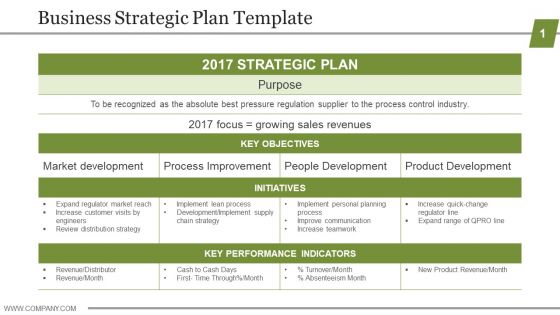
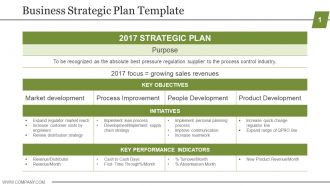
The image is of a PowerPoint slide titled "Business Strategic Plan Template." This slide is a structured framework for outlining a business's strategy for a specific year, in this case, 2017.The template is divided into several sections:
1. 2017 Strategic Plan:
This is the overarching theme of the slide, setting the stage for the content.
2. Purpose:
The stated purpose is for the company to be recognized as the best pressure regulation supplier in the process control industry.
3. 2017 Focus:
The focus for the year is on growing sales revenues.
4. Key Objectives:
The objectives are categorized into four areas – Market Development, Process Improvement, People Development, and Product Development.
5. Initiatives:
Under each objective category, there are specific initiatives listed, such as expanding market reach, implementing lean process development, improving communication, and increasing the quick-change regulator line.
6. Key Performance Indicators (KPIs):
The slide lists several KPIs to measure progress, such as Revenue/Distributor, Cash to Cash Days, % Turnover/Month, and New Product Revenue/Month.
Use cases:
Strategic plan templates are crucial for aligning goals, setting clear objectives, and measuring progress across various industries.
1. Technology:
Use: Aligning product development with market needs.
Presenter: Chief Technology Officer.
Audience: Product Teams, Investors.
2. Healthcare:
Use: Planning healthcare services expansion and process improvement.
Presenter: Healthcare Administrator.
Audience: Medical Staff, Stakeholders.
3. Education:
Use: Setting institutional objectives and initiatives for development.
Presenter: School Principal or University Dean.
Audience: Faculty, Educational Board.
4. Finance:
Use: Outlining new financial product launches and market strategies.
Presenter: Financial Strategist.
Audience: Investment Teams, Shareholders.
5. Manufacturing:
Use: Implementing efficiency improvements and product line expansions.
Presenter: Operations Manager.
Audience: Manufacturing Staff, Supply Chain Partners.
6. Retail:
Use: Expanding market reach and improving sales processes.
Presenter: Retail Manager.
Audience: Sales Teams, Marketing Department.
7. Real Estate:
Use: Developing property portfolio strategies and growth initiatives.
Presenter: Real Estate Developer.
Audience: Investors, Real Estate Agents.
Strategic Plan Template For Business Success with all 5 slides:
Inform folks of their inheritance with our Business Strategic Plan Template Powerpoint Guide. Acquaint them with their great culture.

FAQs for Strategic Plan Template
Hey! Start with the basics - executive summary, mission/vision stuff, and a SWOT analysis (situational analysis sounds so corporate, ugh). Then map out your strategic objectives with actual measurable goals, not just fluffy statements. Action plans need timelines and clear ownership - like who's actually doing what. Metrics for tracking progress are crucial too. Budget section is mandatory because finance will definitely ask. Honestly, I'd grab a simple template first and just tweak it for your company's style. Way easier than building from scratch.
Honestly, those templates are just starting points - don't feel locked into them. First thing I'd do is swap out the mission/vision stuff with your actual company values. Then mess around with the goal sections based on your industry. Like if you're in healthcare, throw in compliance tracking. Manufacturing? Add sustainability metrics or whatever makes sense. The timeline parts are pretty flexible too, which is clutch since every company plans differently. Oh, and definitely update the stakeholder sections to match how your org actually works. Add your specific KPIs while you're at it. Basically treat it like a rough framework, not some sacred document you can't touch.
Honestly, start with clear goals that actually match what your company's trying to do - gives everyone something to aim for. Include the basics: where you're at now, SWOT analysis, main projects, deadlines, and how you'll measure success. But seriously, don't make it some massive 50-page monster that'll just collect dust. Simple language works best so teams can actually refer to it when they're planning stuff. Oh, and create a one-page version too - trust me, you'll need it for meetings when people want the quick overview.
Honestly, templates are a lifesaver because everyone's on the same page from the start. No more "wait, what format are we using?" conversations that waste half the meeting. You can slice up different sections for different people - board gets the financial stuff, marketing team sees their goals, whatever. Way less messy than reinventing the wheel every single time. Plus people know exactly where their input belongs instead of just throwing random comments everywhere. Oh, and here's a tip I learned the hard way - don't send the whole document at once. Just share the relevant bits with each group. You'll actually get useful feedback instead of people skimming through sections that don't even apply to them.
Mix leading indicators (stuff that predicts what's coming) with lagging ones (results after things happen). Customer acquisition cost, revenue growth, employee satisfaction - those work well. Honestly, don't go crazy with too many metrics or you'll drown in data. Pick 3-5 that actually connect to your main goals. Each one needs a starting point, target, and deadline. The key thing? Choose metrics that'll change how people act and make decisions. Not just numbers that look pretty in presentations - those are useless.
Dude, seriously - visuals are a game changer for strategic plans. Nobody wants to read through pages of dense text (I sure don't). Charts and graphs make complex data actually understandable at a glance. Colors help highlight what's important, timelines show urgency, icons make everything easier to navigate. I've watched so many text-heavy plans get ignored because they're just boring to look at. Dashboards are great for tracking progress too. Start simple - throw in some charts for your key metrics and maybe a visual timeline. Oh, and visual hierarchy helps guide people through your content without them getting lost halfway through.
So SWOT analysis is basically your reality check before diving into any big strategic planning. You map out Strengths, Weaknesses, Opportunities, and Threats - sounds simple but it's clutch. Honestly, I've seen so many people skip this step and then their whole plan crumbles later. Use what you find to set goals that actually make sense for where you're at. The key? Don't sugarcoat anything during your assessment. Being brutally honest now saves you from headaches when you're trying to execute later. It's one of those foundational things that seems obvious but... yeah, people still skip it constantly.
Start with quarterly check-ins - they're a lifesaver for most teams. Your template needs sections that straight-up ask "what's changed?" and "what assumptions are we wrong about now?" Honestly, treat it like updating your route when there's unexpected traffic (yeah, I know, but it works). Make flexibility part of the design from day one. Throw in scenario planning sections. Keep goals specific enough to matter but flexible enough so you can pivot when everything goes sideways. Oh, and actually show up to those review meetings - half my friends schedule them then skip them.
Honestly, the worst thing you can do is treat those templates like Mad Libs - just filling in blanks without thinking. You end up with cookie-cutter goals that have nothing to do with your actual business. I've watched teams waste entire weeks obsessing over fonts and colors instead of, you know, actually planning anything meaningful. Don't copy metrics from other companies either. Just because they track customer acquisition costs doesn't mean that's what matters for your situation. Templates should spark your thinking, not do it for you. Figure out your real problems first, then let the template help you organize everything into something coherent.
Honestly, ditch those static Word docs that nobody ever looks at again. Tools like Notion or Monday.com let your whole team update stuff in real-time, which is actually pretty game-changing. You can set up dashboards to track your KPIs automatically too – way better than those quarterly spreadsheet updates we all hate. There's even AI now that spots gaps in your planning (though I'm still figuring that part out myself). Just don't go overboard with tech. Pick one solid platform your team will actually stick with instead of trying to connect everything at once.
Make it clean and scannable first - bullet points, headers, tons of white space. Nobody reads walls of text anymore. Skip the corporate speak that puts people to sleep. Here's the thing though - explain WHY behind each priority, not just what you're doing. People won't care unless they get the reasoning. Oh, and don't send the same version to everyone. Your board wants different stuff than your team does. Actually talk about it after you send it out. I've seen too many strategic plans get emailed once then die in people's inboxes.
Honestly, those templates are super helpful for breaking down your big sustainability goals into smaller chunks that don't feel overwhelming. You can set quarterly milestones that actually work with your schedule instead of these vague "someday" targets. Plus everyone stays on the same page about what you're prioritizing - trust me, that alone prevents so many arguments down the road. The built-in check-ins are clutch too because you'll catch problems early instead of realizing two years later that nothing's working. Oh, and start with just 2-3 metrics you can actually track consistently. Don't go overboard at first.
So basically, non-profits are all about mission stuff - donor relationships, volunteer coordination, community impact metrics. For-profits? They're laser-focused on revenue, market share, beating competitors. Both have strategy sections obviously, but the whole vibe is different. Non-profit templates talk about "stakeholder engagement" while business ones are straight up about profit margins and shareholder returns. Honestly, just get the right template from the start. I tried adapting a business one for a charity once and it was such a pain - way easier to find one that actually fits your org type.
Quarterly reviews are your sweet spot - that's when you'll catch market shifts before they mess up your goals. The template itself doesn't really change much, it's more about updating what's inside. Annual updates though? That's when you might need to restructure things, add new sections, or honestly just cut stuff that isn't working. I always tell people to set those calendar reminders right now because when you're swamped (which, let's be real, is always), these reviews are the first thing to get pushed aside. But they're what keep you from wandering off course completely.
McKinsey's 7S model is a solid starting point, plus balanced scorecard frameworks. Sites like Smartsheet and Monday.com have customizable templates - though honestly, I've watched people overthink this and just use Google Docs instead. SWOT analysis templates are key for assessment stuff. For tracking everything, Asana or Trello work great. Oh, and here's what I'd actually do: grab 2-3 different templates and steal the best parts from each. Way better than trying to force one template to do everything. Sometimes the simplest approach wins.
-
Appreciate the research and its presentable format.
-
Commendable slides with attractive designs. Extremely pleased with the fact that they are easy to modify. Great work!