


Strategy and tactics matrix





Try Before you Buy Download Free Sample Product
 Impress Your
 Audience
 100%
100% Editable
 Save Hours
 of Time


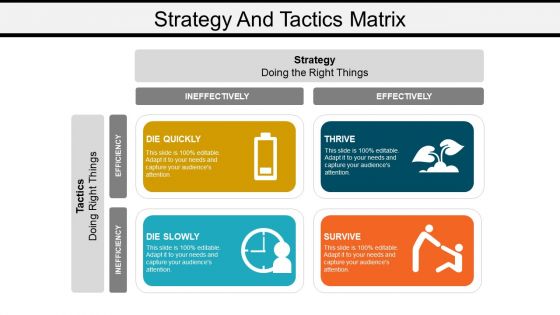
Download our strategy and tactics matrix PowerPoint slides to present the revenue growth of your organization effectively. We have designed various strategy and tactics planning PPT slides to represent whether your business strategy is effective or ineffective or your tactics are efficient or inefficient. Our strategy and tactics methods PPT layouts also remove the confusion between the fundamental difference of strategy and tactics as strategy stresses on doing the right things and tactics emphasize on doing things right. Our strategy and tactics matrix showcase whether your plans are executed efficiently or not. Besides that, our PPT slideshows describe that your organization will thrive or die quickly if your tactics are effective and it will thrive or survive if your strategy is effective. Save your time using our readymade strategy and tactics matrix PPT layouts for an appealing presentation. Calculate greater profits with our Strategy And Tactics Matrix. Multiply your income of accolades and earnings.
People who downloaded this PowerPoint presentation also viewed the following :
Strategy and tactics matrix with all 5 slides:
Dig out gems with our Strategy And Tactics Matrix. The brilliance of your ideas will come bursting forth.

FAQs for Strategy
Okay so basically strategy is your big picture stuff - like where you want your business to go and why. Tactics are the actual steps you take to get there. Picture this: strategy is deciding you want to climb a mountain. Your tactics would be picking the trail, buying the right boots, planning your daily hikes. Business-wise, maybe your strategy is "dominate our market in 3 years." Then your tactics might be running email campaigns or hitting up industry conferences. Here's what I've learned though - you gotta nail down your strategy first. Otherwise you're just throwing random tactics at the wall and hoping something sticks.
Look, break down your big goals into smaller chunks first - that's your roadmap. Then design tactics that actually hit those specific targets. Most teams totally skip the check-in part (honestly drives me crazy) but you need regular reviews to see if you're drifting off course. Your tactical team has to get the "why" behind what they're doing, not just the tasks. Set quarterly reviews to see if tactics are moving the big picture forward. Think of it like a decision tree - every move should trace back to your main strategy. Otherwise you're just busy being busy, which... we've all been there.
Honestly, separating strategy from tactics is a game changer. Write down your main goal first - that's your strategy. Then look at what you're actually doing day-to-day and ask "does this get me closer to my goal?" You'll be shocked how much busy work you can cut. Your team gets it too when they understand the bigger picture. They won't bug you for every little decision because they know what you're aiming for. I learned this the hard way after spinning my wheels for months on stuff that didn't matter. Map your current tactics against your strategy and see what's actually worth your time.
Look, SWOT is where you gotta start with that strategy framework thing. It's like taking inventory of what you've got working for you and what's screwing you over - both inside your company and in the market. Without knowing your actual strengths and weaknesses, plus what opportunities are out there, you're just guessing at strategy. That's how companies end up doing dumb stuff like expanding when they should be fixing their core problems first. The whole point is getting a realistic picture so you can decide whether to go aggressive or play it safe. Do this before you even think about tactics - trust me on this one.
Honestly, you'll want to track both the quick wins and the long-term stuff. Pick 3-5 solid metrics for each thing you're doing - engagement rates, conversions, whatever makes sense. Some strategies are painfully slow to show results though, just warning you! Set up a basic dashboard so you can actually see if your tactics are hitting their targets. Check in weekly or monthly (I'd go monthly unless things are moving fast). The trick is connecting your day-to-day activities to the bigger picture outcomes like revenue or customer happiness. Roll everything up so you get the full strategic view, not just scattered data points.
Ugh, the worst thing companies do is label everything "strategic" when it's just regular work stuff. Like, calm down Karen, updating the website isn't strategic planning. Teams also bounce between big-picture thinking and daily tasks without connecting the dots - or they skip the vision part entirely because tackling your to-do list feels more satisfying. Plus you get this annoying situation where executives dream up grand plans while everyone else figures out logistics, so nothing actually lines up. Quick test though: before jumping into any project, just ask yourself if it actually gets you closer to where you want to be long-term.
Yeah, definitely adjust your tactics based on what's happening in the market. Your main strategy stays the same - that's your end goal. But how you get there? That's gotta be flexible. Market changes, competitors doing weird stuff, economic shifts - all that can mess with your execution timeline or where you put your resources. Actually, I think the best leaders are the ones who can roll with these changes without getting distracted from the bigger picture. Just keep watching those external signals and be ready to pivot your approach quickly. The destination doesn't change, but the route might.
Honestly, just separate your strategy talks from your tactical stuff completely. Do quarterly all-hands meetings for the big picture vision and "why we're doing this" conversations. Weekly standups and sprint planning should cover the nitty-gritty how-to stuff. The trick is being really obvious about which one you're discussing. I've watched so many meetings turn into total chaos because half the room is talking long-term strategy while everyone else is worried about this week's deliverables. Literally label everything - "Strategic Update" or "Sprint Goals" so people know what headspace to be in. Trust me, it works.
Match your metrics to what you're actually measuring - that's the key thing. Long-term strategy stuff needs bigger picture numbers like market share or customer lifetime value over months/years. Tactical execution? Track the day-to-day things - sprint velocity, task completion, weekly budget stuff. I made this mistake before and couldn't figure out if we sucked at doing things or if our whole plan was wrong lol. Keep them separate but make sure your short-term numbers actually support the bigger goals. Dashboards help tons - you'll want both views so you can adjust when things go sideways.
So it's basically like having a GPS for your company - you know where you're headed but can take detours when needed. The cool thing is your teams can switch up their day-to-day moves without losing the big picture. Way faster decisions, less red tape nonsense. Instead of rigid rules, think guardrails. Market changes? New opportunity pops up? People can adapt right away instead of waiting around for approvals. Oh, and you gotta set clear boundaries - like when someone can just go for it versus when they need to check with the boss first. Makes everything flow better.
So here's the thing - startups need to move way faster than big companies. You're looking at quarterly strategy checks with weekly tactical shifts because honestly, everything's changing constantly. Big enterprises? They can do annual strategic planning with monthly tweaks since they've got more stability. The real difference is startups are still figuring out what works while enterprises are just making existing stuff better. I've watched so many startups try copying corporate playbooks and it's painful - they just get stuck. Start with 2-3 main strategic areas, then test different tactics quickly under each one. Keep it simple.
So most teams I know mix different tools depending on what they're doing. Miro and Mural work really well for the visual stuff - mapping out your big strategy and connecting it to actual tactics. For execution though? Monday.com and Asana are solid because you can break everything down into real tasks with deadlines. Honestly, some of the smartest people I work with still just use Excel or Google Sheets (which feels almost retro now but whatever works). The trick is finding something where your team can see both levels - the high-level strategy AND the day-to-day stuff. Just start with whatever everyone already knows.
Okay so basically you want to stress-test your tactics by running them through different scenarios, but keep your main strategy locked in. Like, imagine you're planning for three different ways next quarter could go - best case, worst case, whatever. Your big picture goal stays the same, but you sketch out different tactical moves for each situation. That's honestly the part most people mess up - they change everything when things get weird instead of just adjusting the "how" while keeping the "what" and "why" solid. I'd start simple though. Pick 2-3 realistic scenarios and map out your options for each one.
Honestly, you really need those stakeholders involved from the start - otherwise you're just planning in a vacuum. They'll catch things you totally missed and give you that buy-in that makes everything run smoother later. Map out who your key people are first, then build in regular check-ins with them throughout the whole process. Don't just ask for their input at the end as some checkbox exercise. They're the ones who know what'll actually work in practice vs. what sounds good on paper. Both the big picture strategy stuff AND the nitty-gritty details - they help with all of it.
Innovation is this constant push and pull between your big picture plans and day-to-day execution. New tech can flip your entire business model overnight - just look at what AI did to like, everything. But smaller tactical tweaks help you nail whatever strategy you've already got going. Here's what's weird though: breakthroughs can start anywhere. Your team might stumble on some random approach that works so well it changes your whole direction. Or you pivot strategically and suddenly need completely different methods to pull it off. Just keep testing stuff at both levels. Let the small wins inform your bigger decisions - that's where the magic happens honestly.
-
This is attractive and mesmerizing slides to take for any work related to different official work and educational task.
-
Great product with effective design. Helped a lot in our corporate presentations. Easy to edit and stunning visuals.
-
The content is very helpful from business point of view.