


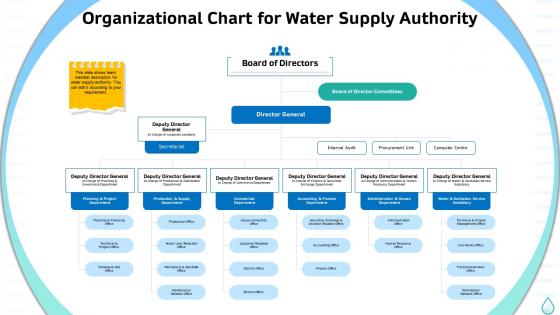
Sustainable water management organizational chart water supply authority




Try Before you Buy Download Free Sample Product
 Impress Your
 Audience
 100%
100% Editable
 Save Hours
 of Time


Our Sustainable Water Management Organizational Chart Water Supply Authority are topically designed to provide an attractive backdrop to any subject. Use them to look like a presentation pro.
People who downloaded this PowerPoint presentation also viewed the following :
Sustainable water management organizational chart water supply authority with all 6 slides:
Use our Sustainable Water Management Organizational Chart Water Supply Authority to effectively help you save your valuable time. They are readymade to fit into any presentation structure.





FAQs for Sustainable water management organizational chart
Look, water management basically comes down to not using more than what gets naturally replaced. Conservation is huge - audit what you're using first, that's where you'll find the biggest wins. Recycling wastewater helps a ton too. Oh, and keeping pollution away from sources is pretty obvious but people mess it up constantly. Planning for droughts and floods matters since weather's getting weirder. I know it sounds like a lot but honestly? Just treat water like it's actually limited instead of pretending it's endless. That mindset shift alone fixes most problems.
Look, you've got to hit this from both angles. Increase your supply with rainwater collection and greywater systems, but also cut demand with efficient fixtures and tiered pricing - honestly, nothing changes behavior like hitting people's wallets. Smart meters are clutch because they show real-time usage data. Oh, and permeable pavement helps with stormwater too (random but effective). I'd start by figuring out where you're bleeding the most water, then focus on fixes that'll pay for themselves quickest. The pricing strategy really works though - heavy users suddenly care about conservation when their bills spike.
So green infrastructure is just copying what nature already does - but way better than boring concrete systems. Think rain gardens, permeable pavement, wetlands, urban forests. They soak up stormwater instead of letting it flood everywhere. Plus they filter out nasty pollutants and recharge groundwater naturally. Honestly, I think they look prettier too than gray concrete everywhere. You get bonus stuff like wildlife habitat and cleaner air. If you're planning any water projects, just map out where you could ditch the traditional pipes for these natural options instead.
Dude, the tech stuff for water is actually pretty cool. Smart sensors can catch leaks instantly - and apparently cities waste like 30% of water just from leaks nobody knows about, which is nuts. IoT sensors do real-time monitoring, irrigation systems check weather forecasts automatically, and AI figures out usage patterns. Smart meters show exactly where you're wasting water too. Honestly? If your company's thinking about this, just start with basic monitoring systems first. They'll give you the data foundation you need. Everything else builds from there, but you can't optimize what you can't measure.
Dude, climate change is totally screwing with water systems. Some places are getting slammed with floods while others can't catch a break from drought - there's no middle ground anymore. Reservoirs are evaporating faster because of the heat, plus farmers need way more irrigation water. Coastal cities? Their freshwater is getting contaminated by rising seas. The worst part is you can't predict anything - how do you build infrastructure when the weather's this unpredictable? My cousin works in city planning and says it's a nightmare. You've gotta start factoring climate projections into any long-term water planning now.
Dude, community engagement is seriously where it's at for water management. Locals know their neighborhood's weird quirks way better than some city planner sitting in an office downtown. Get them involved in the actual planning and they'll buy into conservation efforts instead of ignoring them. I've watched this play out in a few pilot programs - it's honestly pretty cool to see. People report problems faster when they feel heard. You get better info, more compliance, and sometimes residents come up with solutions nobody else thought of. Just start with neighborhood meetings to figure out what's bugging people most about water issues.
So there's a bunch of stuff you can do here. Buffer zones around waterways work really well - they basically filter out all the bad stuff before it reaches streams. Industrial discharge needs way stricter rules too. The agriculture thing is honestly massive since farms dump so much fertilizer and pesticides everywhere. Wetland reconstruction helps a ton for restoration, plus you gotta get rid of invasive species messing things up. Oh and sustainable farming practices are clutch. Really it's about hitting the problem from every direction - stopping pollution at the source, better regulations, and actually fixing damaged areas.
Oh yeah, sustainable farming is actually pretty smart about water. Drip irrigation and crop rotation cut down on waste big time. Cover crops help too - they make soil hold onto moisture way better. Those massive monocultures are honestly the worst for sucking up groundwater. You'll see less runoff with healthier soil, which means aquifers get recharged instead of depleted. Precision agriculture is probably your best starting point for research. Some farms are cutting water use by like 20-30% without losing their yields, which is wild.
So there are basically three things that actually work: mandatory efficiency standards, pricing that goes up with usage (companies hate this but it works), and discharge rules with real teeth. Honestly, the pricing thing is where you'll see companies suddenly care about conservation - funny how money changes everything. Tax breaks for recycling infrastructure help too, plus making companies report their water usage publicly. Check what's already happening in your area first, then figure out where the biggest gaps are. Mix of punishment and rewards usually does the trick.
So basically you want to treat wastewater like an actual water source instead of just something to get rid of. First thing - map out where your water goes and figure out what you could swap for treated wastewater. Irrigation's the obvious one, but industrial cooling works too. Hell, with good enough treatment you can even make it drinkable again. Grey water systems aren't nearly as complicated as people make them sound, especially for smaller setups. Just match your treatment level to what you're using it for. The annoying part? Getting permits and convincing people it's safe. But honestly, you're cutting water use AND waste output at the same time, which is pretty solid.
Honestly, it's mostly about money and basic infrastructure. Most developing countries just don't have the cash upfront for treatment plants and all those pipes. Rural areas get screwed over the worst since they're crazy expensive to connect. Governments end up prioritizing other stuff that seems more urgent - can't really blame them. They also don't have local experts, so they're stuck hiring pricey consultants from abroad. The smart move is starting small with community-run solutions people can actually fix when they break, instead of going straight for the fancy tech that'll just sit there broken in five years.
Water campaigns actually work pretty well when they make it personal, you know? Like showing people their exact impact instead of just saying "save water" - that's way too vague. The smart ones use social pressure too ("your block used 15% less last month"). People respond better when they see immediate benefits rather than just getting lectured about the environment. Honestly, guilt doesn't work as well as making people feel empowered. Focus on specific stuff - shorter showers, fixing leaks, whatever. Makes it feel doable instead of overwhelming.
So there's actually tons of options now for water project funding. Green bonds are everywhere these days - investors love them because they're doing good while making money. Blended finance mixes public and private cash to make things less risky. Oh, and payment for ecosystem services is pretty genius - communities get paid to protect watersheds that naturally clean water. Impact investing and water funds are solid too, where everyone pools resources. Honestly though? Start with your regional development bank - they'll know what's actually available near you instead of just the flashy stuff you read about online.
Honestly, water sharing between countries is tricky but doable. Joint governance is huge - everyone needs equal say or they'll get pissy about decisions. Protect the ecosystems first by keeping minimum water flows and quality standards that work downstream. Small wins build trust, so start with joint research or pollution monitoring before jumping into big allocation deals. Long-term planning matters too - balance what people need now vs. future generations. Oh, and shared data systems help tons. The trick is nobody wants to feel screwed over, so transparency really helps sell these agreements.
Honestly, the ROI is pretty solid - you're looking at major cost savings and way less risk from droughts or supply issues. Your residents will actually be happy with you for once, which is rare in municipal work! Upfront costs pay off through cheaper water treatment and better public health outcomes. Businesses love reliable water access too, so economic development gets easier. Climate change is only making water security more critical anyway. My advice? Find your biggest inefficiencies first - that's where you'll see quick wins and can build support for the larger projects down the road.
-
Amazing product with appealing content and design.
-
Unique design & color.