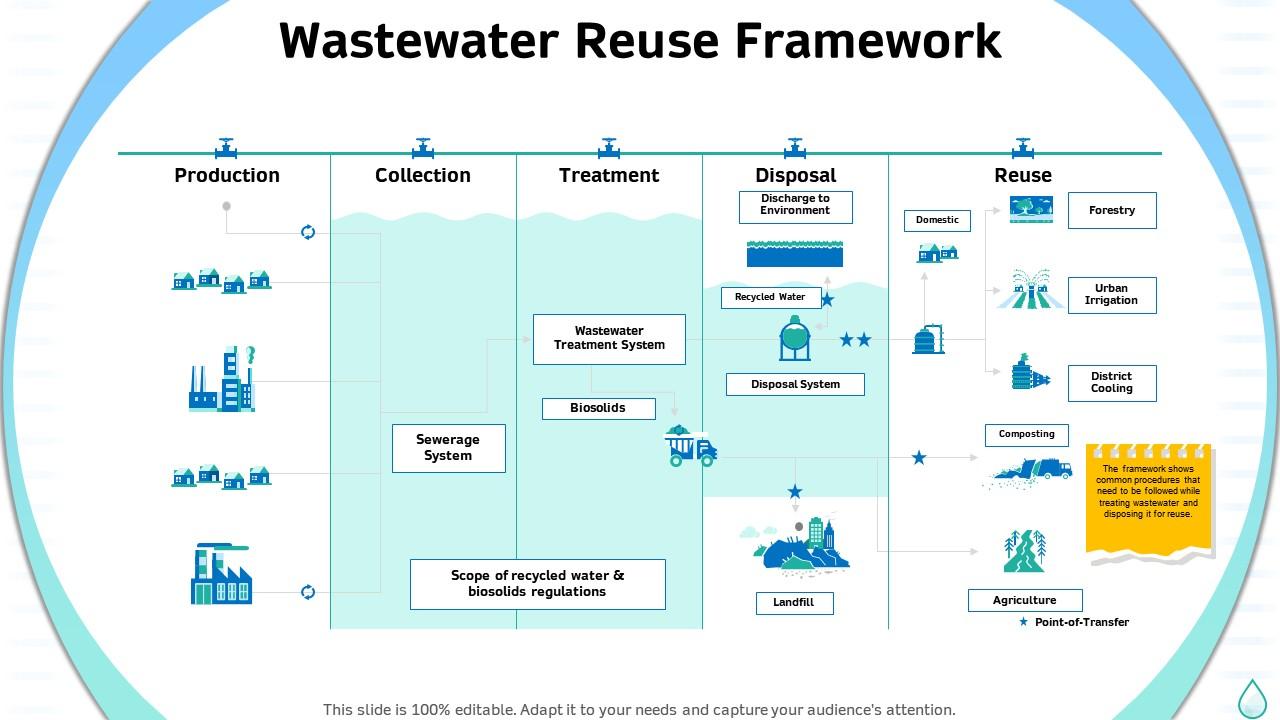
Wastewater reuse framework sustainable water management
Try Before you Buy Download Free Sample Product
Audience
Editable
of Time
Our Wastewater Reuse Framework Sustainable Water Management are topically designed to provide an attractive backdrop to any subject. Use them to look like a presentation pro.
People who downloaded this PowerPoint presentation also viewed the following :
Wastewater reuse framework sustainable water management with all 6 slides:
Use our Wastewater Reuse Framework Sustainable Water Management to effectively help you save your valuable time. They are readymade to fit into any presentation structure.
FAQs for Wastewater reuse framework
Wastewater reuse for agriculture delivers water conservation, cost reduction, nutrient supplementation, and enhanced crop yields through treated effluent application. This strategic approach enables farmers to maintain consistent irrigation during droughts, reduce fertilizer expenses, and improve soil health, with many agricultural operations finding that recycled water systems provide reliable resource access while supporting sustainable farming practices.
Wastewater reuse significantly reduces urban water scarcity by recycling treated effluent for irrigation, industrial processes, and groundwater replenishment, creating additional water sources beyond traditional supplies. Cities like Singapore and Orange County have implemented comprehensive reuse programs, ultimately delivering 30-40% water supply augmentation while reducing dependence on imported water and enhancing long-term resilience.
Wastewater reuse involves primary treatment (screening and sedimentation), secondary treatment (biological processes), tertiary treatment (filtration and disinfection), and advanced treatment technologies like membrane bioreactors and reverse osmosis. These processes enable municipalities and industries to deliver safe, high-quality recycled water for irrigation, industrial cooling, and groundwater recharge, ultimately reducing freshwater demand while enhancing resource sustainability.
Wastewater reuse regulations vary significantly by region, with the US relying on state-specific guidelines, the EU implementing comprehensive water reuse standards, and countries like Australia and Singapore establishing advanced national frameworks. These regulatory approaches balance public health protection with resource sustainability, enabling municipalities and industries to implement strategic water recycling programs while maintaining strict safety standards and environmental compliance.
Public perception of wastewater reuse can be improved through transparent communication, community education programs, demonstration projects, and highlighting successful case studies from municipalities worldwide. By showcasing advanced treatment technologies, emphasizing environmental benefits, and involving local stakeholders in facility tours, water utilities build trust while demonstrating safety standards, ultimately delivering greater public acceptance and support for sustainable water management initiatives.
Wastewater reuse in industrial processes significantly reduces freshwater consumption, minimizes discharge of pollutants into water bodies, and decreases energy requirements for water treatment and transportation. Through advanced filtration and recycling systems, manufacturing facilities, chemical plants, and refineries achieve substantial resource conservation while reducing their environmental footprint, ultimately delivering both cost savings and enhanced sustainability compliance.
Technological advancements enhancing wastewater treatment efficiency include membrane bioreactors, advanced oxidation processes, reverse osmosis systems, UV disinfection, and smart monitoring sensors. These technologies streamline treatment by removing contaminants more effectively, reducing energy consumption, and enabling real-time quality control, with municipalities and industries finding that modern systems deliver higher water quality and lower operational costs.
Wastewater reuse embodies circular economy principles by transforming waste streams into valuable resources, minimizing water extraction, and closing material loops through nutrient recovery. Industries like manufacturing, agriculture, and municipalities increasingly leverage treated wastewater for irrigation, cooling systems, and groundwater recharge, ultimately reducing environmental impact while delivering cost savings and resource security.
Wastewater reuse helps manage stormwater runoff by reducing pressure on drainage systems, providing alternative water sources for irrigation and industrial cooling, and enabling strategic water capture during peak rainfall events. Through advanced treatment technologies, municipalities streamline stormwater infrastructure demands while delivering cost-effective flood mitigation and enhanced water resource management for growing urban areas.
Wastewater reuse mitigates climate change effects by reducing freshwater demand, decreasing energy consumption in treatment processes, and minimizing greenhouse gas emissions from traditional disposal methods. Through advanced treatment technologies, municipalities and industries enhance water security, reduce carbon footprints, and create resilient infrastructure systems, ultimately delivering sustainable resource management and competitive operational advantages.
Large-scale wastewater reuse projects face challenges including high infrastructure costs, regulatory compliance complexities, public acceptance concerns, technical treatment requirements, and maintenance demands. While these obstacles present significant hurdles, many municipalities and industries find that strategic planning, community education, and phased implementation approaches ultimately deliver substantial water security, cost savings, and environmental benefits in increasingly water-scarce regions.
Different treatment methods significantly impact reclaimed water quality, with advanced processes like membrane bioreactors, reverse osmosis, UV disinfection, and advanced oxidation delivering superior results compared to conventional secondary treatment. These technologies enhance water quality by removing pathogens, pharmaceuticals, and trace contaminants more effectively, with many municipalities and industries finding that strategic combinations ultimately enable safe agricultural irrigation, industrial cooling, and potable reuse applications.
Investing in wastewater reuse infrastructure presents both significant upfront costs and substantial long-term economic benefits, including reduced water procurement expenses, lower discharge fees, and decreased regulatory compliance costs. Many municipalities and industries find that these systems deliver operational savings of 20-40% within five years, while creating new revenue streams through treated water sales, ultimately providing competitive advantage in water-scarce regions.
Cities integrate wastewater reuse by implementing advanced treatment facilities, establishing dual distribution systems, creating regulatory frameworks, and developing public-private partnerships for sustainable infrastructure. Through strategic planning, municipalities streamline water resource allocation, reduce dependency on freshwater sources, and enhance operational efficiency, with many urban centers finding that comprehensive reuse programs deliver cost savings while strengthening water security.
Successful wastewater reuse programs demonstrate the importance of phased implementation, community engagement, regulatory compliance, and technology integration for sustainable outcomes. Singapore's NEWater, Israel's national program, and California's initiatives show that strategic partnerships, public education, and advanced treatment technologies enable organizations to achieve water security, reduce costs, and enhance environmental sustainability while building public trust.
-
Very well designed and informative templates.
-
Use of different colors is good. It's simple and attractive.