

System integration ppt infographic template





Try Before you Buy Download Free Sample Product
 Impress Your
 Audience
 100%
100% Editable
 Save Hours
 of Time


Our System Integration Ppt Infographic Template make the environment conducive. Folks become more accepting.
People who downloaded this PowerPoint presentation also viewed the following :
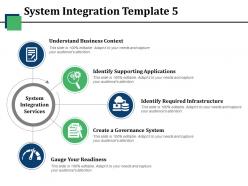
System integration ppt infographic template with all 5 slides:
Our System Integration Ppt Infographic Template are like Father Christmas. They ensure you get the gifts you desire.



FAQs for System integration
**INPUT**: What are the key benefits of effective system integration for businesses? **OUTPUT**: Effective system integration delivers enhanced operational efficiency, streamlined data flow, reduced redundancies, improved decision-making capabilities, and significant cost savings across organizations. Through strategic integration, businesses in sectors like healthcare, finance, and retail achieve faster customer service, eliminate manual processes, and gain competitive advantages, with many enterprises finding that seamless connectivity ultimately transforms their scalability and market responsiveness.
System integration improves operational efficiency by eliminating data silos, automating workflows, and streamlining communication between departments and technologies. Through centralized platforms, organizations reduce manual processes, minimize errors, and accelerate decision-making, with many financial institutions and healthcare systems finding that integrated systems deliver faster customer services, lower operational costs, and enhanced competitive advantage.
Middleware acts as a bridge between different applications and systems, enabling seamless communication through message queuing, data transformation, and protocol translation. It streamlines integration by handling complex connectivity challenges, managing data flow between disparate platforms, and ensuring reliable transactions, with many organizations finding that middleware significantly reduces development time while enhancing operational efficiency.
Cloud-based solutions enhance system integration by providing unified platforms, standardized APIs, real-time data synchronization, and scalable infrastructure that eliminates traditional compatibility barriers. Through cloud services, organizations streamline connections between disparate systems, reduce integration costs, and accelerate deployment timelines, with many financial institutions and healthcare providers finding that cloud platforms deliver seamless operational efficiency.
Common system integration challenges include data compatibility issues, legacy system limitations, security vulnerabilities, timeline overruns, and budget constraints. These obstacles often arise when organizations merge disparate technologies, with many enterprises finding that careful planning, phased implementation approaches, and dedicated integration teams significantly streamline the process while minimizing operational disruptions.
Organizations can measure system integration success through key performance indicators including data accuracy rates, transaction processing times, user adoption metrics, cost reduction percentages, and operational efficiency improvements. Many enterprises track specific outcomes like reduced manual processes, faster customer response times, and enhanced cross-departmental collaboration, ultimately delivering measurable ROI and competitive advantage.
Horizontal integration connects systems at the same organizational level, such as linking different departmental software or peer applications, while vertical integration connects systems across hierarchical levels, from operational databases to executive dashboards. Horizontal integration streamlines cross-functional workflows and data sharing, whereas vertical integration enables strategic reporting and decision-making transparency, with many organizations finding that combining both approaches delivers comprehensive operational efficiency and enhanced business intelligence capabilities.
API management facilitates smoother system integration by standardizing data exchange protocols, providing centralized security controls, enabling real-time monitoring, and offering comprehensive documentation for developers. Through effective API governance, organizations streamline connectivity between disparate systems like CRM platforms and inventory databases, while ensuring consistent performance and reducing integration timeframes, ultimately delivering enhanced operational efficiency and scalability.
Security concerns significantly reshape system integration strategies by requiring encrypted data pathways, multi-layered authentication protocols, and comprehensive vulnerability assessments throughout the integration process. Organizations increasingly adopt zero-trust architectures and API security frameworks, with many financial services and healthcare institutions finding that proactive security measures, while adding complexity, ultimately deliver enhanced customer trust and regulatory compliance advantages.
Successful system integration requires thorough planning and assessment, robust API documentation, comprehensive testing protocols, phased implementation approaches, and continuous monitoring frameworks. These practices streamline operations by minimizing downtime, ensuring data consistency, and maintaining security standards, with many organizations finding that strategic integration planning ultimately delivers enhanced operational efficiency and scalability across departments.
Legacy systems can be effectively integrated with modern applications through APIs, middleware solutions, data mapping tools, cloud-based integration platforms, and microservices architecture. These approaches enable organizations to bridge technological gaps while preserving existing investments, with many enterprises in banking and manufacturing finding that strategic integration streamlines operations, reduces costs, and accelerates digital transformation initiatives.
Future system integration trends include AI-powered automation, API-first architectures, cloud-native platforms, microservices adoption, and low-code integration solutions. These technologies streamline connectivity by reducing manual processes, enhancing scalability, and accelerating deployment timelines, with many organizations finding that strategic integration investments ultimately deliver competitive advantages and operational efficiency.
Data consistency ensures integrated systems maintain accurate, synchronized information across all platforms through real-time synchronization, standardized data formats, and robust validation protocols. Financial institutions and healthcare organizations particularly benefit from consistent data integration, as it eliminates discrepancies, reduces errors, and enables seamless workflows, ultimately delivering improved operational efficiency and reliable decision-making capabilities.
Business intelligence transforms system integration by providing unified data analytics, real-time performance monitoring, cross-platform reporting capabilities, and predictive insights that guide integration decisions. Through BI dashboards and analytics tools, organizations streamline data flow between disparate systems, enhance operational visibility, and identify integration bottlenecks, ultimately delivering faster decision-making and improved system performance across enterprise environments.
User training and change management support system integration by building employee competency, reducing resistance to new workflows, and ensuring smooth technology adoption across departments. Through structured training programs and communication strategies, organizations enhance user confidence, minimize operational disruptions, and accelerate time-to-value, with many companies finding that comprehensive change management ultimately delivers higher adoption rates and improved system performance.
-
Visually stunning presentation, love the content.
-
Wonderful templates design to use in business meetings.