

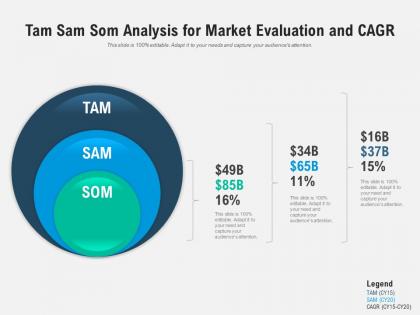
Tam sam som analysis for market evaluation and cagr




Try Before you Buy Download Free Sample Product
 Impress Your
 Audience
 100%
100% Editable
 Save Hours
 of Time


Increase the amount of interaction with our Tam Sam Som Analysis For Market Evaluation And CAGR. Create conditions for frequent gatherings.
People who downloaded this PowerPoint presentation also viewed the following :
Tam sam som analysis for market evaluation and cagr with all 2 slides:
Create conditions for frequent gatherings with our Tam Sam Som Analysis For Market Evaluation And CAGR. Increase the amount of interaction.

FAQs for Tam sam som analysis for market
TAM, SAM, and SOM are like your market-sizing cheat sheet. Start with TAM - that's if literally everyone who could buy your product did (never gonna happen but whatever). SAM cuts it down to who you can actually reach based on where you operate and how your business works. Then SOM is the realistic slice you'll grab considering competitors, your budget, timeline - all that fun stuff. Think of them as circles inside circles getting smaller. Super helpful for figuring out if an idea's worth chasing and setting revenue goals that won't make you look delusional to investors.
There are three ways to tackle TAM - top-down using industry reports, bottom-up from your actual unit economics, or value theory based on what your product's worth. Honestly, bottom-up is your best bet since you're working with real data you actually know. The biggest mistake? Assuming you'll grab 10% of some massive market overnight - that's just not how it works. Start conservative, then build different scenarios from there. Cross-check with multiple methods because one approach alone can mislead you. Oh, and don't forget to update these numbers as you learn more about who's actually buying.
Don't try to be everything to everyone - that's where most companies mess up. Break down your market by what's actually bothering people and how they like to buy stuff. Then create messaging that hits those specific pain points. Find the customers who are already kinda excited about what you're doing and turn them into your biggest fans. They'll do half your selling for you, honestly. Create content that actually addresses their real problems (not generic fluff). Oh, and make sure your sales process isn't fighting against how people want to buy from you. Start with whichever segment gives you the clearest wins first.
Think of SOM as your sanity check when setting sales goals. TAM might show some crazy billion-dollar market (love those flashy deck numbers), but SOM tells you what you can actually grab with your current team and resources. Your geographic limits, product gaps, competition - all that real-world stuff gets factored in. Honestly saved my butt from setting impossible targets that would've destroyed team morale. Start with your SOM number for quarterly goals, then figure out backwards what you'd need to actually hit them. Way more realistic than those pie-in-the-sky projections everyone loves.
Honestly, most people get TAM numbers wrong anyway - they're usually way too optimistic. But here's how I'd actually use this stuff: Start with your SOM (what you can realistically grab right now), then look sideways at adjacent markets in your SAM. Find spots where you already have some edge or your customers overlap. The key is spotting where your product fixes similar problems but for different types of people or use cases. Don't just chase the biggest numbers though. Focus on effort vs. return - some smaller markets might be way easier to crack than the obvious big ones.
Dude, the worst thing startups do is get crazy optimistic with TAM. They'll say "our market is literally every small business!" when realistically they're only targeting tech companies with super specific problems. Also seen way too many pitches using ancient market data - like bro, that report is from 2019. Geographic limits matter too, obviously. Here's what kills me though: the lazy population x average spend formula. Investors hate that garbage. Way better to start small with your actual customer segments and build up from there using real data instead of some massive industry report.
Hey! So industry stuff totally changes how you calculate SAM. Like, if your industry is consolidating fast, your addressable market might actually be shrinking even when demand goes up. Competitive advantages, how companies distribute, regulations - all that filters your TAM down to what you can actually serve. Perfect example: a fintech can't just say "we'll take the whole banking market!" That's nuts. You've got to think about how hard it is for customers to switch, what advantages the big players have, whether you can even access certain segments. Map out the major forces first, then be brutally honest about which parts you can actually crack.
For TAM/SAM/SOM stuff, I'd hit up IBISWorld and Statista first - they're pretty solid for market data. Excel is still my go-to for building the actual models, though Google Sheets works fine too. Crunchbase helps with competitive intel and funding numbers. If you need deeper research, Grand View Research has decent reports but they're pricey. Oh, and don't sleep on free government databases - sometimes they've got exactly what you need buried in there. Start cheap with the free stuff, then shell out for paid tools if you're still missing pieces. PitchBook's great but expensive unless your company already has it.
Look, TAM, SAM, and SOM basically keep you from making dumb money mistakes. TAM is your total potential market, SAM is who you can actually reach, and SOM is what you'll realistically grab. I always tell people to figure out SOM first - it's like knowing your actual budget before you go shopping. Then work backwards from there. This stops you from either playing way too small or blowing your entire budget on campaigns that'll never work. Trust me, I've watched companies burn through cash thinking they could target everyone. Way smarter to focus on your real addressable market and pick channels that actually convert.
Honestly, B2B segmentation is a total pain but you've gotta get way more specific than B2C. Think company size, exact industries, how they actually make purchasing decisions - all that narrows your market fast. Consumer markets? You can usually get away with basic demographics and behavior patterns. The research part kills me though - you'll be digging into procurement cycles and budget stuff forever. Worth it, but ugh. Your SOM calculation gets tricky because B2B sales take months and it's all relationship-heavy, unlike B2C where people just buy. Start with your buyer personas first and work backwards from there.
TAM analysis is perfect for finding those blind spots in your product strategy. Compare your TAM to your SAM - that delta usually shows you segments you're totally missing. Honestly, most teams get way too hyped about massive TAM numbers and miss the real gold. Map out what you're actually building against your TAM breakdown. The biggest unaddressed chunks? That's where you should expand next. Maybe it's adjacent markets, maybe it's use cases you never considered. The key isn't the size - it's figuring out WHY those areas aren't being served yet. That'll tell you if it's worth building new features or going after completely different product lines.
Track your market penetration rate first - that's current revenue against your serviceable addressable market (SAM). Customer acquisition velocity matters too. Revenue growth and lifetime value show if you're actually capturing available market share. Most companies get obsessed with TAM but totally ignore their SAM penetration, which is honestly backwards. Keep an eye on competitive win rates and deal size trends in your serviceable market. Those tell you if you're winning or getting crushed. Calculate your current SAM penetration percentage - everything else builds from there.
Check your TAM/SAM/SOM stuff at least once a year, but quarterly's better if your market moves fast. Markets change quick with new regulations or when competitors do something crazy. Your SOM especially - that one's tied to how well you're actually executing. Major shifts are your cue to refresh everything. New product drops, regulatory changes, big players leaving the space. I've seen too many startups just set these numbers once and never touch them again (terrible idea). Also track when your assumptions start looking off - that's usually when something big shifted and you missed it.
Dude, demographics totally change the game for TAM/SAM/SOM. You stop making those crazy broad assumptions and actually slice things up by age, income, location, company size - whatever matters for your business. Like instead of "everyone drinks coffee," you're looking at "urban professionals 25-45 making over 50k." Way more realistic. Honestly, most people overestimate their market by a mile. I'd start simple - just throw 2-3 demographic filters on top of what you've already calculated. Your numbers will probably shrink, but they'll actually mean something. Better to be realistic than delusional, right?
Look, a solid SOM basically proves you're not just throwing around crazy numbers. Investors hear inflated market size claims all day - it's honestly exhausting for them. But nail your serviceable obtainable market with real data? That's when they actually pay attention. You're showing you get which customers you can realistically grab with your current setup. Smart money loves this because they can finally model actual returns instead of guessing. Don't wing it though - your SOM math needs to be rock solid before you walk into that room. It's the difference between looking legit vs. looking like every other dreamer.
No Reviews