


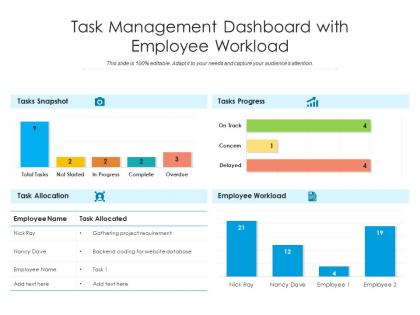
Task management dashboard with employee workload




Try Before you Buy Download Free Sample Product
 Impress Your
 Audience
 100%
100% Editable
 Save Hours
 of Time


Our Task Management Dashboard With Employee Workload are topically designed to provide an attractive backdrop to any subject. Use them to look like a presentation pro.
People who downloaded this PowerPoint presentation also viewed the following :
Task management dashboard with employee workload with all 2 slides:
Use our Task Management Dashboard With Employee Workload to effectively help you save your valuable time. They are readymade to fit into any presentation structure.
FAQs for Task management dashboard
Try the Eisenhower Matrix thing - seriously changed my life. Sort stuff by urgent vs important and you'll stop freaking out over every "emergency" email. I always pick my top 3 priorities each morning, then tackle the worst one first while I'm still functional. Time-blocking is huge too. Like, give each task its own time slot instead of jumping around all day. Oh, and batch similar stuff together - do all your calls at once, answer emails in one go. Just pick something and actually stick with it for a week before you decide it sucks.
Honestly, you should try visual stuff like Kanban boards or Gantt charts - they're game changers. When tasks aren't just floating around in people's heads, everyone can see who's working on what and where things are getting stuck. Moving those little cards from "doing" to "done" hits different too, weirdly addictive. No more constant "what's your status" meetings because it's all right there on the board. I'd start super simple - grab Trello or literally just sticky notes on a wall. You'll notice the difference pretty much immediately.
Honestly, good task management software is like having a bird's eye view of everything happening. You'll see who's doing what, when stuff's due, and where things are getting stuck. No more awkward "I thought you were handling that" conversations - we've all been there! Everyone can actually see how their work fits into the whole project, which is pretty game-changing. My advice? Map out how you currently do things first, then find software that works with your team's style. Don't force your team to completely change how they operate just because some app looks fancy.
So there's this thing called the Eisenhower Matrix that's actually pretty helpful. Four boxes: urgent + important (do now), important but not urgent (schedule for later), urgent but not important (delegate if you can), and neither (just delete those honestly). Each morning I quickly sort my tasks into these buckets. Here's the thing though - most people live in crisis mode with the urgent stuff. The real wins come from that second box where the important-but-not-urgent tasks live. Those are usually what actually matter for your bigger goals. Try to spend like 30% of your time there and you'll feel way more in control.
Honestly, breaking stuff into tiny pieces has saved my sanity more times than I can count. There's this 2-minute rule thing - if it takes under 2 minutes, just knock it out right then instead of writing it down. I swear by time-blocking too, where you actually put tasks on your calendar like appointments. Oh, and those 25-minute Pomodoro sessions work pretty well if you can stick to them. Here's what nobody tells you though - don't start with the "important" stuff. Pick something easy or interesting first to get rolling. Just try one method for a week and see what happens.
Dude, SMART goals are a game changer - they cut through all that mental fog that tanks your productivity. No more staring at "finish the project" wondering what the hell that even means. Break it down: Specific, Measurable, Achievable, Relevant, Time-bound. Like "interview 5 customers about user experience by Friday" instead of some vague mess. I used to procrastinate constantly because everything felt so unclear. Now? Way less mental gymnastics. Honestly, just pick three random tasks from your list and convert them to SMART format. You'll be shocked how much clearer everything becomes.
Honestly, delegation is a game-changer for getting more done. When you spread work around, things happen way faster since everyone's working at once instead of you grinding through everything solo. Match people with what they're actually good at - makes a huge difference. Your team picks up new skills too, which is pretty cool for their growth. I used to think I had to do everything myself, but once I started handing off stuff that didn't need my specific touch, I could focus on the big picture strategy work. Start small with tasks that aren't mission-critical.
Honestly, agile is a game-changer because you're working in these short 2-week sprints where you can actually see stuff getting done. No more being trapped by some plan you made months ago that doesn't make sense anymore. You're constantly reprioritizing based on what's real, not what you thought would matter. The daily check-ins keep everyone on the same page (even if they're boring sometimes). Sprint reviews are clutch - they catch problems early before they blow up. You'll get way better at spotting where things get stuck and what actually needs attention vs. fake urgent stuff. Start with 2-week cycles and watch how much clearer everything becomes.
Honestly, just getting everything out of your head and onto paper changes everything. Your brain stops that constant loop of "wait, what was I supposed to do?" Write down literally everything bouncing around up there right now - even weird random stuff. You'll feel way less overwhelmed once it's all visible instead of this swirling mess in your mind. Plus checking things off gives you these little wins throughout the day. I'm not gonna lie, sometimes I write down tasks I already finished just to cross them off immediately. Don't judge me! But seriously, start with a brain dump and you'll see what I mean.
Yeah, deadlines are tricky. Too tight and you're rushing through everything, skipping the double-checking stuff that actually matters. I hate when that happens - you know your work could be better but there's just no time. On the flip side, having forever to finish something usually means I'll overthink it to death and change things that were fine to begin with. What works for me is breaking the big scary deadline into smaller chunks. That way you're not scrambling at the end but you're also not sitting there tweaking fonts for three hours (guilty). Find that middle ground where you have enough time to do solid work without going down rabbit holes.
Focus on completion rates and whether you're actually hitting deadlines - that's the stuff that matters. Track how many people are using the system too, since a tool nobody touches is pretty useless. I'd throw in measuring your task backlog (hopefully it's shrinking, not growing) and maybe do quick team satisfaction surveys. Oh, and watch how often priorities get shuffled around - that can tell you a lot. Don't go crazy tracking everything though. Pick 3-4 things that make sense for how your team works, then build from there.
Honestly, task reviews are like hitting pause before everything goes sideways. You'll catch bottlenecks early instead of panicking later when deadlines hit. I totally messed this up on my last project - learned real quick that 15 minutes weekly beats crisis mode every time. Plus your team stays on the same page, which is huge. Look at what's finished, what's stuck, and shuffle things around if someone's buried in work. Scope creep loves to sneak in too, so these check-ins help you spot it. Short sessions work way better than those marathon meetings nobody wants.
Honestly? You'll just end up babysitting the app instead of getting stuff done. I learned this the hard way - spent like two weeks tweaking Notion templates when I could've just written tasks on sticky notes. Complex tools are productivity killers. Your brain starts avoiding them because adding a simple task becomes this whole ordeal. Then your teammates hate it too because nobody wants to learn another complicated system. The learning curve alone can wreck your flow for weeks. Best tool is whatever you'll actually open every day without groaning.
Definitely stay on top of your updates and be specific about what you're actually doing. Daily standups are perfect for this - just tell everyone what you finished and what's coming next instead of the usual "everything's fine" nonsense. Honestly, I've watched so many projects blow up because someone didn't mention they were stuck for like a week! Flag problems right away so people can actually help you figure it out. Yeah, update your project management thing, but don't just rely on that. Quick Slack messages catch issues way faster than waiting for someone to randomly check the board.
Honestly, mindfulness is like going to the gym but for your brain. It teaches you to actually stay present instead of bouncing between a million things. I used to be terrible at this, but when you practice catching your wandering thoughts and pulling them back, you get way better at focusing on one task. Plus you start noticing when you're procrastinating or freaking out - then you can just pause and reset instead of spiraling into chaos. Try doing 5 minutes of deep breathing before your hardest task. Sounds simple but it actually works.
-
Graphics are very appealing to eyes.
-
Great quality product.
-
Unique and attractive product design.
-
Excellent products for quick understanding.
-
Helpful product design for delivering presentation.
-
Great product with highly impressive and engaging designs.
-
Visually stunning presentation, love the content.