


Telesales Training Practices With Planning





Try Before you Buy Download Free Sample Product
 Impress Your
 Audience
 100%
100% Editable
 Save Hours
 of Time


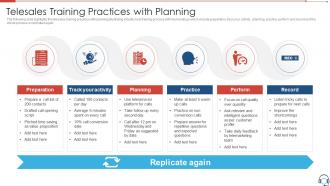
The following slide highlights the telesales training practices with planning illustrating industry best training process with key headings which include preparation, track your activity, planning, practice, perform and record and the whole process is replicated again.
People who downloaded this PowerPoint presentation also viewed the following :
Telesales Training Practices With Planning with all 6 slides:
Use our Telesales Training Practices With Planning to effectively help you save your valuable time. They are readymade to fit into any presentation structure.





FAQs for Telesales Training
Telesales professionals should focus on developing active listening, objection handling, rapport building, product knowledge mastery, and closing techniques during their training. These foundational skills work together to enhance customer interactions, streamline sales processes, and ultimately deliver higher conversion rates, with many organizations finding that well-trained telesales teams significantly outperform competitors in customer acquisition.
Role-playing exercises enhance telesales training by simulating real customer interactions, allowing representatives to practice objection handling, refine communication techniques, and build confidence in a risk-free environment. These interactive sessions enable trainees to experience diverse scenarios, from difficult customers to complex product inquiries, ultimately delivering improved conversion rates and customer satisfaction, with many organizations finding that structured role-play significantly accelerates skill development.
Common telesales objections include price concerns, lack of trust, timing issues, competitor preferences, and perceived irrelevance of the product or service. Effective training addresses these through role-playing scenarios, objection-handling scripts, active listening techniques, and value-proposition development, with many sales teams finding that structured practice sessions and real-time coaching significantly improve conversion rates and customer rapport.
Emotional intelligence proves crucial in telesales by enabling representatives to read vocal cues, manage rejection effectively, build rapport quickly, and adapt communication styles to different customer personalities. Through role-playing exercises, active listening workshops, and feedback sessions, sales teams can cultivate these skills, with many organizations finding that emotionally intelligent representatives achieve higher conversion rates and stronger customer relationships.
Effective telesales training measurement methods include conversion rate improvements, call-to-close ratios, average deal sizes, call duration optimization, and customer satisfaction scores. These metrics enable organizations to track performance gains across sales teams, with many companies finding that combining quantitative results with qualitative feedback delivers comprehensive insights, ultimately enhancing training ROI and competitive advantage.
Technology tools can be integrated into telesales training through CRM simulation platforms, AI-powered call analytics, virtual reality practice environments, automated feedback systems, and performance tracking dashboards. These technologies enhance training effectiveness by providing real-time coaching insights, personalized skill development pathways, and comprehensive performance metrics, ultimately enabling sales teams to accelerate learning curves while delivering improved conversion rates and customer engagement outcomes.
A comprehensive telesales training manual should include product knowledge fundamentals, objection handling techniques, call structuring frameworks, communication skills development, and performance metrics tracking. These components work together by building representative confidence, streamlining customer interactions, and enhancing conversion rates, with many sales organizations finding that structured training approaches ultimately deliver improved call outcomes and sustained revenue growth.
Trainers can tailor telesales training by incorporating visual presentations for visual learners, role-playing exercises for kinesthetic learners, detailed scripts for auditory learners, and structured frameworks for analytical thinkers. This multi-modal approach enhances skill retention and performance outcomes, with many sales organizations finding that personalized training strategies deliver higher conversion rates and improved customer engagement across diverse teams.
Ethical considerations in telesales training include honest product representation, respecting customer privacy, obtaining proper consent for calls, avoiding high-pressure tactics, and maintaining transparent pricing practices. These principles enhance customer trust, reduce legal risks, and improve long-term retention rates, with many organizations finding that ethical approaches ultimately deliver stronger sales performance and brand reputation.
New telesales employees can be effectively onboarded through comprehensive product training, role-playing exercises, shadowing experienced representatives, structured call scripts, and gradual progression from simple to complex sales scenarios. This systematic approach enables faster skill development, builds confidence through practical experience, and streamlines the transition from training to independent selling, with many organizations finding that structured onboarding reduces ramp-up time significantly.
Ongoing coaching reinforces initial telesales training by addressing skill gaps, adapting to market changes, and maintaining performance standards through regular feedback and personalized development. This continuous support enables sales teams to refine their techniques, overcome challenges, and consistently improve conversion rates, with many organizations finding that sustained coaching delivers higher revenue growth and reduced employee turnover.
Trainers can effectively simulate high-pressure sales environments through role-playing with aggressive objection scenarios, time-constrained pitch exercises, mock calls with difficult prospects, competitive sales contests, and rejection-heavy simulations. These methods prepare sales teams by building resilience, improving quick thinking under stress, and developing confident responses to challenging situations, with many organizations finding that realistic pressure training significantly enhances actual performance outcomes.
Organizations should track call conversion rates, average deal size, sales cycle length, customer acquisition costs, and revenue per representative to assess telesales training ROI. These metrics enable businesses to quantify improvements in performance, operational efficiency, and profitability, with many companies finding that well-trained teams deliver significantly higher close rates and customer satisfaction scores.
Customer feedback can be incorporated through call recording analysis, satisfaction survey insights, complaint pattern identification, success story documentation, and real-time coaching adjustments. These approaches enhance training by addressing actual customer pain points, refining scripts based on genuine interactions, and developing role-play scenarios from real situations, ultimately delivering more personalized customer experiences and higher conversion rates.
Global telesales training strategies address cultural differences by incorporating localized communication styles, cultural sensitivity modules, region-specific customer behavior insights, and adaptive sales techniques tailored to diverse markets. Through customized training programs, organizations enhance cross-cultural communication skills, build cultural awareness among sales teams, and develop market-specific approaches, ultimately delivering improved customer relationships and higher conversion rates across international markets.
-
Use of different colors is good. It's simple and attractive.
-
Professional and unique presentations.