


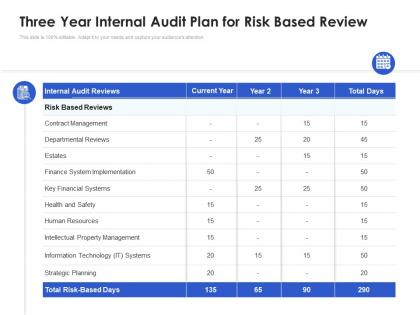
Three year internal audit plan for risk based review




Try Before you Buy Download Free Sample Product
 Impress Your
 Audience
 100%
100% Editable
 Save Hours
 of Time


Our Three Year Internal Audit Plan For Risk Based Review are topically designed to provide an attractive backdrop to any subject. Use them to look like a presentation pro.
People who downloaded this PowerPoint presentation also viewed the following :
Three year internal audit plan for risk based review with all 2 slides:
Use our Three Year Internal Audit Plan For Risk Based Review to effectively help you save your valuable time. They are readymade to fit into any presentation structure.
FAQs for Three year internal audit plan for
Key components of an effective internal audit plan include risk assessment, audit universe mapping, resource allocation, timing schedules, and stakeholder communication frameworks. These elements work together by prioritizing high-risk areas, ensuring comprehensive coverage, and optimizing audit resources, with many organizations finding that strategic planning ultimately delivers enhanced operational efficiency and stronger regulatory compliance across all business functions.
Organizations assess risks when planning internal audits by analyzing operational vulnerabilities, regulatory compliance gaps, financial controls, strategic objectives, and historical audit findings. Through risk matrices and stakeholder input, audit teams prioritize high-impact areas like fraud exposure, process inefficiencies, and regulatory changes, with many finding that this systematic approach ultimately delivers more targeted audits and enhanced organizational resilience.
Risk-based auditing, strategic alignment assessment, regulatory compliance mapping, stakeholder impact analysis, and resource availability evaluation help prioritize audit areas effectively. These methodologies enable organizations to focus on high-risk processes, critical business operations, and compliance requirements, with many internal audit departments finding that this strategic combination delivers enhanced operational efficiency and stronger governance oversight.
Technology enhances internal audit planning through automated risk assessments, data analytics for identifying high-risk areas, digital workflow management, and real-time monitoring capabilities. These tools streamline resource allocation, enable continuous auditing approaches, and provide predictive insights, with many organizations finding that integrated audit management systems ultimately deliver faster planning cycles, improved risk coverage, and enhanced strategic alignment across their audit functions.
Stakeholder input provides crucial insights into organizational priorities, emerging risks, regulatory requirements, and operational challenges that shape comprehensive audit planning. Through structured interviews, surveys, and collaborative sessions with management, board members, and department heads, auditors identify high-risk areas, resource allocation needs, and strategic focus areas, ultimately ensuring audit plans align with business objectives and stakeholder expectations.
Internal audit plans should typically be reviewed quarterly and updated annually, with additional reviews triggered by significant organizational changes, regulatory updates, or emerging risks. This flexible approach enables audit departments to respond to evolving business landscapes, shifting priorities, and new compliance requirements, while maintaining strategic alignment with organizational objectives and delivering maximum value to stakeholders.
Common internal audit planning challenges include resource constraints, inadequate risk assessment, stakeholder alignment difficulties, regulatory compliance complexities, and insufficient organizational knowledge. These obstacles often result from competing priorities, limited budgets, and evolving business landscapes, with many organizations finding that strategic planning frameworks and cross-functional collaboration ultimately enhance audit effectiveness and organizational value.
Internal auditors align their plans with organizational objectives by conducting comprehensive risk assessments, engaging with senior leadership and board members, analyzing strategic business plans, and mapping audit priorities to key performance indicators. Through regular stakeholder consultations and enterprise risk management integration, auditors ensure their work supports strategic goals like operational efficiency, regulatory compliance, and growth initiatives, ultimately delivering targeted insights that enhance decision-making and competitive advantage.
Internal audit plans should consider ISO 31000 for risk management, COSO frameworks for internal controls, IIA standards for audit practices, regulatory compliance requirements, and industry-specific benchmarks. These standards enable organizations to establish comprehensive audit scopes, prioritize high-risk areas, and ensure systematic coverage, with many financial services and healthcare institutions finding that standardized approaches deliver enhanced regulatory compliance and operational transparency.
Continuous auditing integrates into internal audit planning by establishing real-time monitoring systems, automated risk assessments, and data analytics protocols that operate alongside traditional audit cycles. This approach enables auditors to identify anomalies immediately, allocate resources more strategically, and shift from reactive to predictive oversight, ultimately delivering enhanced risk management and operational efficiency.
Resource allocation for internal audits should consider audit complexity, risk levels, team expertise requirements, time constraints, and available technology tools. Organizations typically balance these factors by assigning experienced auditors to high-risk areas, allocating additional time for complex processes, and leveraging automation where possible, ultimately ensuring comprehensive coverage while optimizing efficiency and audit quality.
Regulatory compliance significantly shapes internal audit planning by determining audit priorities, resource allocation, and scheduling requirements to address mandatory regulatory areas. Financial services, healthcare, and manufacturing organizations increasingly align their audit cycles with regulatory deadlines, enhanced examination protocols, and compliance monitoring frameworks, ultimately delivering proactive risk management and reduced regulatory penalties.
Internal audit plan effectiveness can be evaluated through audit completion rates, finding resolution timeframes, stakeholder satisfaction scores, risk coverage percentages, and compliance improvement metrics. These measurements enable organizations to assess audit quality, resource allocation efficiency, and strategic value delivery, with many companies finding that balanced scorecards combining quantitative and qualitative indicators ultimately enhance audit program performance and organizational governance.
Internal auditors ensure their plans accommodate emerging risks by conducting continuous risk assessments, monitoring industry trends, engaging with cross-functional teams, and incorporating scenario planning into their methodologies. Through dynamic risk registers and regular stakeholder consultations, organizations like financial institutions and healthcare systems adapt their audit focus quarterly, ultimately delivering proactive risk management and enhanced operational resilience.
Communication serves as the foundation for effective audit planning, involving stakeholder consultation, risk assessment discussions, resource coordination, and expectation management with audit committees and management. Through regular dialogue and collaborative planning sessions, internal audit teams align priorities with organizational objectives, clarify scope boundaries, and establish reporting protocols, ultimately delivering more targeted audits and stronger stakeholder buy-in.
-
Designs have enough space to add content.
-
Very unique, user-friendly presentation interface.