


Roles and functions of internal audit committee




Try Before you Buy Download Free Sample Product
 Impress Your
 Audience
 100%
100% Editable
 Save Hours
 of Time


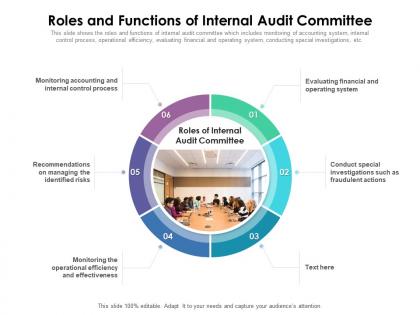
This slide shows the roles and functions of internal audit committee which includes monitoring of accounting system, internal control process, operational efficiency, evaluating financial and operating system, conducting special investigations, etc.
People who downloaded this PowerPoint presentation also viewed the following :
Roles and functions of internal audit committee with all 2 slides:
Use our Roles And Functions Of Internal Audit Committee to effectively help you save your valuable time. They are readymade to fit into any presentation structure.

FAQs for Roles and functions of
An Internal Audit Committee's primary roles include overseeing internal audit functions, ensuring regulatory compliance, monitoring risk management processes, reviewing financial reporting accuracy, and evaluating internal controls effectiveness. These committees enhance organizational governance by providing independent oversight, facilitating transparent communication between auditors and management, and ensuring audit recommendations are implemented, ultimately delivering improved operational efficiency and stakeholder confidence.
The Internal Audit Committee enhances risk management by providing independent oversight of risk assessment processes, monitoring internal controls, and evaluating the effectiveness of risk mitigation strategies across the organization. Through systematic review of audit findings and regulatory compliance, these committees enable businesses to identify vulnerabilities early, streamline corrective actions, and maintain stakeholder confidence, ultimately delivering stronger governance and competitive advantage.
Internal Audit Committee members should be familiar with SOX compliance, COSO frameworks, IIA standards, SEC regulations, and industry-specific requirements like Basel III or HIPAA. These standards enable committees to oversee risk management, ensure regulatory compliance, and maintain financial reporting integrity, with many organizations finding that comprehensive knowledge ultimately delivers enhanced governance and competitive advantage.
The Internal Audit Committee enhances organizational governance by providing independent oversight of risk management, financial reporting accuracy, compliance monitoring, and internal control effectiveness. Through strategic guidance and transparent communication with stakeholders, committees streamline decision-making processes, ensure regulatory adherence, and strengthen accountability frameworks, ultimately delivering improved operational transparency and competitive advantage in increasingly complex business environments.
Internal Audit Committees should typically meet quarterly, with additional meetings scheduled as needed for urgent matters, regulatory changes, or significant audit findings. This frequency enables committees to maintain oversight of audit planning, risk assessments, and compliance monitoring, while many organizations find that quarterly sessions provide sufficient time for thorough review of audit reports, management responses, and strategic risk developments without overwhelming members' schedules.
Internal Audit Committee members should possess financial expertise, risk management experience, regulatory knowledge, analytical capabilities, and strong ethical judgment. These qualifications enable effective oversight through independent assessment, strategic questioning, and informed decision-making, with many organizations finding that diverse professional backgrounds in accounting, finance, and operations ultimately enhance audit quality and organizational governance.
The Internal Audit Committee fosters communication by establishing regular reporting protocols, facilitating open dialogue sessions, and creating structured feedback mechanisms between auditors and management. Through quarterly assessments and direct access policies, organizations streamline audit processes, enhance transparency, and minimize operational conflicts, with many companies finding that improved communication ultimately delivers faster issue resolution and stronger internal controls.
**INPUT**: What strategies can the Internal Audit Committee implement to ensure audit independence? **OUTPUT**: Internal Audit Committees can ensure audit independence through direct reporting structures, independent budget allocation, unrestricted access to records, separate hiring authority, and regular executive sessions without management present. These governance mechanisms enhance transparency and objectivity by eliminating conflicts of interest, protecting auditor decision-making autonomy, and establishing clear accountability channels, ultimately delivering more reliable risk assessments and stronger organizational oversight. [Word count: 58 words]
The Internal Audit Committee measures audit effectiveness through key performance indicators, audit plan completion rates, management response timeliness, issue resolution tracking, and stakeholder feedback assessments. These metrics enable organizations to evaluate audit quality, resource allocation, and strategic impact, with many financial institutions and corporations finding that comprehensive measurement frameworks ultimately enhance governance transparency and operational efficiency.
The Internal Audit Committee serves as the primary liaison with external auditors, overseeing their appointment, independence, and performance while coordinating audit activities to minimize duplication. This strategic collaboration enhances organizational transparency and compliance, with many corporations finding that effective committee oversight of external auditor relationships ultimately delivers stronger financial controls and improved stakeholder confidence.
Internal Audit Committees prioritize audit objectives by conducting comprehensive risk assessments, evaluating regulatory requirements, analyzing operational vulnerabilities, and aligning with strategic business goals. Through systematic risk mapping and stakeholder input, committees focus resources on high-impact areas like compliance, fraud prevention, and process efficiency, with many organizations finding that this strategic approach enhances operational oversight while delivering measurable improvements in risk management and competitive advantage.
Technology and data analytics enhance Internal Audit Committee functions by automating risk assessments, enabling real-time monitoring of financial controls, streamlining audit workflows, and providing predictive insights through advanced reporting tools. These capabilities allow committees to identify emerging risks more quickly, reduce manual oversight processes, and make data-driven decisions, with many organizations finding that automated analytics deliver faster audit cycles and improved regulatory compliance.
The Internal Audit Committee should handle conflicts of interest through mandatory disclosure policies, recusal procedures, and independent oversight mechanisms that ensure transparency and objectivity. Financial institutions and healthcare organizations increasingly implement structured protocols where conflicted members withdraw from relevant discussions and voting, while external advisors provide unbiased perspectives, ultimately maintaining audit integrity and stakeholder confidence.
The Internal Audit Committee ensures organizational compliance by overseeing internal controls, monitoring regulatory adherence, reviewing risk management frameworks, and establishing ethical governance standards. Through independent oversight of audit functions, these committees enable organizations to identify compliance gaps, strengthen ethical protocols, and maintain regulatory transparency, with many financial institutions and healthcare organizations finding that robust committee structures ultimately deliver enhanced stakeholder confidence and competitive advantage.
The Internal Audit Committee supports continuous improvement by establishing performance metrics, reviewing audit methodologies regularly, and promoting adoption of emerging technologies like data analytics and automation. Through strategic oversight and resource allocation, committees enable audit functions to enhance efficiency, reduce cycle times, and deliver more insightful risk assessments, with many organizations finding that this collaborative approach ultimately strengthens governance frameworks and competitive positioning.
-
Great experience, I would definitely use your services further.
-
Enough space for editing and adding your own content.
-
Informative presentations that are easily editable.
-
Content of slide is easy to understand and edit.
-
Great designs, Easily Editable.