


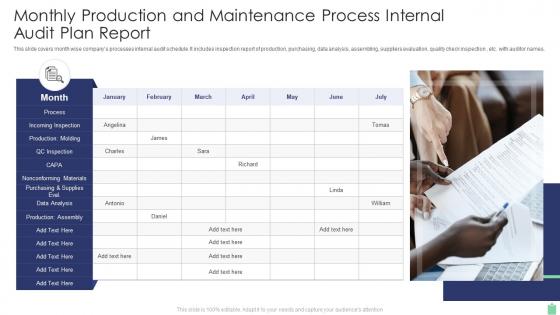
Monthly Production And Maintenance Process Internal Audit Plan Report




Try Before you Buy Download Free Sample Product
 Impress Your
 Audience
 100%
100% Editable
 Save Hours
 of Time


This slide covers month wise companys processes internal audit schedule. It includes inspection report of production, purchasing, data analysis, assembling, suppliers evaluation, quality check inspection , etc. with auditor names.
People who downloaded this PowerPoint presentation also viewed the following :
Monthly Production And Maintenance Process Internal Audit Plan Report with all 6 slides:
Use our Monthly Production And Maintenance Process Internal Audit Plan Report to effectively help you save your valuable time. They are readymade to fit into any presentation structure.





FAQs for Monthly Production And Maintenance Process Internal
So internal audit basically does health checks on your company's risk management and control systems. They work independently from regular operations - reporting straight to the board or audit committee. Their job isn't really catching bad actors (though that happens sometimes). More like spotting weak spots before they blow up into actual problems. Honestly, most people get nervous when audit comes around, but you shouldn't. It's actually a good opportunity to tighten up your processes. They're looking at governance stuff too - just making sure everything runs smoothly across the organization.
You want to test two things - whether their risk framework actually makes sense on paper, and if it's working in practice. Check if they're catching the right risks and monitoring them properly. Sample some transactions, dig through their docs. The governance part is honestly the trickiest - see if risk reports actually reach decision-makers when they need them. I'd look for that classic gap between what management claims they do versus reality. Also test whether they stick to their risk appetite, escalate problems correctly, and spot new threats before they blow up. Don't forget emerging risks - those get missed constantly.
Look, you need five main things for your audit plan. Risk assessment comes first - seriously, this drives everything else so don't skip it. Then map out your audit universe (basically all the stuff you *could* audit), create a prioritized schedule, figure out resource allocation, and set reporting timelines. I'd honestly start with the high-risk processes since those matter most. Build in some wiggle room too because random stuff always comes up mid-year - trust me on this one. Oh, and update that risk assessment every quarter or it'll get stale fast. Match your schedule to what your team can actually handle given your budget constraints.
Look, internal audits are basically your safety net for staying compliant. You're doing practice runs before the real regulatory exam hits. They catch all the stuff that could bite you later - sloppy procedures, staff cutting corners, missing paperwork. Way better to find this stuff yourself than have some external auditor point it out, trust me. Regular audits in your riskiest areas will save you so much headache down the road. Honestly, it's the difference between knowing you're compliant versus just crossing your fingers and hoping everything's fine.
So there's basically three ways auditors test stuff. First is just asking people how their controls work - pretty straightforward. Then you've got observation where you literally watch them do it in real time. Inspection is when you dig through all the paperwork and documents to see if controls actually happened. Walk-throughs are solid too - you follow one transaction from beginning to end, which honestly gives you the best picture of what's really going on. Mix these up depending on your risk assessment and what you're trying to prove. I'd start with asking questions to get the design, then observe and inspect to test if it's actually working.
Start with walkthrough interviews - seriously, this catches problems faster than anything else. Test your main controls: close process, revenue recognition, account reconciliations. Make sure management reviews actually happen and get documented (shocking how often they don't). Sample some transactions to verify controls work like they're supposed to. Check if your month-end deadlines are even realistic - I've seen companies stress over impossible timelines. Look for segregation issues and whether estimates make sense. The whole point? Your processes need to pump out accurate financials that follow accounting standards.
Honestly, keep it simple - hit the big risks first and make sure everything's actionable. Executive summary upfront is clutch because nobody wants to wade through 20 pages of details (been there, done that, got completely ignored). Each finding needs the problem, why it matters business-wise, and how to fix it. Oh, and get management responses with actual deadlines - not just "we'll look into it" nonsense. The real test though? Following up relentlessly. Your reputation lives or dies on whether people actually implement your recommendations, not whether they just nod and file your report away.
So basically, tech can totally change how you do audits. Instead of testing samples, you can analyze every single transaction with data analytics - catches so much more stuff. There's this process mining software that shows how things actually work vs. how they're supposed to work, which is honestly kind of shocking the first time you see it. Automation takes care of the boring routine tests. That frees you up for the tricky high-risk areas where you actually need to think. Oh, and continuous monitoring catches problems as they happen rather than months later. I'd start with just automating one thing first though.
Track completion rates for your audit cycles and how long reports take from fieldwork to final draft. Management acceptance rates matter too - plus how fast they actually fix stuff. Honestly, stakeholder satisfaction surveys are clutch because politics matter more than we'd like to admit. Also measure value-add things like cost savings you identify. Keep it to maybe 5-7 metrics max or you'll go crazy analyzing everything. Start with whatever your leadership obsesses over first, then build out from there.
So internal audit is like being the company's detective, honestly. You're hunting down risks that could totally mess up the big goals and spotting ways to make things run smoother. Sure, compliance stuff matters, but the real value is showing leadership their blind spots - like where their strategy might be falling apart in execution. Short version: your findings need to connect to whether the company can actually pull off what they're trying to do this year. The trick is making sure your audit plan focuses on whatever keeps the executives up at night. Way more interesting than just ticking boxes.
Ugh, it's honestly brutal trying to keep up when everything changes so fast. By the time you finish auditing one process, they've already rolled out two new versions. Risk profiles shift constantly, and suddenly you need to understand AI tools or whatever new tech they're using. Your carefully planned audit schedule? Basically useless after six months. People want insights now, not some report that comes out a year later when it's irrelevant. Continuous monitoring is probably your best shot - way better than those traditional point-in-time reviews. Building flexibility into everything you do helps, though it's exhausting always pivoting.
Dude, you gotta match your style to who you're talking to. Executives just want the bottom line - what's broken and how much it's costing. Operational folks need the nitty-gritty details they can actually act on. Always lead with your main point first. People's attention spans are terrible these days. Dashboards and charts beat long reports every single time - I swear everyone thinks they're easier to digest. When you're presenting formal stuff, give them specific timelines and who's responsible for what. Don't just drop problems in their lap though. Come with solutions ready and be prepared to work together on fixing things. Then actually follow up - shows you care about results, not just getting the presentation over with.
Look, internal and external auditors work together but answer to different people. Internal teams report to management - they're constantly checking risks, controls, and ways to improve operations. External auditors? They're independent outsiders who show up yearly to verify financial statements for shareholders and regulators. Here's what's smart though: they coordinate so they're not doing the same work twice. External auditors might use internal audit's testing if it's solid enough. Internal teams can also build off external findings for their own risk reviews. Just make sure both teams actually talk to each other regularly.
Dude, internal audit is way more valuable than people think. Instead of just ticking compliance boxes, use it to find where processes are broken or money's being wasted. Auditors see everything - they know which departments hate each other and where the real bottlenecks are. Risk stuff too, obviously. Catching problems early beats dealing with disasters later. Here's the thing though: you gotta position your team as helpers, not cops. Nobody likes being policed. Start throwing improvement suggestions into every report alongside the usual findings. Makes you look like you actually care about making things better.
Oh man, internal audit is SO different depending on your industry. Banking and healthcare? You're drowning in compliance and regulatory stuff - it's honestly brutal at first. Manufacturing companies focus way more on operations and supply chain issues. Tech is all about cybersecurity and data privacy these days. Each sector has totally different materiality thresholds too, which is kinda confusing when you're starting out. My advice? Find auditors at similar companies and pick their brains about what frameworks they actually use. Way better than trying to figure it out alone!
-
I am not the best at presentations but using SlideTeam’s PPT template made it easier for me. Thank you SlideTeam!
-
I’m not a design person, so I couldn’t make a presentation to save my life. Thankfully, they have all kinds of templates that I regularly use for my work.