


Timeline showing phases of hiring plan





Try Before you Buy Download Free Sample Product
 Impress Your
 Audience
 100%
100% Editable
 Save Hours
 of Time


Our Timeline Showing Phases Of Hiring Plan are topically designed to provide an attractive backdrop to any subject. Use them to look like a presentation pro.
People who downloaded this PowerPoint presentation also viewed the following :
Content of this Powerpoint Presentation
Description:
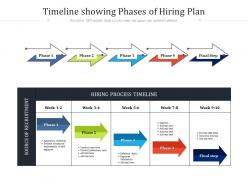
The image depicts a presentation slide with the title "Timeline showing Phases of Hiring Plan" which outlines a structured approach to the recruitment process over a 10-week period. The stages of the hiring process are denoted by five phases, each with a corresponding arrow that points to the next phase, indicating the progression of time and steps in the recruitment process.
In the detailed section labeled "HIRING PROCESS TIMELINE," each phase is associated with a specific time frame and outlines key activities:
Phase 1 (Week 1-2):
Involves application screening and evaluation of educational requirements of each employee.
Phase 2 (Week 3-4):
Suggests conducting interviews, with empty bullet points for further details.
Phase 3 (Week 5-6):
Indicates reference checks and employee information collection, with additional space for extra information.
Phase 4 (Week 7-8):
Refers to employee selection, with placeholders for more details.
Final step (Week 9-10):
Involves providing an offer letter and induction training, along with empty points to add more elements to the phase.
Use Cases:
This visual tool is useful for outlining the recruitment strategy and can be used across various sectors to enhance process understanding among stakeholders. The industries where such slides can be applicable, highlighting their usage, presenters, and potential audiences are:
1. Technology:
Use: Streamlining the hiring process for tech roles
Presenter: HR Manager
Audience: Recruitment team
2. Healthcare:
Use: Planning the recruitment of healthcare professionals
Presenter: HR Specialist
Audience: Hospital administration
3. Education:
Use: Organizing the hiring of educators and staff
Presenter: School District HR Coordinator
Audience: School board members
4. Finance:
Use: Outlining the stages of recruiting financial analysts and advisors
Presenter: Talent Acquisition Lead
Audience: Hiring managers in financial institutions
5. Retail:
Use: Implementing a hiring plan for seasonal employment surge
Presenter: HR Director
Audience: Store managers and regional directors
6. Manufacturing:
Use: Detailing the hiring process for factory workers and supervisors
Presenter: Recruitment Planner
Audience: Plant management team
7. Hospitality:
Use: Establishing a timeline for hiring hotel staff and management
Presenter: HR Consultant
Audience: Hotel owners and senior staff
Timeline showing phases of hiring plan with all 2 slides:
Use our Timeline Showing Phases Of Hiring Plan to effectively help you save your valuable time. They are readymade to fit into any presentation structure.
FAQs for Timeline showing phases
Okay so there are basically 5-6 main steps. You start with posting the job and finding people, then HR does their resume screening thing. Interview rounds come next - some places do one, others go crazy with like five rounds (honestly depends how much they obsess over "culture fit"). Reference checks happen after that, then offer stuff and negotiating. Finally there's onboarding. Timeline's usually 2-6 weeks but it's all over the place depending on the role. Oh and company size matters too. I'd definitely tell candidates upfront what your process looks like so they're not left wondering.
Batch your phone screens into specific days instead of scattering them everywhere - seriously, it's a game changer. Standardize job descriptions and interview questions so you're not starting from scratch every time. The biggest killer though? Hiring managers who aren't actually available when you schedule stuff. Make sure they can commit before blocking calendars. Use structured scorecards for faster decisions and give candidates real timelines upfront (not vague "we'll get back to you" nonsense). Oh, and figure out where applications sit the longest - that's usually your main problem right there.
Honestly, good employer branding is like a cheat code for hiring. Candidates who already vibe with your company will apply faster and actually accept offers instead of ghosting you. Plus you'll get way better applicants from the start - no more wading through random resumes. But if your brand sucks or nobody's heard of you? Get ready for drawn-out negotiations and people bailing halfway through. I learned this the hard way at my last job. Bottom line: spend some time showing off your culture online. Social media, employee stories, whatever works. It's worth it when you're scrambling to fill roles.
Honestly, a good job description is everything. Vague ones are the worst - you'll get buried under resumes from people who clearly didn't read it. Trust me on this one. When you're specific about what you actually want, the right candidates show up and screening becomes way easier. Less time going back and forth with your hiring manager too. I know it feels like extra work upfront, but spending that extra day writing a solid JD will literally save you weeks of headaches later. Worth it every time.
Honestly, most places take forever. You're probably looking at 4-7 weeks total if they're being reasonable about it. First they'll do initial screening for like 1-2 weeks, then phone interviews for another week or two. Final rounds with all the skills tests and whatever usually eat up 2-3 more weeks. But I've literally seen companies take months because they can't get their hiring managers in the same room. It's wild. Best thing you can do is ask upfront what their timeline looks like, then don't be shy about following up if they go MIA past their own deadline.
Oh man, analytics totally changed our hiring game! Track your time-to-fill and conversion rates between interview stages first. We found our biggest bottleneck was actually in the reference check phase - who knew? You'll start seeing patterns like which job boards waste your time vs. bring quality people. Referrals might take longer to close but they're usually worth it. I'd say track everything for about a month, then tackle whatever's eating up the most time. Honestly, we shaved off like 3 weeks just from spotting where candidates were dropping out and fixing those pain points.
Honestly, most companies either drag things out forever or have zero organization. Good candidates will bail if you're still "thinking it over" after three weeks - they've got other options. Communication between HR and hiring managers is usually a mess too. And when job requirements keep changing mid-interview? That's just annoying for everyone. But rushing isn't great either - you'll end up with terrible hires. I'd say nail down your timeline from the start, maybe 2-3 weeks max, and actually stick to it. Keep people posted on where things stand. Trust me, a well-planned process beats scrambling around any day.
Yeah, ATS systems can definitely cut your hiring time down. They handle all the tedious stuff automatically - screening resumes, scheduling interviews, sending those "thanks for applying" emails. You're looking at saving weeks honestly, since it filters candidates instantly based on whatever criteria you set up. The best part? Everything stays organized in one spot instead of you drowning in spreadsheets and random email chains. Just heads up though - some platforms are pretty clunky if you don't configure them properly first. Oh, and make sure your team actually learns the system or it'll backfire completely.
Just shoot them a quick message every week or so - even when there's literally nothing new happening. Most people just need to know they're not being ghosted, honestly. Give them real timelines from the start, then don't blow past them without explanation. Walk them through what your hiring process actually looks like so delays make sense. When stuff inevitably gets pushed back (and it will), just own it and reset expectations. I learned this the hard way - candidates remember how you treat them way more than you'd think. Basically treat them like actual humans, not applicants in a queue.
Honestly, it depends on what level you're going for. Entry-level stuff moves pretty quick - like 2-4 weeks tops since they know what they want and fewer people have to sign off. Executive positions though? Ugh, those can take forever, sometimes 2-4 months with all the rounds of interviews and committees and background checks. Mid-level is usually somewhere in the middle, maybe 4-6 weeks. Oh and definitely ask the recruiter what their usual timeline is for that specific job - saves you from going crazy wondering if you're still in the running or not.
Oh totally, seasonal stuff messes with hiring timelines big time. Summer's the worst - everyone's checked out mentally or actually on vacation. Holiday season too. Response rates tank, references take forever to get back to you, and hiring managers drag their feet on decisions. Spring and early fall are way better for moving things along quickly. I learned this the hard way last year when I tried to fill a role in July... what a nightmare. If you're stuck hiring during those slow periods, just pad your timeline by like 2-3 weeks and start reaching out earlier than you normally would.
Honestly, you'll want to bake feedback right into every step. Ask candidates how interviews went, get hiring manager thoughts within 48 hours, and track stuff like time-to-hire. But here's the thing - actually DO something with what you learn. I've seen so much feedback just disappear forever, it's ridiculous. Monthly reviews work well for spotting patterns. Like if three people say your job description is confusing, fix it that week. After every hire, ask yourself what bombed and what didn't. Then change things before the next round starts.
Give yourself way more time than you think you'll need for background checks and reference calls - that stuff always takes forever. Can't rush some candidates while making others wait either, that's asking for discrimination issues. Industry licensing verification is another pain that drags on. Honestly, I'd build in buffer time at every stage so you're not scrambling later. Document whatever timeline you pick and use it for everyone. Trust me, cutting corners on this stuff will bite you later when legal gets involved.
Honestly, remote hiring is so much faster. Back-to-back interviews without travel time? Amazing. Candidates don't need full days off anymore either, so they're way more available. Geography isn't limiting you which opens up everything - though you'll probably need extra video calls to get a read on culture fit since the in-person energy is gone. Oh, and definitely budget time for tech issues because there's always someone with audio problems. Your interview team needs to sync across time zones but that's minor compared to shaving off like a week from your process.
Honestly, pack those interviews into 1-2 weeks max. Candidates will literally vanish if you drag it out - I've watched people take other jobs while companies were being all slow and indecisive. Get your team to block off time and actually stick to it (easier said than done, I know). Phone screens first, then pull your top 3-4 people in for finals that same week if you can swing it. The whole thing is about moving fast but not being a jerk about people's schedules. Oh, and send those calendar invites right after each round. Keeps everyone on the same page.
-
Good research work and creative work done on every template.
-
Nice and innovative design.
-
Excellent Designs.
-
Best way of representation of the topic.