


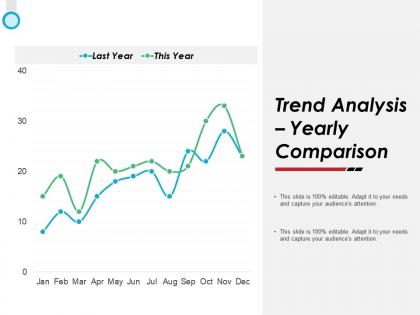
Trend analysis yearly comparison ppt powerpoint presentation gallery designs download




Try Before you Buy Download Free Sample Product
 Impress Your
 Audience
 100%
100% Editable
 Save Hours
 of Time


Earmark the critical components of your plan. Concentrate on them with our Trend Analysis Yearly Comparison Ppt Powerpoint Presentation Gallery Designs Download.
People who downloaded this PowerPoint presentation also viewed the following :
Trend analysis yearly comparison ppt powerpoint presentation gallery designs download with all 5 slides:
Highlight examples of good character with our Trend Analysis Yearly Comparison Ppt Powerpoint Presentation Gallery Designs Download. Enlighten folks on the importance of ethics.
FAQs for Trend analysis yearly comparison ppt powerpoint presentation
Key business trend indicators include market share fluctuations, customer behavior patterns, competitor activities, regulatory changes, and emerging technology adoption rates. These metrics enable organizations to anticipate market shifts, identify growth opportunities, and adjust strategic positioning, with many companies finding that comprehensive indicator monitoring delivers enhanced competitive advantage and more informed decision-making capabilities.
Data visualization techniques enhance trend understanding by transforming complex datasets into intuitive charts, graphs, and interactive dashboards that reveal patterns, correlations, and anomalies instantly. Through heat maps, trend lines, and dynamic visualizations, organizations across retail, finance, and healthcare can identify emerging opportunities, predict market shifts, and make data-driven decisions faster, ultimately delivering competitive advantage and improved strategic planning.
Historical data provides the foundation for identifying patterns, seasonal variations, market cycles, and performance benchmarks, while predictive analytics uses machine learning algorithms, statistical modeling, and data mining to forecast future trends. Through these strategic combinations, organizations in retail, finance, and manufacturing can anticipate demand fluctuations, optimize inventory management, and make proactive strategic decisions, ultimately delivering competitive advantage and enhanced operational efficiency.
Social media sentiment analysis informs trend identification by monitoring emotional responses to products, brands, and topics across platforms, analyzing conversation volume patterns, and detecting shifts in consumer preferences before they become mainstream. Through AI-powered tools, retailers and consumer goods companies track emerging interests, predict purchasing behaviors, and identify market opportunities, ultimately enabling proactive product development and strategic positioning in an increasingly competitive marketplace.
Common pitfalls in trend analysis include relying on insufficient data periods, ignoring external factors, over-extrapolating short-term patterns, confirmation bias, and neglecting seasonal variations. These mistakes can mislead strategic planning, with many organizations finding that combining multiple analytical approaches, validating assumptions against market realities, and maintaining objectivity ultimately delivers more accurate forecasts and competitive advantage.
Businesses should revisit trend analyses quarterly for fast-moving industries and annually for stable sectors, though emerging technologies or market disruptions may require monthly updates. With many financial services and retail companies finding that continuous monitoring through automated analytics delivers more accurate forecasting, ultimately enabling faster strategic pivots and competitive advantage.
Emerging technologies revolutionize traditional trend analysis by enabling real-time data processing, predictive modeling through machine learning, social media sentiment analysis, and automated pattern recognition across vast datasets. These advancements help organizations in retail, finance, and marketing identify trends faster, reduce forecasting errors, and adapt strategies more dynamically, ultimately delivering competitive advantage in increasingly data-driven markets.
Trend analysis assists startups in strategic decision-making by identifying market opportunities, anticipating customer needs, and timing product launches effectively. Through comprehensive data evaluation, startups can allocate limited resources strategically, pivot when necessary, and position themselves ahead of competitors, with many emerging companies finding that early trend recognition ultimately delivers sustainable competitive advantage and accelerated growth trajectories.
Technology, healthcare, retail, financial services, and energy are experiencing the most significant trend shifts, driven by digital transformation, regulatory changes, and evolving consumer expectations. These industries are leveraging automation, data analytics, and sustainable practices to streamline operations, enhance customer experiences, and maintain competitive advantage in an increasingly dynamic marketplace.
Companies leverage trend analysis to improve customer engagement by identifying behavioral patterns, predicting preferences, personalizing communications, and optimizing touchpoint timing across digital channels. Through predictive analytics and customer data platforms, organizations in retail, banking, and hospitality deliver targeted campaigns, proactive service recommendations, and timely interventions, ultimately enhancing satisfaction while driving higher conversion rates and customer lifetime value.
Ethical trend analysis requires ensuring data privacy compliance, obtaining proper consent for consumer information collection, avoiding manipulative targeting practices, and maintaining transparency about data usage. Companies should balance competitive insights with responsible consumer protection, especially when analyzing vulnerable demographics like children or elderly populations, ultimately delivering strategic advantages while respecting consumer rights and building sustainable trust.
Cultural factors significantly influence market trends by shaping consumer values, preferences, purchasing decisions, and brand loyalties across different demographics and regions. These cultural influences drive demand patterns in sectors like fashion, food, technology, and entertainment, with companies increasingly leveraging cultural insights to tailor products, marketing strategies, and customer experiences for competitive advantage.
Effective frameworks for categorizing trends include Porter's Five Forces for competitive analysis, PESTLE for macro-environmental factors, technology adoption lifecycles, consumer behavior segmentation, and industry-specific matrices. These frameworks streamline trend identification by organizing market dynamics, regulatory shifts, and technological developments, with organizations across healthcare, finance, and retail finding that structured categorization enhances strategic planning and competitive positioning.
Trend analysis contributes to product development by identifying emerging consumer preferences, market gaps, technological advances, and competitive patterns that inform innovation strategies. Through systematic data evaluation, companies can anticipate customer needs, optimize feature development, and accelerate time-to-market, with many organizations finding that trend-driven insights ultimately deliver more targeted products and sustained competitive advantage.
**INPUT**: What are the best tools available for conducting comprehensive trend analysis? **OUTPUT**: Leading trend analysis tools include Google Trends, SEMrush, Tableau, Power BI, and specialized platforms like TrendHunter and WGSN. These technologies streamline data collection, pattern recognition, and predictive modeling across industries, with many retail, financial services, and marketing organizations finding that comprehensive analytics ultimately deliver faster market insights, strategic competitive advantage, and enhanced decision-making capabilities.
No Reviews