


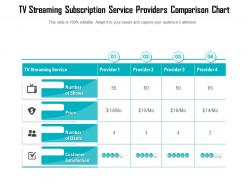
Tv streaming subscription service providers comparison chart





Try Before you Buy Download Free Sample Product
 Impress Your
 Audience
 100%
100% Editable
 Save Hours
 of Time


Our TV Streaming Subscription Service Providers Comparison Chart are topically designed to provide an attractive backdrop to any subject. Use them to look like a presentation pro.
People who downloaded this PowerPoint presentation also viewed the following :
Tv streaming subscription service providers comparison chart with all 2 slides:
Use our TV Streaming Subscription Service Providers Comparison Chart to effectively help you save your valuable time. They are readymade to fit into any presentation structure.

FAQs for Tv streaming subscription service
Key differentiators include original content libraries, pricing structures, simultaneous streaming limits, offline viewing capabilities, and integrated ecosystem features. Netflix excels with global originals, Hulu offers live TV integration, while Amazon Prime Video provides comprehensive shopping benefits, with many households finding that content variety and user experience ultimately determine their streaming loyalty and subscription combinations.
Content libraries vary significantly between platforms through exclusive originals, licensed content breadth, genre specialization, release timing, and regional availability differences. Netflix emphasizes diverse global originals while Disney+ focuses on family content and franchises, HBO Max prioritizes premium series, and Hulu combines current TV with originals, with many viewers increasingly choosing multiple subscriptions to access comprehensive entertainment portfolios.
Popular TV streaming services offer subscription-based, ad-supported, and tiered pricing models, with Netflix providing multiple plan options, Disney+ bundling content libraries, Hulu combining ad-free and live TV tiers, and Amazon Prime integrating streaming with broader membership benefits. These models deliver varying value propositions by balancing content exclusivity, streaming quality, and additional features, with many households finding that strategic combinations of services optimize both entertainment variety and cost efficiency.
Original content offerings significantly enhance subscriber retention by creating exclusive viewing experiences, building brand loyalty, and reducing churn through unique programming that competitors cannot replicate. Services like Netflix, HBO Max, and Disney+ leverage flagship series, award-winning productions, and franchise exclusives to maintain engagement, with many platforms finding that subscribers who regularly consume original content show 40-60% higher retention rates than casual viewers.
User interfaces and accessibility significantly impact streaming platform adoption and retention by determining navigation ease, content discoverability, visual clarity, and inclusive design features. Platforms with intuitive interfaces and robust accessibility options, including audio descriptions, closed captions, and voice navigation, enhance user satisfaction across diverse audiences, ultimately delivering competitive advantages through improved engagement and broader market reach.
Streaming services handle regional content through geo-blocking technology, local licensing agreements, content partnerships with regional providers, and compliance with national broadcasting regulations. These platforms balance global content libraries with local censorship requirements by implementing automated content filtering, culturally sensitive programming selections, and strategic partnerships with local distributors, ultimately delivering tailored viewing experiences while navigating complex regulatory landscapes across different markets.
Streaming services have implemented adaptive bitrate streaming, 4K/HDR support, AI-powered content recommendations, interactive storytelling features, and advanced compression algorithms like AV1. These technologies enhance viewer experiences by delivering optimal video quality across devices, personalizing content discovery, and enabling immersive features, with platforms like Netflix and Disney+ finding that superior technical capabilities significantly boost subscriber retention and engagement.
Free streaming services typically feature frequent commercial interruptions, banner advertisements, and limited content libraries, while subscription platforms deliver uninterrupted viewing experiences with extensive catalogs and premium features. This creates distinct user experiences, with many viewers finding that ad-supported models work well for casual consumption, while subscription services enhance engagement through seamless binge-watching and exclusive content, ultimately delivering superior customer satisfaction.
Prominent trends in live TV streaming include cloud-based DVR expansion, personalized content recommendations, multi-device synchronization, cord-cutting acceleration, and sports content prioritization. YouTube TV and Hulu + Live TV are adapting by enhancing their unlimited DVR capabilities, integrating AI-driven viewing suggestions, and securing exclusive sports partnerships, ultimately delivering more flexible viewing experiences while competing aggressively for traditional cable subscribers.
Personalized recommendations vary significantly across streaming services, with Netflix using collaborative filtering and viewing history, Hulu emphasizing real-time preferences, Amazon Prime leveraging purchase data, and Disney+ focusing on franchise-based suggestions. These algorithmic differences substantially impact content discovery and user engagement, with Netflix's sophisticated machine learning delivering highly targeted suggestions while newer platforms like Apple TV+ rely more on editorial curation, ultimately determining subscriber retention and viewing satisfaction.
Streaming services face complex content licensing negotiations, rising acquisition costs, exclusive content bidding wars, territorial distribution restrictions, and evolving partnership terms with studios and networks. These challenges require strategic relationships and significant financial investment, with many platforms finding that original content production and long-term studio partnerships ultimately deliver greater control, cost predictability, and competitive differentiation.
Streaming services significantly reduce traditional cable subscriptions by offering on-demand content, lower costs, and personalized viewing experiences, with many households cutting cords entirely. This shift transforms viewing habits from scheduled programming to binge-watching and mobile consumption, while cable providers increasingly bundle internet services and develop their own streaming platforms, ultimately delivering more flexible entertainment options and competitive pricing across the industry.
Consumers should consider content library diversity, monthly subscription costs, streaming quality options, device compatibility, and simultaneous viewing capabilities when selecting streaming services. With platforms like Netflix focusing on original series, Disney+ emphasizing family content, and HBO Max targeting premium entertainment, households increasingly find that combining two complementary services delivers broader content access while maintaining reasonable monthly expenses.
Streaming platforms are responding to competition through exclusive content investments, strategic partnerships, tiered pricing models, international expansion, and advanced personalization technologies. These approaches enable services to differentiate offerings, capture diverse market segments, and enhance user engagement, with many platforms finding that combining original programming with technological innovation ultimately delivers stronger subscriber retention and competitive advantage in an increasingly saturated entertainment landscape.
Analytics and viewer data are revolutionizing content development by enabling streaming platforms to identify trending genres, predict audience preferences, optimize storylines, and determine optimal episode lengths and release schedules. Through sophisticated data analysis, services like Netflix and Amazon Prime can strategically invest in targeted content that resonates with specific demographics, ultimately reducing production risks while maximizing viewer engagement and subscription retention.
No Reviews