


Unlocking Artificial Intelligence In Healthcare Training Ppt




Try Before you Buy Download Free Sample Product
 Impress Your
 Audience
 100%
100% Editable
 Save Hours
 of Time


These slides give an overview of Artificial Intelligence within the Healthcare industry. These slides also present some examples where AI can be used in healthcare, such as diagnosis, pharmaceuticals, assistants, and surgeries.
People who downloaded this PowerPoint presentation also viewed the following :
Content of this Powerpoint Presentation
Slide 1
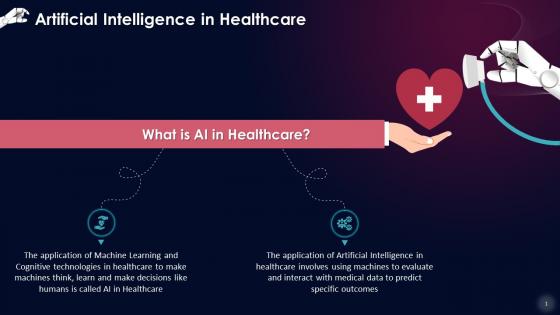
This slide gives an overview of Artificial Intelligence within the Healthcare industry. The application of Machine Learning and Cognitive technologies in healthcare to make machines think, learn and make decisions like humans is called AI in Healthcare.
Slide 2
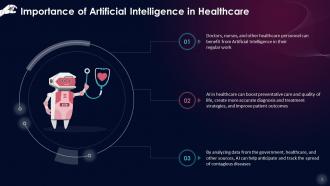
This slide highlights the importance of Artificial Intelligence in the healthcare industry because of its crucial role in a productive, thriving society. AI in healthcare can boost preventive care and the quality of life, create more accurate diagnosis and treatment strategies, and improve patient outcomes.
Slide 3
This slide lists examples where Artificial Intelligence can be used within healthcare. These include diagnosis, pharmaceuticals, assistants, and surgeries.
Instructor’s Notes:
- Diagnosis: The involvement of AI in diagnostic and treatment suggestions is one of its most significant advantages in healthcare. Applying deep learning in medical diagnosis to detect cancer is a critical AI trend in medicine. Because medical AI techniques can gather data in one location, they can use it to gain insight into past and current health issues. Millions of symptoms, diagnoses, and specific cases could be stored in healthcare AI databases, allowing early detection
- Pharmaceuticals: Artificial Intelligence and healthcare are closely associated with the pharmaceutical industry. Artificial Intelligence in medicine can save approximately reduce $70 billion spent yearly on research and development by the ten largest pharmaceutical corporations, AI drug discovery companies are gaining clout as a result
- Assistants: The Virtual Health Assistant, or VHA, is one example of Artificial Intelligence in healthcare that allows communication between remote patients, physicians, and payers. This Artificial Intelligence healthcare application provides a conversational technology interface for AI in medicine, similar to the digital assistants and chatbots that offer services at the consumer level
- Surgeries: The application of AI in surgery not only grows beyond technology functioning as an extra set of hands or eyes for human surgeons, but the link between AI and surgery is growing as well. Artificial Intelligence has proven to be beneficial in detecting anomalies in medical imaging, increasing detection rates for cancer-positive lymph nodes, reducing the number of missed diagnoses, and saving lives
Slide 4
This slide discusses the scope of Artificial Intelligence in the healthcare industry. The future of AI in healthcare will include remote, virtual, and mechanically automated ways for health delivery, communications, and administration
Instructor’s Notes: AI robot systems are being used to sanitize patient rooms and operating rooms, lowering the risk of infection for both patients and medical staff
Slide 5
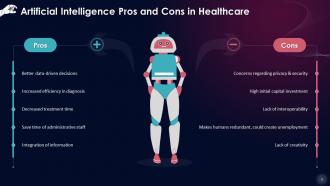
This slide lists the advantages and disadvantages of Artificial Intelligence within the healthcare industry. The advantages include better data-driven decisions, increased efficiency in diagnosis, decreased treatment time, save time of administrative staff, and integration of information whereas, disadvantages include concerns regarding privacy & security, high initial capital investment, lack of interoperability, makes humans redundant & could create unemployment, and lack of creativity.
Unlocking Artificial Intelligence In Healthcare Training Ppt with all 21 slides:
Use our Unlocking Artificial Intelligence In Healthcare Training Ppt to effectively help you save your valuable time. They are readymade to fit into any presentation structure.











FAQs for Unlocking Artificial Intelligence In
So AI's mostly doing three big things in med training right now. Virtual patients that actually react like real people when you make treatment calls - honestly kind of wild how realistic they've gotten. Then there's personalized learning that adapts to how fast you pick stuff up and spots where you're struggling. The diagnostic training is probably my favorite though - you can practice on rare cases you'd literally never encounter during residency. Oh, and it handles boring admin stuff for training programs plus standardizes assessments across schools. If you're checking this out for your program, I'd definitely start with those virtual patient sims since they're crushing it with learning outcomes.
Dude, medical sims are getting insane with AI now. Virtual patients actually react like real people - their heart rate spikes, they get emotional, symptoms change based on what you do. It's pretty trippy honestly. The cool part? It adapts to where you're struggling and throws harder cases at you. No more boring cookie-cutter scenarios. Plus you get instant feedback on everything - whether you nailed the diagnosis or totally bombed talking to the patient. If you're building training stuff, definitely check out these AI simulation platforms. Game changer for sure.
So ML tracks how you're doing with cases and figures out where you're struggling. Then it customizes everything - more cardiology if that's your weak spot, easier stuff if you're moving too fast. It's like having a tutor who actually pays attention, which is rare these days lol. Way better than those generic training programs everyone gets stuck with. Short answer: you get practice that's actually useful for YOUR gaps. I'd bug your program directors about getting ML platforms - they're everywhere now and honestly make a huge difference in how fast people learn.
Honestly, AI feedback is a game-changer for med students. Instead of waiting weeks for exam results, you get real-time analysis of their clinical decisions through simulation platforms. The communication assessment part is pretty cool too - it actually evaluates how they interact with patients. Adaptive testing adjusts difficulty based on performance, so your stronger students stay challenged while others get targeted help. Though I'd probably start with just one tool first, see how it goes. Don't want to overwhelm everyone right off the bat. Way more personalized than anything we had before.
Look, you're gonna run into three big headaches: data privacy stuff, biased algorithms, and students getting too dependent on AI. Patient data anonymization is way harder than people think - I learned that the hard way. Your AI will probably just copy whatever biases already exist in healthcare if you don't watch the training data diversity. Oh, and make sure students still think for themselves instead of just doing whatever the AI says. Honestly, I'd set up some ground rules early about when they should actually use these tools. Otherwise you'll be cleaning up messes later.
So basically AI tracks all the stuff you'd never catch manually - response times, error patterns, decision-making quirks across tons of trainees. Pretty wild actually. It'll spot that Sarah nails respiratory cases but keeps missing cardiac symptoms, or that your whole class sucks at drug interactions. The dashboards show individual gaps plus group trends, then spit out targeted learning recommendations. Honestly, the pattern recognition is crazy good compared to spreadsheet hell. I'd test it on just one specialty first though - see how accurate the data actually is before going all-in.
Oh dude, you've gotta try this if your hospital gets it. VR training with AI is wild - honestly felt like I was actually in surgery my first time. The system figures out your skill level and adjusts everything accordingly. Throws random complications at you, different patient reactions, even super rare cases you'd probably never encounter normally. What's crazy is how fast your reflexes and decision-making improve compared to regular training methods. Plus zero real-world risk, obviously. The feedback is instant and actually useful too. Definitely push for a demo if they're on the fence about it.
Honestly, the money thing hits first - these AI systems aren't cheap and hospitals are already tight on budgets. Staff pushback is huge too since everyone's overworked and doesn't want another system to learn. Integration with old tech? Total headache, trust me. Patient data makes everything 10x more complicated because of privacy rules. Oh, and proving it actually works takes forever. I'd say pilot something small first - way easier to get buy-in when you can show it's actually worth the hassle.
So basically, NLP can take all that medical text - clinical notes, research papers, case studies - and automatically create personalized training for your staff. It figures out what each person struggles with and builds custom learning modules around that. The system also whips up realistic patient scenarios for practice and gives real-time feedback on documentation. Honestly, I think it's kind of brilliant because it's like having a teaching assistant that doesn't need coffee breaks. You should probably test it with your new residents first and see if their diagnostic skills improve compared to the old-school training methods.
So AI training in healthcare is actually pretty game-changing for patient outcomes. Trainees get way more realistic practice scenarios they can repeat over and over before touching real patients. Their diagnostic skills get sharper, they make faster decisions, and honestly fewer mistakes happen overall. The really cool part? AI can throw rare conditions at them that they'd probably never encounter otherwise - builds serious confidence. Plus you get instant feedback during sims, so you're learning from screwups without any patient risk. My cousin's in med school and swears by these tools. Definitely worth adding to your programs if you haven't yet.
So the biggest thing coming is learning that actually adapts to what you don't know yet - like it figures out your weak spots and builds lessons around that. VR training is getting crazy good too, you can practice procedures without worrying about messing up on real patients. AI's gonna handle all the tedious credit tracking stuff automatically. Plus it'll suggest courses when new research drops or policies change. There's even AI tutors now that answer questions while you're in training scenarios - kinda wild honestly. Oh, and they're using predictive analytics to spot skill gaps early. Probably worth checking out some AI learning platforms now so you're not scrambling later.
So there's this pretty neat AI training stuff for telemedicine now. Basically you practice on fake patients - the AI plays different personalities and medical conditions, which is honestly way less awkward than I thought it'd be. You get real-time feedback on how you're communicating, what questions you're asking, even technical stuff like lighting and camera angles. The best part? You can mess up those really uncomfortable conversations as many times as you want without actually traumatizing anyone lol. I'd check with your training department to see what simulation platforms they've got available.
Honestly, there's some pretty sick AI stuff for med school collab now. You've got these discussion forums that automatically pull up relevant cases when you're arguing with classmates about diagnoses. Virtual study groups will match you with people who suck at the same things you do, which is weirdly helpful. The simulation environments are my favorite though - you can work through patient scenarios with your whole cohort. There's also smart annotation tools for sharing insights on medical images. It's like having a study coordinator who actually stays awake during finals week lol. I'd try the case discussion platforms first since they won't mess with your current routine.
Dude, AI basically solves the whole "no experts available" problem that kills training programs in remote areas. Instead of needing someone physically there, the AI handles personalized instruction and simulates procedures around the clock. Pretty wild how it adapts to each person's learning speed too. You can train tons of healthcare workers at once without quality dropping off a cliff. The whole thing becomes way more cost-effective since location doesn't matter anymore. Honestly, I'd start small - pick one training module you could digitize first. Makes for a solid proof of concept before you go all-in.
Honestly, the biggest worry is becoming lazy with your thinking. You'll start just accepting whatever the AI spits out instead of actually working through problems yourself. That's terrifying when real patients are involved, you know? AI misses stuff too - like when a patient seems off but you can't pinpoint why, or those messy ethical situations that don't have clear answers. I've seen people get way too comfortable just following AI suggestions without questioning anything. Use it as backup for sure, but don't let it replace your brain. Always double-check and make sure you actually get why it's recommending something.
-
I am extremely pleased with these PPT slides that we used for our event. They were easy to modify and came out great in all aspects!
-
Excellent template with unique design.