


E Commerce In Age Of AI Training Ppt




Try Before you Buy Download Free Sample Product
 Impress Your
 Audience
 100%
100% Editable
 Save Hours
 of Time


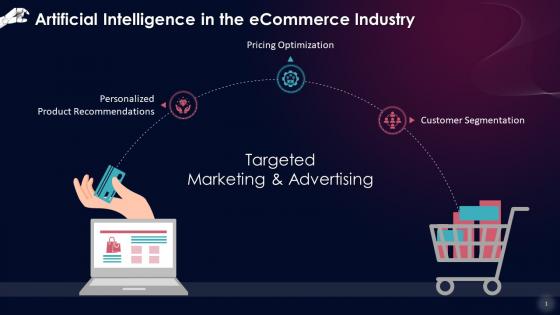
These slides highlight the importance of Artificial Intelligence AI in eCommerce. One of the biggest use cases is targeted marketing and advertising via providing personalized product recommendations, pricing optimization, and customer segmentation.
People who downloaded this PowerPoint presentation also viewed the following :
Content of this Powerpoint Presentation
Slide 1
This slide lists the advantages Artificial Intelligence brings to the table in terms of changing the face of the eCommerce industry. One of the biggest use cases is targeted marketing and advertising via providing personalized product recommendations, pricing optimization, and customer segmentation.
Instructor’s Notes:
- Targeted Marketing & Advertising: Advancements in AI and Machine Learning have facilitated deep customization approaches, allowing the message/communication to be customized for each user. You can hone in on what your consumers want and deliver the message that will resonate the most by evaluating massive data from purchase histories and other customer interactions
- Personalized Product Recommendations: Collecting and processing customer data regarding their online purchasing experience is now easier than ever. AI is being used to provide customized product suggestions based on prior consumer behavior and customer lookalikes
- Pricing Optimization: Dynamic pricing using AI is a method for altering the price of your product based on supply and demand. Today's solutions can forecast when and what to discount with the correct data, dynamically determining the floor discount required for sale
- Customer Segmentation: More consumer data and processing capacity are allowing e-commerce businesses to understand their customers better and spot new trends earlier than ever before
Slide 2
This slide highlights the advantage of increased customer retention and enhanced customer service that the adoption of Artificial Intelligence within eCommerce offers.
Instructor’s Notes:
According to McKinsey's omnichannel personalization research, personalization techniques can increase revenue and retention by between 10% and 15%.
Slide 3
This slide highlights the advantage of seamless automation and smart logistics that the adoption of Artificial Intelligence within eCommerce offers.
Slide 4
This slide highlights the advantage of efficiency in sales process and sales & demand forecasting that the adoption of Artificial Intelligence within eCommerce offers.
Slide 5
This slide depicts a step by step process of successful implementation of Artificial Intelligence in eCommerce.
Instructor’s Notes:
- Create a Strategy: You'll need to devise a strategy that lays out the steps to achieving your AI goal. Consider taking a practical approach and remembering what you want to accomplish with AI
- Finding relevant Use Cases: Business goals, data segmentation, and widely available Artificial Intelligence models all come together in the most effective AI use cases. You should concentrate on revenue-generating possibilities where you have a data edge and where established AI technology may be used
- Leverage third-party expertise: Bring in an experienced team to help you create a strategic AI roadmap on a project. These third parties can also aid in the development of your MVP (Minimum Viable Product)
- Build a full-scale solution: Once you're confident with what your team has created, it's time to build the full-scale solution. It may still take a few revisions to get it to work the way you want it to. You'll see an increased advantage from the initiatives you execute as you and your team become more comfortable working in the AI realm
E Commerce In Age Of AI Training Ppt with all 21 slides:
Use our E Commerce In Age Of AI Training Ppt to effectively help you save your valuable time. They are readymade to fit into any presentation structure.







FAQs for E Commerce In Age Of
So you know how Amazon always seems to know exactly what you want? That's AI tracking everything - your clicks, purchases, even how long you stare at random stuff. Creepy but effective. It builds this whole profile of your tastes and then customizes literally everything for you. Product suggestions, when emails hit your inbox, even your homepage layout. Those "people also bought" recommendations that make you go "how did they know??" - pure AI magic. Check your Amazon against a friend's sometime, it's wild how different they look. Like having a really attentive personal shopper, just way more data-obsessed.
So basically these algorithms look at your past sales data, seasonal stuff, weather patterns - even weird things like local events. Pretty cool how they factor in competitor prices and social media trends too. You'll avoid the nightmare of having too much inventory eating up your cash, or running out of popular items. The algorithms keep getting smarter as they learn your business patterns. Honestly, I'd start with something simple for demand forecasting first - don't go crazy with all the fancy features right away. Build up to the complex stuff once you see it's actually working.
Dude, NLP totally changes the game for chatbots. Instead of customers having to guess the right keywords, they can just ask "where's my order?" like they're talking to a real person. The bot actually gets what they mean and can handle follow-ups too. Plus it picks up when someone's getting pissed off and routes them to a human. Remember those awful phone trees where you'd press 5 different numbers? Yeah, this isn't that. Your support team will thank you because all the basic stuff gets handled automatically, and customers don't end up trapped in some endless loop of useless responses.
So basically, AI looks at all your customer data - browsing habits, purchases, seasonal trends - and finds patterns we'd totally miss. It crunches through search queries, abandoned carts, click rates, everything. The algorithms get weirdly accurate at predicting what people want next. Sometimes it's honestly a little creepy how spot-on they are. You can use machine learning to forecast demand and personalize recommendations. Oh, and it helps with inventory too. Start with whatever analytics you're already using, then check out Google Analytics Intelligence or those specialized e-commerce AI tools.
Dude, AI pricing is actually insane - it adjusts your prices automatically based on what competitors are doing and demand patterns. When someone drops their price, boom, you're competitive again instantly. During busy periods, you're maximizing profits without thinking about it. Plus you can do personalized pricing for different customers, which honestly feels a bit sneaky but works. Your conversion rates usually go up because you're not pricing yourself out or leaving money on the table. I'd start small though - pick like one product category to test it on first. You'll see results pretty quick and then you can expand from there.
Look, the main stuff you gotta watch out for is privacy, consent, and bias in your algorithms. People have no clue how much data you're actually grabbing from them - it's honestly pretty invasive when you step back and think about it. Don't bury consent in some 20-page terms document nobody reads. Make it obvious and easy to opt in. Your AI will also start showing different products or prices to different groups, which gets sketchy fast. My rule of thumb? If you wouldn't want some company doing this tracking to you, don't do it to your customers. Let them see what data you've got and control it.
So basically, your customers can upload photos instead of trying to describe what they want - which honestly saves everyone a headache. Like, they see a cute bag somewhere and just snap a pic to find similar ones on your site. The system also gets pretty smart about showing related stuff based on colors, patterns, materials, whatever. I've seen it work really well for clothes especially. Short version: it fixes that annoying problem where people know exactly what they want but can't put it into words, you know?
Ugh, honestly the data integration stuff is going to be your biggest headache. Most platforms weren't designed for AI so you're stuck doing tons of backend work just to get systems connected. Quality control becomes a huge mess too - bad data means useless results, obviously. Your team will need proper training or they'll freak out every time something breaks (trust me on this one). Privacy regulations are another pain point you can't ignore. I'd say pick something simple first, like product recommendations maybe? Get that working, show it actually makes money, then expand. Way less stressful than trying to do everything at once.
So sentiment analysis is basically digging into what people actually think about your stuff - reviews, social posts, all that. You'll spot patterns like "everyone loves the product but hates the packaging" which is super useful for marketing angles. Honestly, the data can be pretty surprising sometimes. Focus your campaigns on what people are genuinely excited about rather than guessing. Like if customers rave about durability but complain about convenience, lead with the durability angle. You can also find those emotional triggers that make people buy. Start with your recent reviews - that's where the gold is.
So demand forecasting with AI is probably your best bet - clearest returns and you'll actually see results fast. Route optimization is saving companies crazy money on deliveries right now. Computer vision handles warehouse sorting automatically, which is pretty sweet. IoT sensors track everything in real-time (temperature, location, whatever). Oh and natural language processing even helps with customer service stuff now. Honestly feels like every month there's something new. Machine learning just crushes traditional forecasting methods. If I had to pick one thing to start with though, definitely go with the demand forecasting first.
So basically these AI systems are crazy good at making you think "omg this is perfect for me!" They track what you browse and make suggestions feel super personal. Short version? It works. Like, really well - I'm talking 10-30% better conversion rates, which is honestly pretty wild when you think about it. Plus they throw in all that social pressure stuff - "people like you bought this" or "only 2 left!" Your friend definitely needs one if they're serious about their online store. The personalization game is no joke these days.
AI fraud detection is pretty solid for catching sketchy transactions fast. The speed is insane - it'll analyze thousands of purchases instantly and catch weird patterns you'd never notice. Plus it gets smarter over time. But man, the false positives are annoying. Nothing worse than your legit purchase getting blocked. Fraudsters are also figuring out how to trick these systems now. You need good data and regular updates or it'll fall apart. Honestly though? Don't rely on it completely. Pair it with human reviewers - that combo works way better than going full robot.
Yeah totally! Start with chatbots for customer service - they're way cheaper than hiring people. Mailchimp has this AI feature for email marketing that's actually pretty solid. Dynamic pricing tools are clutch too, they'll adjust your prices automatically based on demand. Honestly? Some of the cheaper AI stuff works better than those expensive enterprise systems that crash every other day. Pick maybe 2-3 tools max that solve your biggest headaches first. Product recommendations, automated social posts, inventory prediction - that kind of thing. Don't go crazy trying to automate everything right away though.
Dude, shopping's about to get wild. AI will literally predict what you want before you even know it - kinda creepy but also convenient? Voice ordering through Alexa is already taking off, and visual search is insane now. Just snap a pic and boom, you'll find exactly what you're looking for. Smart chatbots are getting scary good at customer service too, they actually get what you mean instead of giving robotic responses. Oh, and prices will change constantly based on demand and your browsing history. Honestly, start playing with personalization tools ASAP or you'll be left behind.
Track your conversion rates, average order value, and customer acquisition costs before you start. Then compare after. Basic math - add up all your AI costs (software, setup, training) and see what you gained in revenue plus savings. Cart abandonment stuff and personalized recommendations usually show the clearest wins. Most companies I've seen hit positive ROI within 6-12 months, assuming they're actually measuring the right things. Oh, and set those baselines first or you're kinda flying blind. Check monthly - short, choppy tracking never tells the real story.
-
It is my first time working with them and that too on a friend's recommendation. I would say, I am not expecting such a worldly service at this low price.
-
Exclusive and extensive collection of templates. Really helped me create a professional presentation in just no time.