

Warehouse Optimization Strategies to Control Expenses powerpoint presentation slides





Try Before you Buy Download Free Sample Product
 Impress Your
Audience
 100%
Editable
 Save Hours
of Time


Warehouse management involves systematically organizing and supervising all operations carried out within the warehouse. Grab our Warehouse optimization strategies to control expenses template. It is designed to assist businesses in effectively managing their warehouse expenses and increasing profitability. Our Inventory Management deck aids in minimizing overall business costs by optimizing processes and efficiently utilizing resources and space. It includes a storage optimization strategy that enhances inventory visibility in the warehouse while reducing overstocking of goods. Our Warehouse Automation PPT provides insights into inventory management techniques such as ABC analysis, LIFO FIFO method, and HML analysis. It also showcases various ways to identify and minimize warehouse theft. Additionally, our Warehouse Stock Management module utilizes inventory-picking optimization techniques to decrease warehouse expenses and reduce manual errors. It further highlights warehouse automation technologies that can significantly reduce operational costs and manual errors. Our Warehouse Shipment Presentation emphasizes vital performance indicators KPIs to monitor warehouse expenses and measure the impact of these strategies on warehouse direct, indirect, and fixed costs. Lastly, it features a dashboard to track warehouse shipments and payments. Get instant access.
People who downloaded this PowerPoint presentation also viewed the following :
Content of this Powerpoint Presentation
Slide 1: This slide introduces teh Warehouse Optimization Strategies to Control Expenses. Commence by stating Your Company Name.
Slide 2: This slide depicts the Agenda of the presentation.
Slide 3: This slide includes the Table of Contents.
Slide 4: This slide highlights the Title for the Topics to be covered further.
Slide 5: This slide showcases different categories of costs incurred by organization to manage and run the warehouse.
Slide 6: This slide reveals the graph that can help organization in analyzing the rise of warehouse costs.
Slide 7: This slide mentions the Heading for the Contents to be covered in the following template.
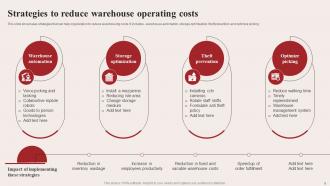
Slide 8: This slide states the strategies that can help organization to reduce warehousing costs.
Slide 9: This slide depicts the Title for the Ideas to be discussed further.
Slide 10: This slide showcases strategies that can help organization to maximize warehouse space utilization.
Slide 11: This slide talks about Reducing inventory in warehouse with cross docking.
Slide 12: This slide mentions the Warehouse structure for inventory management.
Slide 13: This slide showcases ABC analysis that can help organization in arranging inventory for warehouse.
Slide 14: This slide talks about Labelling for effective warehouse storage and management.
Slide 15: This slide mentions the Heading for the Ideas to be covered in the following template.
Slide 16: This slide showcases process flow that can help organization in managing warehouse inventory.
Slide 17: This slide reveals ABC analysis method that can help organization in inventory management.
Slide 18: This slide depicts the LIFO and FIFO method that can help organization in inventory management.
Slide 19: This slide showcases HML analysis method that can help organization in inventory management.
Slide 20: This slide highlights the Title for the Contents to be discussed in the upcoming template.
Slide 21: This slide showcases red flags that cn help organization in identification of warehouse theft.
Slide 22: This slide includes the Preventive measures to reduce warehouse theft.
Slide 23: This slide showcases implementation of warehouse management system that can help organization in theft prevention.
Slide 24: This slide portrays the Heading for the Topics to be covered further.
Slide 25: This slide showcases overview of warehouse picking system that can help organization to manage the warehouse.
Slide 26: This slide exhibits the Best practices for warehouse picking optimization.
Slide 27: This slide displays the Inventory picking optimization methods for warehouse.
Slide 28: This slide indicates the Problems faced by organization in warehouse picking.
Slide 29: This slide reveals the Title for the Topics to be discussed enxt.
Slide 30: This slide showcases impact of implementing automation technologies on warehouse costing.
Slide 31: This slide presents the process of automation that can help organization to reduce warehouse costs.
Slide 32: This slide mentions the Warehouse automation technologies to minimize costs.
Slide 33: This slide portrays the Warehouse automation levels for cost reduction.
Slide 34: This slide focuses on Conducting training for warehouse automation.
Slide 35: This slide includes the Heading for the Contents to be covered in the following template.
Slide 36: This slide displays the Warehouse performance KPIs to manage warehouse costs.
Slide 37: This slide depicts the Title for the Ideas to be further discussed.
Slide 38: This slide showcases graph that analyze the impact on warehouse costs after implementation of various strategies.
Slide 39: This slide reveals the Heading for the Ideas to be covered in the following template.
Slide 40: This slide showcases dashboard that can help organization to track operating cost incurred by organization in different warehousing activities.
Slide 41: This slide illustrates the Dashboard to manage inventory and warehouse operations.
Slide 42: This is the Icons slide containing all the Icons used in the plan.
Slide 43: This slide is used for depicting some Additional information.
Slide 44: This is the About us slide. State your comapny-related information here.
Slide 45: This is Our Team slide for highling the infomration related to the team members.
Slide 46: This is the 30,60,90 days plan slide for effective planning.
Slide 47: This slide reveals the SWOT analysis.
Slide 48: This slide contains the Post it notes for reminders and deadlines.
Slide 49: This slide elucidates the comapny Roadmap.
Slide 50: This is Target slide for stating the organizational targets here.
Slide 51: Thsi is the Idea generation slide for encouraging fresh ideas.
Slide 52: This is the Puzzle slide with related imagery.
Slide 53: This slide displays the firm's vision, mission & goal.
Slide 54: Thsi is the Thank You slide for acknowledgement.
Warehouse Optimization Strategies to Control Expenses powerpoint presentation slides with all 59 slides:
Use our Warehouse Optimization Strategies to Control Expenses powerpoint presentation slides to effectively help you save your valuable time. They are readymade to fit into any presentation structure.









FAQs for Warehouse Optimization Strategies to Control Expenses
Track these five things: order accuracy (shoot for 99%+), how many orders your team picks per hour, inventory turnover, and how well you're using your warehouse space. Order cycle time matters too - from when you get it to when it ships out. Most places I've worked with get obsessed with speed but totally blow it on accuracy. That's backwards thinking. Labor costs are eating everyone alive right now with wages going up. Get your baseline numbers first, then pick the two metrics that are actually costing you money and fix those. Don't try to improve everything at once - you'll just spread yourself thin.
Look, the main thing is getting actual data on how your space works versus what you assume. A warehouse management system tracks where inventory moves and suggests better placement - the results are usually shocking, honestly. Sensors show you dead zones you didn't even know existed. Also, automated storage crushes manual operations for vertical space (though that's obviously a bigger investment). If you don't have a WMS yet, start there. Just the space insights will probably cover the cost in a few months. I've seen warehouses find like 30% more capacity just from reorganizing based on actual usage patterns.
Honestly, inventory software is a game changer for warehouses. It tracks your stock in real-time and shows you exactly where everything sits. No more hunting around for random SKUs like you're playing hide and seek. The system predicts when you'll run low on stuff and maps out the best picking routes too. Plus it spots dead inventory that's just hogging space - which happens more than you'd think. Really cuts down on overstock headaches. If you don't have barcode scanning yet, that's where I'd start. Turns the whole operation from chaos into something actually manageable.
Dude, layout is HUGE for warehouse efficiency. I've literally watched places cut picking time by 30% just from reorganizing better. Put your fast-moving stuff close to shipping - seems obvious but you'd be surprised how many don't do this. Map out where your workers actually walk during shifts. You'll probably find they're taking way more steps than needed. Don't let your receiving and shipping areas fight for space either. Oh, and make sure flow paths don't cross - creates chaos during busy periods. It's wild how much smoother everything runs when you fix the basics first.
Honestly, start by timing what you're doing now - you'll spot the worst bottlenecks pretty quick. Your picking routes are probably the biggest mess, so fix those first. Nobody should be running around the warehouse like it's a scavenger hunt. Group similar orders together and maybe try zone picking where each person owns their section. Put your popular stuff close to packing stations (seems obvious but you'd be surprised how many places screw this up). Handheld scanners help kill the paperwork delays too. Oh, and batch processing saves way more time than people think.
Honestly, automation is a game-changer for cutting out those dumb mistakes that happen constantly in warehouses. Barcode scanners and RFID systems make it so your workers can't grab the wrong stuff anymore - everything gets verified against your database instantly. Manual picking usually sits around 85% accuracy, but with automated systems you're looking at 99%+. No more "oops wrong SKU" situations that turn into pissed off customers calling you later. The real-time cross-referencing catches problems right away instead of after it's too late. If you don't have barcode scanning yet, start there - biggest impact for the money. Though honestly, even basic RFID makes a huge difference once you see it in action.
Honestly, start with figuring out where you're bleeding money first - do a quick audit. FIFO rotation is huge, and get your demand forecasting tight so you're not overordering. Those cycle counts matter more than people think. Staff training's worth it too because mistakes happen and they're expensive. Oh, and fix your picking routes - all those extra steps are killing you. Cross-docking works great for stuff that moves fast. Don't sleep on returns either, that merchandise just sits there forever if you don't have a system.
Training your warehouse crew makes a massive difference, trust me. Your accuracy rates will jump up, fewer things get damaged, and people just move through their tasks smoother. I've literally watched places struggle with mysterious bottlenecks for months - turns out half their staff didn't know the picking system properly. Safety protocols matter too obviously, but honestly the inventory system training is where you see the biggest wins. Start with whatever's causing you the most headaches right now. Don't try to fix everything at once or you'll overwhelm everyone.
Dude, start by actually mapping out what you've got now - most people skip this step but it's huge. Vertical is your best friend here. Mezzanines and high-bay racking can literally double your space without expanding the building. Mobile shelving is sick too since the racks move and you don't waste space on permanent aisles. The ROI hits different once you see how much you save. If budget's tight, cube storage works well - just size everything perfectly. Automated systems are awesome but pricey. Honestly though, going up instead of out is where most warehouses find the biggest wins first.
Look, forecasting is basically your way to figure out how much stuff to keep on hand without going crazy with overstock or running out completely. You can tweak your safety stock and reorder points based on what you think demand will look like. Honestly, it's not magic but it helps you spot seasonal patterns and those random demand spikes before they blindside you. The trick is making your inventory thresholds flexible instead of just setting them once and forgetting about them. I'd start by checking how accurate your current forecasts actually are - might be surprised at what you find.
Honestly, start with a safety audit to see where you're most screwed right now. Mark your aisles clearly and make them wide enough - trust me, forklift accidents are expensive and messy. Good lighting is huge, especially in busy areas. Train your people properly on lifting and equipment use. PPE stuff matters too, obviously. Oh, and don't skip equipment maintenance schedules - broken machinery causes way more problems than you'd think. Emergency procedures should be drilled into everyone. It's really about creating habits before something goes wrong.
Dude, real-time data completely transforms warehouse ops. You can't manage inventory or spot problems without knowing what's happening right now. Manual tracking is honestly painful to watch - those places are losing so much money daily it's not even funny. Pick your worst bottleneck first and get live tracking there. You'll immediately see faster picks, better accuracy, plus customers actually get realistic delivery times. The difference is night and day. Oh, and your staff will thank you since they won't be constantly putting out fires anymore.
So environmental stuff is massive for warehouse optimization right now. LED lighting and solar panels are your biggest money-savers since these places just devour electricity. HVAC optimization too - that's where you'll see real results. Route planning cuts transportation emissions, sustainable packaging helps, even basic recycling programs add up. Honestly, most green improvements actually reduce costs through lower utility bills, which is pretty sweet. I'd start with an energy audit to find your worst problem areas first. Oh, and waste reduction strategies - forgot about those but they're clutch too.
Cross-docking really shines with predictable, high-volume stuff where you can sync your inbound and outbound schedules super tight. Focus on fast-moving products that don't need storage - retail replenishment works great, or those consolidated LTL shipments. Real-time visibility is crucial so you know what's rolling in and can prep your outbound trucks. Honestly feels like juggling fire at first, but the efficiency gains are wild once you nail the timing. Oh, and definitely start small with just one product line or customer. Work out all the chaos before your team has to deal with the faster pace across everything.
Real-time inventory tracking is honestly where you'll see the biggest difference - no more guessing where stuff is. Your picking accuracy shoots up because everything's automated, which cuts down on labor costs too. Order fulfillment gets way faster since the system figures out the best routes and what to prioritize. The data helps you make quick calls when things get crazy busy. ROI usually kicks in pretty fast, though obviously depends on your setup. I'd map out what's driving you nuts right now, then test drive systems that actually fix those specific problems.
-
Easily Understandable slides.
-
I am so thankful for all of the templates I've found on your site. They have saved me hours every week and helped make my presentations come alive. Keep up with these amazing product releases!