


Good Warehouse Practices Powerpoint PPT Template Bundles





Try Before you Buy Download Free Sample Product
 Impress Your
 Audience
 100%
100% Editable
 Save Hours
 of Time


Our Good Warehouse Practices Powerpoint PPT Template Bundles are topically designed to provide an attractive backdrop to any subject. Use them to look like a presentation pro.
People who downloaded this PowerPoint presentation also viewed the following :
Content of this Powerpoint Presentation
Slide 1: This slide introduces Good Warehouse Practices. State your company name and begin.
Slide 2: This slide covers practices to improve safety in pharmaceutical warehousing processes. It involves adequate infrastructure and resources, safety and security measures etc.
Slide 3: This slide displays adopting lean practices for effective warehouse management such as warehouse auditing, just in time inventory management and employee training.
Slide 4: This slide covers utilizing IoT for effective warehouse management as it monitors storage conditions, tracks goods arrival time and mitigate risks such as overstock or under stock situations.
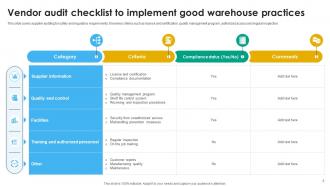
Slide 5: This slide displays supplier auditing for safety and regulatory requirements. It involves criteria such as license and certification, quality management program etc.
Slide 6: This slide covers essential requirements for effective storage of warehouse products such as documentation, labeling & storage and verification.
Slide 7: This slide displays checklist for adopting good warehouse practice to enhance supply chain operations. It involves assessment of emergency exits, identification of hazardous materials etc.
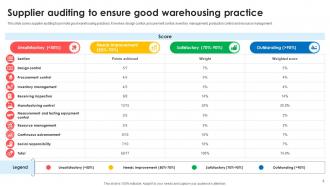
Slide 8: This slide covers supplier auditing to promote good warehousing practices. It involves design control, procurement control, inventory management, production control etc.
Slide 9: This slide displays employee health and safety training to enhance warehouse security. It involves training on topics such as hazard identification injury preventions etc.
Slide 10: This slide covers practices to enhance warehouse management efficiency. It involves strategies such as vendor compliance, advanced shipping notification and data collection technology etc.
Slide 11: This slide presents adopting inventory tracking software manage warehouse operations effectively as it reduce stock outs, improves order accuracy and facilitate better customer experience.
Slide 12: This slide covers adopting good warehouse practices to ensure safety of food products. It involves hygiene and sanitation, temperature process controls and prevent cross contact.
Slide 13: This slide presents good warehouse practices to monitor temperature and control humidity. It involves elements such as infrastructural design, advanced technologies etc.
Slide 14: This slide covers practices to assure quality products in warehouse such as quality control basics, warehouse layout, technology software and tracking individual orders.
Slide 15: This slide displays implementing digital technologies to streamline workflows. It involves automated picking tools, digital signage and IoT sensors.
Slide 16: This slide covers warehouse details to implement management practices such as number of units, multiple items, location, empty location status and unit of measure disparency.
Slide 17: Technology adoption for good warehouse practices icon.
Slide 18: Good warehouse practice for quality management icon.
Slide 19: Good warehouse practices for inventory management icon.
Slide 20: This is a Thank You slide with address, contact numbers and email address.
Good Warehouse Practices Powerpoint PPT Template Bundles with all 28 slides:
Use our Good Warehouse Practices Powerpoint PPT Template Bundles to effectively help you save your valuable time. They are readymade to fit into any presentation structure.














FAQs for Good Warehouse Practices Powerpoint
Honestly, start with your workflow - figure out where things get stuck first. Go vertical with your storage to save floor space. Put your fastest-moving stuff close to where trucks load up. Wide aisles are a must for forklifts and whatnot. You'll want different zones for receiving, storing, picking, packing - keeps things from turning into chaos. Match your shelving to what you're storing too. Pallet racks for big stuff, bins for smaller parts. Don't skimp on lighting and make sure people can actually see around corners. Safety exits need to stay clear obviously.
Honestly, barcodes are a game-changer for inventory stuff. No more writing down item numbers by hand or typing everything into spreadsheets - just scan and boom, it updates automatically. Your accuracy goes from like 85% to over 99% because nobody's squinting at messy handwriting anymore. Real-time updates mean you actually know what you have in stock instead of guessing. Your team moves way faster too during receiving and counts. Oh, and definitely start with your expensive items first - that's where screwing up the numbers really hurts your wallet.
Dude, training is everything in warehouses. Your team needs to know proper handling, storage, all the safety stuff - otherwise you're looking at expensive mistakes and accidents. Well-trained people catch problems before they blow up too. I watched one place lose thousands because nobody taught their crew basic procedures. Equipment operation, spotting hazards, quality control - cover it all. Oh and don't just do it once during onboarding. People forget stuff, so you'll need refresher sessions. Honestly think some managers skip this part but it always bites them later.
Start with ABC analysis - basically ranking your stuff by value and how fast it moves. Cycle counting beats those nightmare yearly inventories every time. Clean data is everything though, seriously - if your system's full of junk info, you're screwed from the start. FIFO rotation keeps things fresh, and decent labeling saves everyone headaches. Oh, and train your team properly on receiving and picking - half the problems come from shortcuts there. Set up SOPs for the important processes but actually stick to them (shocking concept, right?). Focus on your critical SKUs first, then work outward. Regular audits help catch problems before they snowball.
Dude, just weave safety into everything you're already doing instead of treating it like some separate checklist. Do your equipment checks when shifts change anyway. Mark sketchy stuff as you see it. Keep walkways clear while working - you know, basic stuff. Quick safety huddles at shift start work great for covering daily priorities and new hazards. The warehouses that nail this? They make safety feel as natural as quality checks. Oh, and definitely let your team call timeout on unsafe situations - that's huge. Honestly, once it becomes muscle memory, it's way easier than you'd think.
Honestly, going vertical is your best bet - taller racks mean way more storage without expanding your footprint. Put your fastest-moving stuff in the easiest spots to reach (ABC analysis is clutch for figuring this out). You might be surprised how much space you're wasting on crazy wide aisles too, though obviously don't compromise safety. Cross-docking helps if you can flip inventory fast enough - basically skips storage altogether. Most warehouses I've seen are only hitting like 60-70% efficiency, which is pretty brutal when you actually measure it. Short wins add up quick.
Dude, automation is a game changer for warehouses. Manual tasks get cut way down, errors drop, and your team can do more meaningful stuff instead of boring repetitive work. Picking gets way faster, inventory stays accurate - honestly the numbers don't lie. Most places see 20-40% better throughput once everything's running smooth. The upfront costs hurt at first but ROI comes pretty quick. My advice? Don't go crazy right away. Pick one thing like automated sorting or robotic picking and test it out. See how it meshes with what you're already doing before you overhaul everything.
Honestly, quarterly audits are a lifesaver - they catch safety issues and inventory screw-ups before they cost you serious money. Your team stays on their toes instead of cutting corners on procedures (which happens more than anyone wants to admit). Mix scheduled visits with random pop-ins to really see what's happening. You'll spot ways to make things run smoother and stay on top of compliance stuff. I swear the best part is just knowing everything's actually working like it should. Way better than finding problems when it's too late to fix them cheaply.
Start planning 3-4 months out using your old sales data to predict what's coming. Get some temporary storage ready - extra racks or overflow space you can expand when things get nuts. Cross-train your team now because hiring temps last minute is honestly a nightmare. Talk to suppliers early about lead times and have backup plans ready. Stock up on your big sellers but don't go crazy with the slow stuff. Oh, and make yourself a seasonal playbook so you're not figuring this out from scratch every single year. Trust me on that one.
Honestly, barcode scanning is your best bet - way better than people just eyeballing stuff. Voice-directed picking is pretty slick if you've got the cash for it. Breaking things into zones helps too since workers get comfortable with their specific areas. Pick-to-light systems work great for your popular items. Clear bin labels are obvious but you'd be surprised how many places mess this up. Oh, and batch picking lets people grab multiple orders at once which speeds things up. The real key though? Actually train people on double-checking their picks and show them their error rates regularly. Nobody likes being wrong so they'll usually improve once they see the numbers.
Look, good ergonomics is basically free money. Your team won't get as tired or hurt, which means they're actually working instead of calling out sick. I'd start with the repetitive stuff - that's where you'll see the biggest wins. Anti-fatigue mats, proper shelf heights, maybe some lifting aids. Honestly, even simple tweaks like adjusting conveyor belt height can bump picking speeds up 15-20%. Less fatigue = fewer mistakes too. Workers' comp claims are such a pain to deal with, so anything that prevents injuries is worth it. Just watch how your people move around for a day and you'll spot the problem areas pretty quick.
So there are basically four big things you'll want to keep an eye on. Accuracy stuff is huge - like how often your team picks the right items and ships without screwing up. Customer happiness depends on it. Then productivity numbers: picks per hour, how long orders take to get out the door. Inventory accuracy and turnover rates matter too (seriously, nothing's worse than thinking you have stock when you don't). Oh and safety metrics - track incidents and close calls. Pick maybe 5-7 that actually matter for your warehouse instead of tracking everything under the sun. Simple dashboard, weekly team reviews, and you're good.
So basically start with an energy audit - that'll show you where you're bleeding money and hurting the environment. LED lights and better HVAC systems are huge wins. Solar panels pay for themselves eventually, and electric forklifts are way quieter too (your workers will thank you). Transportation routes matter more than people think - optimizing those cuts emissions fast. Set up recycling for all your packaging materials and switch to eco-friendly alternatives when contracts come up for renewal. The crazy thing is most of this stuff saves money while going green.
Returns are such a pain - you've got mixed condition stuff everywhere, nobody knows why things came back, and it just sits there taking up space. Honestly, I'd set up a separate area just for processing returns because that stuff multiplies like rabbits if you ignore it. Your team needs clear codes for sorting (good, damaged, needs work, trash, whatever). Speed's everything here - get things inspected and back on shelves within 48 hours or you're screwed. Write down the process step-by-step so everyone does it the same way. Track how long each step takes so you can spot where things get stuck.
So basically, you'll want demand forecasting software that plugs into your current inventory setup. It crunches historical sales data plus seasonal patterns - like how everyone buys grills in summer, you know? Machine learning algorithms can factor in weather, events, even social media trends (which is honestly pretty crazy). Your warehouse system then auto-adjusts stock levels and reorder points. The trick is keeping your data clean and consistent. Start simple with basic forecasting, then gradually add more data sources. Some systems now include economic indicators too, but that might be overkill depending on your business size.
-
Thank you for offering such helpful pre-designed templates. They are really beneficial to me in my job.
-
Their designing team is so expert in making tailored templates. They craft the exact thing I have in my mind…..really happy.