


Work plan for bookkeeping and accounting services ppt powerpoint presentation show




Try Before you Buy Download Free Sample Product
 Impress Your
 Audience
 100%
100% Editable
 Save Hours
 of Time


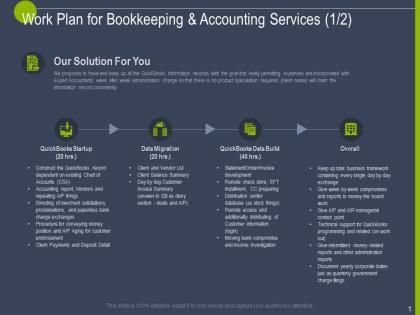
Our Work Plan For Bookkeeping And Accounting Services Ppt Powerpoint Presentation Show give an elaborate touch. Each segment recieves adequate attention.
People who downloaded this PowerPoint presentation also viewed the following :
Work plan for bookkeeping and accounting services ppt powerpoint presentation show with all 2 slides:
You can eke it out with our Work Plan For Bookkeeping And Accounting Services Ppt Powerpoint Presentation Show. They need only your mental input.
FAQs for Work plan for bookkeeping and accounting services ppt
Bookkeeping involves recording daily financial transactions, maintaining ledgers, and tracking receipts and payments, while accounting analyzes this data to create financial statements, tax returns, and strategic reports. These functions complement each other seamlessly, with bookkeepers providing the foundational data that accountants use for financial analysis, budgeting, and compliance reporting, ultimately delivering comprehensive financial management and informed decision-making capabilities for businesses.
Small businesses benefit from outsourcing bookkeeping and accounting services by reducing operational costs, accessing expert financial expertise, and freeing up valuable time for core business activities. This strategic approach enables entrepreneurs to focus on growth while ensuring compliance with tax regulations, ultimately delivering improved cash flow management and professional financial reporting that enhances credibility with investors and lenders.
Essential bookkeeping and accounting software tools include QuickBooks, Xero, FreshBooks, Sage, and Wave Accounting. These platforms streamline financial management by automating transaction recording, generating real-time reports, and ensuring tax compliance, with many small businesses and accounting firms finding that integrated features ultimately deliver enhanced accuracy, reduced processing time, and improved financial visibility.
Ensuring accuracy and compliance in bookkeeping requires implementing systematic verification processes, regular reconciliation procedures, standardized data entry protocols, automated error-checking systems, and adherence to accounting standards like GAAP or IFRS. Through double-entry bookkeeping and monthly reviews, businesses minimize discrepancies, maintain regulatory compliance, and deliver reliable financial reporting, with many organizations finding that these practices significantly enhance operational efficiency and audit readiness.
Common pitfalls include mixing personal and business expenses, neglecting regular reconciliations, poor cash flow tracking, inadequate expense documentation, and delayed financial reporting. These mistakes can lead to tax complications, funding challenges, and poor decision-making, with many startups finding that establishing systematic processes early prevents costly corrections and enhances investor confidence during growth phases.
Real-time financial data improves decision-making by providing immediate insights into cash flow, profitability, and operational performance, enabling business owners to respond quickly to market changes and opportunities. With automated dashboards and live reporting, companies can identify trends, optimize resource allocation, and make strategic adjustments instantly, ultimately delivering competitive advantages and enhanced financial control.
Bookkeeping provides the essential foundation for tax preparation by maintaining accurate records of income, expenses, deductions, and financial transactions throughout the year. This systematic documentation streamlines tax filing processes, ensures compliance with regulations, and maximizes deduction opportunities, with many businesses finding that organized bookkeeping significantly reduces preparation costs and audit risks.
Automated bookkeeping solutions streamline financial processes by eliminating manual data entry, reducing human errors, and providing real-time financial insights through integrated software systems. These technologies enable businesses to automatically categorize transactions, generate reports, and maintain compliance standards, with many companies finding that automation reduces processing time by up to 75% while enhancing accuracy and strategic decision-making capabilities.
Best practices for organizing financial records include establishing consistent digital filing systems, categorizing transactions by type and date, maintaining separate folders for income and expenses, implementing regular backup procedures, and using standardized naming conventions. These organizational methods streamline bookkeeping processes by reducing retrieval time, enhancing accuracy, and ensuring compliance readiness, with many businesses finding that systematic record organization ultimately delivers faster month-end closing and improved financial visibility.
Businesses should reconcile their accounts monthly at minimum, with many organizations performing weekly or even daily reconciliations for high-volume transactions like cash accounts and credit cards. This regular practice enables early detection of discrepancies, prevents fraud, ensures accurate financial reporting, and maintains regulatory compliance, ultimately delivering better cash flow management and strategic decision-making capabilities.
Every business owner should understand income statements, balance sheets, cash flow statements, accounts receivable aging reports, and budget variance reports. These essential financial reports enable effective management by tracking profitability, monitoring asset health, ensuring adequate liquidity, and identifying spending patterns, with many successful businesses finding that regular review ultimately delivers better decision-making and sustainable growth.
Bookkeeping services enhance cash flow management by tracking receivables and payables, monitoring payment patterns, and providing real-time financial visibility through detailed cash flow statements. Professional bookkeepers help small businesses identify payment delays, optimize vendor payment schedules, and forecast seasonal fluctuations, ultimately enabling better financial planning and preventing cash shortages that could disrupt operations.
Certified accountants offer strategic tax planning, financial analysis, audit preparation, and regulatory compliance expertise, while bookkeepers focus on daily transaction recording and basic financial maintenance. Accountants can guide complex business decisions, optimize tax strategies, and provide insights for growth, with many organizations finding that this strategic combination delivers enhanced financial oversight and competitive advantage.
Changes in accounting regulations significantly impact bookkeeping practices by requiring updated recording methods, revised chart of accounts structures, and enhanced compliance documentation procedures. These regulatory shifts often necessitate new software implementations, additional staff training, and modified internal controls, with many businesses finding that proactive adaptation ultimately delivers improved financial transparency, reduced audit risks, and stronger stakeholder confidence in an increasingly regulated environment.
Businesses should prioritize automated transaction categorization, real-time financial reporting, tax compliance support, multi-currency capabilities, and seamless integration with existing business systems when selecting providers. These features streamline financial operations by reducing manual data entry, enhancing accuracy, and delivering comprehensive insights, with many organizations finding that strategic partnerships ultimately enable better resource allocation and competitive advantage.
No Reviews