


0115 four staged rocket diagram powerpoint template





Try Before you Buy Download Free Sample Product
 Impress Your
 Audience
 100%
100% Editable
 Save Hours
 of Time


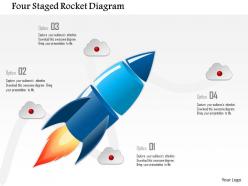
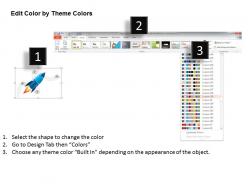
Creating a perfect PowerPoint presentation is not less than understanding rocket science as in both the cases you need to take care of even the smallest of the small detail. Worry not Slide Team has the solution to your problem. You might have a PPT consignment on any topic, Slide Team can handle it for you. Even your presentation related to science can be tackled with our 0115 four staged rocket diagram PowerPoint template crafted for all your science data related PPT. A rocket is shown flying at a full blast, along with this you can write a text giving a heading with some explanation. Your slides related to business and science-related presentations can be made using our graphics. Moreover, an effort is done to give you a stylish graphic and an innovative design. If you are an engineer, scientist, an entrepreneur or a businessman then using our slide can help you get the appreciation you deserve. Let your creativity go full blast as this not just any other slide template, it's the expression of your creativity. Your goal emerges clearly ahead with our 0115 Four Staged Rocket Diagram Powerpoint Template. They ensure the haze clears away.
People who downloaded this PowerPoint presentation also viewed the following :
0115 four staged rocket diagram powerpoint template with all 5 slides:
Be counted among the best with our 0115 Four Staged Rocket Diagram Powerpoint Template. They help you to be competitive.
FAQs for 0115 four staged rocket
A four staged rocket diagram typically represents mission phases, resource allocation, progressive development stages, sequential milestones, and fuel/propulsion systems across distinct operational levels. These components enable organizations to visualize complex project launches, product development cycles, and strategic initiatives by illustrating escalating complexity, resource requirements, and performance targets, with many teams finding that this structured approach streamlines planning and enhances stakeholder communication.
A four staged rocket diagram enhances space exploration presentations by visually representing mission phases, propulsion systems, fuel requirements, payload configurations, and staging sequences in a clear, engaging format. This template enables presenters to illustrate complex aerospace concepts, demonstrate launch progression from liftoff to orbit insertion, and showcase technological achievements, ultimately delivering enhanced audience comprehension and professional credibility.
When creating a PowerPoint template for a rocket diagram, look for software features like customizable vector graphics, layered object management, animation capabilities, color scheme flexibility, and precise alignment tools. These features enable designers to create professional, scalable presentations by streamlining visual consistency, enhancing stakeholder engagement through dynamic transitions, and ensuring brand alignment across organizational communications, ultimately delivering impactful presentations that effectively communicate multi-stage processes and strategic milestones.
A four-staged rocket diagram displays multiple separable sections with distinct fuel tanks, engines, and payload compartments, while single-stage rockets show one unified structure throughout the flight sequence. These multi-stage representations illustrate sequential separation phases, enhanced payload capacity, and improved orbital efficiency, with aerospace organizations finding that staged diagrams better communicate complex mission profiles and operational advantages.
Four staged rocket diagrams enhance engineering presentations by clearly illustrating sequential processes, complex system breakdowns, milestone progressions, and hierarchical component relationships. These visual tools streamline technical communication by making abstract engineering concepts tangible, enabling faster stakeholder comprehension, and facilitating better project planning discussions, with many engineering teams finding that structured diagrams ultimately deliver improved collaboration and more effective decision-making processes.
Animations can effectively highlight each rocket stage sequentially through entrance effects, motion paths, and emphasis animations, creating visual progression that mirrors the launch process. This approach enables presenters to unveil complex project phases, milestone achievements, or strategic developments systematically, with many organizations finding that animated rocket diagrams enhance audience engagement while delivering clearer understanding of multi-phase initiatives and competitive advancement strategies.
Common misconceptions include believing all rocket stages burn simultaneously, that larger stages are always more powerful, that stages detach randomly rather than at calculated points, and that fuel consumption remains constant throughout flight. A well-designed four-staged rocket diagram clarifies these complex sequences by illustrating precise timing, variable thrust levels, and strategic fuel management, with many aerospace educators finding that visual representations significantly enhance comprehension of propulsion physics and mission planning.
Four-staged rocket diagrams find relevance in software development for deployment pipelines, pharmaceutical companies for drug development phases, financial services for investment strategies, and manufacturing for product launch sequences. These industries leverage the progressive, milestone-based visual framework to communicate complex multi-phase processes, with many organizations finding that the upward trajectory metaphor effectively conveys growth, advancement, and systematic achievement of strategic objectives.
Effective color schemes enhance rocket diagram clarity by creating visual hierarchy, differentiating stages clearly, and guiding audience attention through logical flow patterns. Strategic color choices enable presenters to highlight critical components, distinguish between fuel systems and payload sections, while maintaining professional aesthetics that support technical comprehension and audience engagement throughout complex aerospace presentations.
**INPUT**: What additional data can be included alongside a four staged rocket diagram to provide context? **OUTPUT**: Additional data includes timeline milestones, budget allocations, key performance indicators, team responsibilities, and risk assessment metrics for each stage. These contextual elements enhance project clarity by connecting visual progression to measurable outcomes, resource requirements, and accountability structures, with many organizations finding that comprehensive data integration ultimately delivers better stakeholder alignment and strategic decision-making capabilities.
Strategic stage arrangement significantly enhances audience comprehension by creating logical flow, establishing clear hierarchical relationships, and enabling viewers to track progression through complex processes or timelines. Well-structured diagrams guide attention systematically from foundational concepts to advanced outcomes, with many presenters finding that sequential visual organization reduces cognitive load, accelerates understanding, and ultimately delivers more impactful presentations that resonate with stakeholders.
Creative approaches include using gradient color schemes that transition from cool to warm tones across stages, incorporating animated launch sequences, adding dimensional shadows for depth, integrating iconography within each stage, and using contrasting backgrounds like space imagery. These design elements enhance visual storytelling by creating clear stage differentiation, improving information retention, and maintaining audience engagement, with many presenters finding that strategic color psychology and subtle animations ultimately deliver more impactful presentations and stronger audience connection.
To ensure your rocket diagram PowerPoint template adapts for various audiences, customize content complexity, terminology, and focus areas while maintaining the core four-stage visual structure. Modify stage labels, data points, and supporting text to match audience expertise levels, whether presenting technical development phases to engineers or strategic milestones to executives, ultimately delivering clear communication that resonates with each specific stakeholder group.
Labeling serves as the navigational foundation for four staged rocket diagrams, providing clear identification of each phase, specific outcomes, timelines, and key milestones that guide audience understanding. Effective labels transform abstract visual elements into actionable business roadmaps, with many organizations finding that strategic labeling enhances comprehension, streamlines stakeholder alignment, and ultimately delivers stronger project buy-in across departments.
Feedback from previous presentations influences rocket diagram design by identifying confusing visual elements, highlighting sections needing clearer progression flows, and revealing audience comprehension gaps. Through iterative refinements based on viewer responses, presenters enhance stage differentiation, streamline information hierarchy, and optimize color schemes, ultimately delivering more impactful presentations that resonate with diverse stakeholders across industries.
-
It saves your time and decrease your efforts in half.
-
Very unique and reliable designs.