


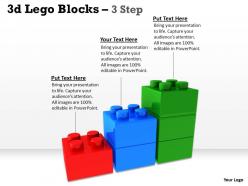
3d lego blocks 3 step





Try Before you Buy Download Free Sample Product
 Impress Your
 Audience
 100%
100% Editable
 Save Hours
 of Time


Club them together with our 3d Lego Blocks 3 Step. Your thoughts will all get into line.
People who downloaded this PowerPoint presentation also viewed the following :
3d lego blocks 3 step with all 3 slides:
Crack the code with our 3d Lego Blocks 3 Step. Unravel the formula for success.
FAQs for 3d lego
Fundamental principles include strong foundational layers, overlapping brick patterns, strategic stud connections, proper weight distribution, and reinforced corner joints. These structural techniques work by distributing stress evenly, minimizing weak connection points, and ensuring load-bearing stability, with many builders finding that alternating brick orientations and cross-bracing ultimately delivers superior durability and construction integrity.
Different Lego block sizes and shapes fundamentally determine structural integrity, visual complexity, and design flexibility by enabling varied connection points, creating detailed textures, and supporting diverse architectural approaches. Larger blocks provide foundational stability for complex builds like architectural models or vehicles, while smaller specialized pieces enable intricate detailing and curved surfaces, ultimately delivering enhanced creative possibilities and more sophisticated final presentations.
Digital tools for visualizing 3D Lego projects include LEGO Digital Designer, Stud.io, LeoCAD, LEGO Builder, and BrickLink Studio. These platforms streamline project planning by enabling virtual construction, automated part counting, and step-by-step instruction generation, with many builders finding that digital visualization significantly reduces construction time and minimizes costly piece ordering errors.
Effective color theory in 3D Lego design incorporates complementary colors for contrast, analogous colors for harmony, and strategic accent colors to highlight key features or guide visual flow. Through thoughtful color placement, builders create depth using darker shades for shadows and lighter tones for highlights, while maintaining cohesive palettes that enhance structural elements and storytelling, ultimately delivering visually compelling models.
Techniques to enhance 3D Lego model aesthetics include advanced building methods like SNOT (Studs Not On Top), texture variation, strategic color blocking, forced perspective, and micro-detailing. These approaches streamline visual impact by eliminating stud visibility, creating realistic surfaces, and adding depth, with many builders finding that combining multiple techniques ultimately delivers professional-quality models with enhanced dimensional appeal.
Proper weight distribution in larger 3D Lego builds requires strategic foundation planning, internal support structures, symmetrical element placement, and careful connection point reinforcement throughout the construction process. These techniques streamline stability by distributing load across multiple contact points, minimizing stress concentrations, and enhancing structural integrity, with many complex architectural and engineering projects finding that systematic weight management ultimately delivers more durable builds and reduces reconstruction needs.
Best practices for starting complex 3D Lego projects include organizing pieces by color and size, studying instruction manuals thoroughly, creating adequate workspace, planning build sequences, and gathering necessary tools like brick separators. These preparation methods streamline construction by minimizing search time, reducing assembly errors, and maintaining momentum throughout lengthy builds, with many experienced builders finding that proper organization ultimately delivers faster completion times and enhanced building satisfaction.
Managing Lego inventory during building involves sorting pieces by color and type, using compartmentalized storage systems, and organizing components according to construction phases. This systematic approach streamlines assembly workflows, minimizes search time, and reduces building delays, with many enthusiasts finding that strategic inventory management ultimately delivers faster completion times and enhanced building experiences.
Common mistakes in 3D Lego building include inadequate foundation planning, ignoring structural support beams, rushing connection points, overlooking symmetry requirements, and insufficient piece inventory management. These oversights often compromise stability and visual appeal, with many builders finding that methodical planning, strategic reinforcement techniques, and systematic assembly approaches ultimately deliver more durable constructions and satisfying building experiences.
Creative Lego construction involves utilizing standard pieces through unconventional orientations, stacking techniques, angle variations, interlocking methods, and strategic color combinations to build complex geometries. Many builders find that experimenting with sideways connections, overlapping patterns, and modular assembly approaches enables intricate architectural details, organic curves, and sculptural elements that extend far beyond traditional building methods, ultimately delivering unlimited structural possibilities.
Modular building enables detailed 3D Lego construction by breaking complex models into manageable sections, standardizing connection points, and allowing independent assembly of components before integration. This approach streamlines the building process, reduces errors, and facilitates collaborative construction projects, with many builders finding that modular techniques ultimately deliver greater precision and scalability for intricate designs.
Storytelling enhances 3D Lego design by establishing clear narrative structure, defining character motivations, creating emotional connections, and guiding architectural choices throughout the building process. This approach enables designers to make cohesive design decisions, develop compelling scenes, and create immersive experiences, with many creative professionals finding that narrative-driven builds deliver stronger visual impact and audience engagement.
Documentation tips include photographing each major step, noting piece counts and colors, sketching connection points, recording alternative techniques, and maintaining a build log with timestamps. These methods streamline reconstruction by providing visual references, technical details, and process insights, with many builders finding that systematic documentation enables sharing instructions, troubleshooting assembly issues, and ultimately delivering repeatable construction workflows for complex creations.
Light and shadow significantly enhance 3D Lego model perception by creating depth, defining structural boundaries, and emphasizing dimensional relationships between components. Strategic lighting reveals intricate details, surface textures, and architectural elements that remain hidden in flat presentations, with many designers and educators finding that proper illumination transforms static builds into engaging, visually compelling demonstrations.
Collaborative building enhances 3D Lego designs by combining diverse creative perspectives, specialized skills, and complementary problem-solving approaches that individual builders often lack. Teams can tackle complex architectural challenges more efficiently, with members focusing on different structural elements simultaneously, ultimately delivering more intricate designs and innovative solutions while accelerating project completion.
-
Great product with effective design. Helped a lot in our corporate presentations. Easy to edit and stunning visuals.
-
Very unique, user-friendly presentation interface.