


Activity strategic plan prioritize options process





Try Before you Buy Download Free Sample Product
 Impress Your
 Audience
 100%
100% Editable
 Save Hours
 of Time


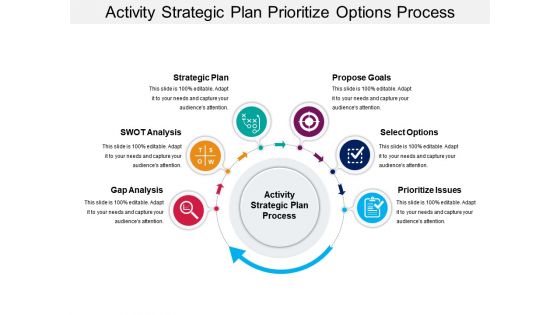
Formulate a strategic plan for business growth and development using this Activity Strategic Plan Prioritize Options Process PPT template. The strategic planning PPT slide will help you prioritize the major issues; thereby helping you in strategizing your plans to curb those risks and gaps. Strengthen the organizational operations by formulating strategic plans for the achievement of organizational goals and objectives. With the assistance of this readymade strategic management PPT slide design, you can also conduct a gap analysis and find out the deviations in the actual and the desired outcomes. Take corrective actions to minimize the gap and showcase the same using our professionally curated business strategy mapping PowerPoint slide show. By using this marketing strategy PowerPoint graphic, you can also guide the subordinates on how to conduct a SWOT analysis. Describe the elements of business planning and present it in front of the audience with this amazingly designed growth planning PPT diagram.
People who downloaded this PowerPoint presentation also viewed the following :
Activity strategic plan prioritize options process with all 5 slides:
Give them a chance to bury the hatchet with our Activity Strategic Plan Prioritize Options Process. They help bring about agreement.
FAQs for Activity strategic plan
Start with your vision and mission - what are you actually trying to accomplish? Then dig into environmental analysis, both internal stuff and external factors. Goal setting comes next, but make them specific and measurable (none of that vague "increase sales" nonsense). Strategy development follows, then implementation planning with clear owners and realistic timelines. Build in quarterly checkpoints because things always go sideways. Involve stakeholders early, not when you're done. Honestly, most strategic plans fail because people skip the nitty-gritty implementation details. Who's doing what by when? That's where the rubber meets the road.
Start with your vision and mission - what are you actually trying to achieve? Break those down into themes, then figure out what specific outcomes would get you closer. Think of objectives as your stepping stones. Honestly, I've seen way too many companies where their strategic plan has nothing to do with what they claim to care about. Don't be one of those places. Each objective needs a clear connection back to your core purpose. Here's the test that actually matters: can you trace a straight line from every objective back to why your organization exists? If not, you're probably off track.
So stakeholder analysis is like mapping out everyone who could make or break your strategy. Start with the obvious ones - employees, customers, investors, regulators. Don't forget competitors though, they matter too. Then dig into what each group actually wants and how much power they have. Honestly, the visual mapping part is where it gets interesting - you'll spot connections you missed before. This whole exercise helps you see potential problems coming and figure out who you need on your side. Without doing this first, you're just shooting in the dark. Trust me, it's worth the time upfront.
Honestly, most companies do their big strategic review once a year, which works pretty well. But here's what I've seen work better - check in every quarter to see how things are going and tweak stuff as needed. Markets change so damn fast now! Save the major overhauls for that yearly deep dive unless something crazy happens in your industry. Really volatile sectors might need to look at things twice a year though. You don't want to be constantly pivoting (drives everyone nuts), but you can't just set it and forget it either. I'd start with those quarterly check-ins and adjust from there.
Pick metrics that actually connect to what you're trying to accomplish - revenue growth, customer retention, market share, whatever your main goals are. Financial stuff matters obviously, but don't ignore the early warning signals like employee engagement or customer satisfaction. Those predict what's coming down the road. I've watched too many companies obsess over lagging indicators and completely miss the red flags. Honestly, less is more here. Choose 3-5 metrics that your stakeholders actually care about and track them religiously. Build a simple dashboard you'll check monthly - not some massive presentation that nobody opens.
Dude, forget those crazy long-term plans - they're basically useless now. Do 1-2 year cycles instead, then check in quarterly to see what's actually happening. Keep your eyes on the market constantly because things change so fast these days. Oh, and definitely game out a few "what if" scenarios ahead of time. The companies that didn't totally crash during COVID? They were already doing this flexible planning thing. Your big goals should stay solid, but how you get there needs to shift quickly. And seriously - streamline your decision process. Nobody has time for endless meetings when you need to pivot fast.
Honestly just use a simple 2x2 grid - even Google Docs works great for this. I've watched teams waste hours picking the "perfect" SWOT tool when a whiteboard gets the job done just fine. Miro's pretty solid though if you need something fancier, and Lucidchart has decent templates too. Oh, and here's something most people skip - after you finish your SWOT, try doing a TOWS matrix. It actually helps you figure out what to DO with all those insights instead of just having a nice-looking chart that sits in a folder somewhere.
Don't just tack risk assessment onto the end - weave it through your whole planning process. When you're scanning the landscape, spot potential risks early. Then figure out how they'd mess with your goals. I learned this the hard way after getting blindsided too many times! Always ask "what could blow this up?" when setting tactics. Build backup plans alongside your main stuff. Someone needs to own monitoring the big risks too - can't just be everyone's job, you know? Make it an ongoing thing, not some box you check once.
Dude, most people mess up by being way too vague - like "let's boost sales 30%" without any actual plan. Super annoying. Talk to the people doing the real work, not just suits in meetings. Your strategy shouldn't become some forgotten document in a drawer somewhere. Actually review it every few months because things change fast. Sometimes you'll need to completely switch directions when stuff doesn't work out. Oh, and don't try to involve everyone - too many cooks in the kitchen makes everything worse. Keep it flexible.
Honestly, tech has completely changed how I approach strategic planning. Business intelligence dashboards are clutch for getting real-time data instead of guessing. Project management tools help you actually track if you're hitting those big goals. AI and predictive stuff can catch patterns you'd totally miss - sounds fancy but it's genuinely useful. Your team can collaborate from anywhere with cloud platforms too, which is nice. Oh, and don't make my mistake of adding tools that don't talk to each other. Figure out what's frustrating you most about planning first, then find something that plays well with what you already use.
Honestly, your strategic plan is worthless if nobody understands it. I've watched brilliant strategies crash because leadership thought people would just figure it out on their own - spoiler alert, they don't. Map out who needs what info and when they need it. Different people prefer different communication styles too, so don't just blast everyone with the same generic email. Cover your rollout meetings, regular updates, feedback sessions. The whole thing. Most importantly? Help people connect the strategy to their actual job. Otherwise you'll have teams going in totally different directions while management wonders why nothing's working.
Honestly, just get your people involved from the start instead of dropping some finished plan on them. Run some focus groups or quick surveys - you'd be surprised how much good stuff they'll come up with. Mix up some cross-department committees too so you're not getting the same viewpoint over and over. I'd probably do regular updates showing how you're actually using their ideas (people hate feeling ignored). Maybe try a big company-wide planning session? Sounds cheesy but it works. The whole thing should feel collaborative, not like management locked themselves in a room for three days.
Honestly, start with your big 3-year vision first, then work backwards from there. Short-term stuff needs actual numbers you can track each month - I'm talking real quarterly goals, not vague hopes. But here's the thing that trips everyone up: your weekly tasks have to actually connect to those bigger dreams, otherwise you're just spinning your wheels. I check my long-term plan twice a year since everything moves so fast now. Weekly check-ins keep me honest on the day-to-day execution though. The whole "dream big, act small" thing actually works if you don't skip the connecting part.
Honestly, competitive analysis is a game changer for figuring out your strategy. It shows you what's working in the market and where there are gaps you can jump into. You'll see what competitors are screwing up so you don't make the same mistakes. Plus it helps with pricing and deciding which features to build first - saves you from wasting time on stuff nobody wants. I'd map out your top 3-5 competitors every few months and keep tabs on their big moves. It's basically like having insider info on the whole market landscape, which sounds dramatic but it really does help you avoid costly screw-ups.
Honestly, strategic planning can totally shift your company culture if you do it right. When people actually help build the vision instead of just getting it dumped on them, they're way more invested. Your team starts seeing how their boring Tuesday tasks connect to something bigger - that's huge for motivation. Plus the whole process makes people feel like their opinions matter. I mean, we tried this at my last job and it worked pretty well, though it took a few tries to get the hang of it. Just don't make it some fake participation thing where you ignore their input afterward. That'll backfire fast and make everyone even more cynical than before.
-
Use of different colors is good. It's simple and attractive.
-
Top Quality presentations that are easily editable.