


Actual Vs Budget Variance Powerpoint Presentation Slides




Try Before you Buy Download Free Sample Product
 Impress Your
 Audience
 100%
100% Editable
 Save Hours
 of Time


Compare changes in financial performance with our content ready Actual Vs Budget Variance PowerPoint Presentation Slides. Identify financial problems and investigate issues using the topic-specific budget analysis report presentation deck. The professionally designed financial forecasting PowerPoint complete deck includes a set of ready-to-use templates such as actual cost vs budget, month-wise forecasting, overhead cost analysis, quarterly budget analysis, variance analysis, actual vs target variance, budget vs plan vs forecast, forecast and projection, etc. Discuss variance in business statements using plan vs. actual financial performance PPT visuals. Utilize professional looking budget variance analysis PowerPoint templates to figure out why your planned and actual performance doesn’t match. Incorporate variance reporting PowerPoint templates to control current expenditures and future costs. Furthermore, the self-explanatory variance analysis in budgeting PPT slides is also helpful in the financial forecast and planning. Thus, download the budget presentation to create a performance audit report. Our Actual Vs Budget Variance Powerpoint Presentation Slides can carry a heavy burden. You will find they have great capacity.
People who downloaded this PowerPoint presentation also viewed the following :
Content of this Powerpoint Presentation
Slide 1: This slide introduces Actual vs Budget Variance. State Your Company Name and begin.
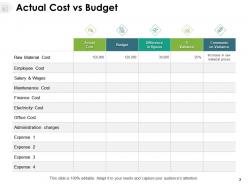
Slide 2: This slide shows Actual Cost vs Budget in tabular form.
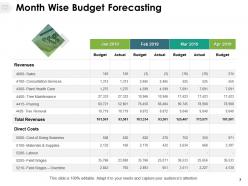
Slide 3: This slide presents Month Wise Budget Forecasting.
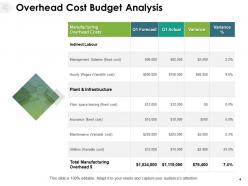
Slide 4: This slide displays Overhead Cost Budget Analysis.
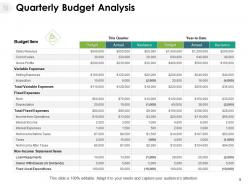
Slide 5: This slide represents Quarterly Budget Analysis in tabular form.
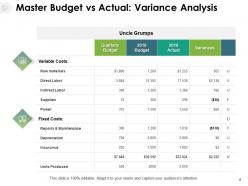
Slide 6: This slide showcases Master Budget vs Actual: Variance Analysis with variable and fixed costs.
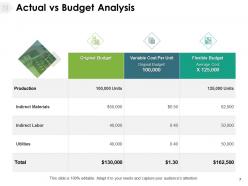
Slide 7: This slide shows Actual vs Budget Analysis with categories as original budget, variable cost per unit and flexible budget.
Slide 8: This slide presents Actual vs Target Variance.
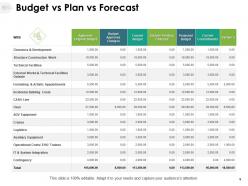
Slide 9: This slide displays Budget vs Plan vs Forecast. You can add data as per requirements.
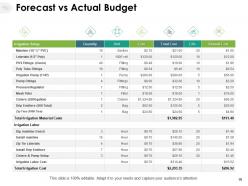
Slide 10: This slide represents Forecast vs Actual Budget.
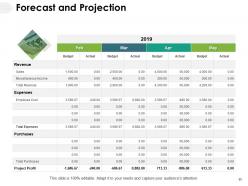
Slide 11: This slide showcases Forecast and Projection on monthly basis.
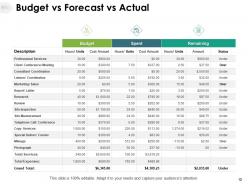
Slide 12: This slide shows Budget vs Forecast vs Actual.
Slide 13: This slide displays icons for Actual vs Budget Variance.
Slide 14: This slide is titled as Additional Slides for moving forward.
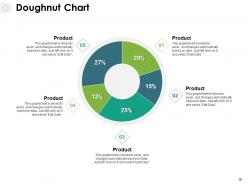
Slide 15: This slide displays Donut chart with data in percentage.
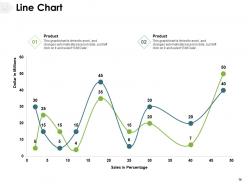
Slide 16: This slide shows Line Chart with two products comparison.
Slide 17: This is Our Mission slide with related imagery and text.
Slide 18: This is Our Team slide with names and designation.
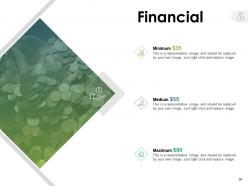
Slide 19: This is a Financial slide. Show your finance related stuff here.
Slide 20: This is a Comparison slide to state comparison between commodities, entities etc.
Slide 21: This is a Thank You slide with address, contact numbers and email address.
Actual Vs Budget Variance Powerpoint Presentation Slides with all 21 slides:
Use our Actual Vs Budget Variance Powerpoint Presentation Slides to effectively help you save your valuable time. They are readymade to fit into any presentation structure.






FAQs for Actual Vs Budget Variance
So variance analysis is just comparing what you actually spent/earned versus what you budgeted for, then digging into why things were different. Really helpful for catching problems before they get out of hand. Like if you planned to spend $5k on marketing but dropped $8k instead - you'd want to know why, right? Monthly reviews work best in my experience, though honestly it can be a pain to stay on top of. But it's worth it because you'll spot trends early and figure out what's actually driving your numbers. Way better than flying blind and hoping for the best.
So basically, variance analysis is just comparing what you actually spent vs. what you planned to spend. Super helpful for figuring out why your budgets keep getting wrecked. Like, maybe marketing always goes over or your sales projections are way too optimistic (happens to everyone). Once you spot these patterns, you can adjust future budgets accordingly. Build in some cushion for the departments that consistently blow past their limits. It's honestly like learning from your mistakes - if you always underestimate office supplies or whatever, factor that in next time. Makes your planning way more realistic.
You need your actual numbers and what you budgeted for - that's basically it. Calculate the difference between them, then figure out why there's a gap. Most people split this into price variance (costs went up or down?) and volume variance (sold more or less than expected?). Honestly, I'd tackle the biggest variances first. No point spending hours on tiny differences that don't really move the needle. My old manager used to obsess over every single variance and it was such a waste of time. Focus on the ones that actually tell you something useful about your business.
Okay so favorable variances are great - you either spent less or made more than planned, which obviously helps your profits. Unfavorable ones hurt your margins and might mean something's going wrong operationally. But here's the thing that trips people up: sometimes "unfavorable" variances aren't actually bad. Like if you spend extra on better materials to avoid angry customers down the road, that's smart business. The real trick is figuring out WHY each variance happened. Then you'll know if you should be celebrating, fixing a problem, or just tweaking next year's budget.
So sales variance is just whether you made more or less money than you planned. Pretty straightforward. Cost variance tracks the same thing but for what you spent - did expenses blow up or stay in line? Profit variance is where things get messy (and where your boss will definitely care most). It's both of those rolled together hitting your bottom line. Here's the thing though - you could nail your sales goals but still be screwed if costs went crazy. I'd look at each one separately first, then piece together what actually happened. Makes way more sense that way.
Honestly, variance analysis is like your business keeping a diary - it shows you patterns you'd miss otherwise. When labor costs spike 15% every Q3, that's not random. Build those trends into your forecasts instead of acting surprised each time. Look for the bigger picture beyond individual numbers - what's driving seasonal swings? Where are the bottlenecks? I'd track these patterns quarterly (even if it's boring) and use them to question your assumptions when planning next year's strategy. Your "mistakes" become goldmines for better decisions.
Okay so variance analysis is like your heads-up for when costs start going sideways. You compare what you actually spent vs what you budgeted, and boom - you can catch problems early instead of getting smacked with surprises later. Check your material and labor variances weekly (I learned this the hard way). Did supplier prices jump? Is your team moving slower than usual? Figure out the why, then fix it quick. Honestly, those weekly reports will save your butt more times than you'd think. Way better than scrambling at month-end trying to explain where everything went wrong.
So variance analysis is super helpful for tracking down where you're losing money compared to your budget. Compare what you planned against reality - labor, materials, how efficient production actually was. The cool part? Don't just look at the numbers. Dig into why things went sideways. Maybe materials cost more because your supplier screwed up, or productivity tanked because nobody got proper training. I've seen companies waste months just staring at bad numbers instead of fixing what's broken. Once you spot these patterns, you can actually solve the root problems.
Don't fall for the trap of thinking favorable = good and unfavorable = bad. Sometimes you'll find favorable variances that actually hide problems brewing underneath. Dig into the why behind each number instead of just celebrating or panicking. Timing stuff can mess with your head too - like comparing March actuals to a budget built on different seasonal assumptions. Big variances grab attention, but honestly? Those smaller ones might be telling you more about what's actually broken. Context is everything. What's the real story here, and what rabbit hole should you go down next?
Honestly, monthly is your sweet spot - gives you enough info to catch trends without drowning in daily weirdness. I used to check weekly like an idiot and just confused myself with random ups and downs. Smaller companies can probably get away with quarterly, but monthly's better if you can swing it. Tight budget or big project? Maybe go bi-weekly. But here's the thing - consistency beats frequency every time. Pick whatever schedule your team won't blow off and stick to it. Oh, and make sure you're actually comparing the same stuff each time. Start monthly, see how it goes.
Honestly, variance analysis is way more than just crunching numbers. Market shifts, supplier drama, new regulations - that stuff explains way more than your spreadsheets will. Don't forget internal chaos either: low morale, training issues, process changes. Sometimes your biggest variance driver isn't even in the financial reports, which is kinda annoying but whatever. Timing differences and one-off events mess things up too. Before you panic about the numbers, just ask yourself what was actually going down operationally that month. That's where you'll find your real answers.
Honestly, tech makes variance analysis so much better - no more calculation errors that used to make me want to pull my hair out. Your ERP system can feed data straight into analytics software, which cuts out all that manual entry nonsense. Even Excel works if you're on a tight budget, though dedicated tools are way better for flagging weird variances automatically. The dashboards actually help you spot trends instead of staring at spreadsheets forever. Different departments will use the same formulas too, so you're not comparing apples to oranges. Start with what you've got and upgrade later.
So basically, you want to match each department's metrics to what they can actually control. Sales should track revenue vs targets. Production focuses on material and labor costs. HR looks at headcount or training budgets - that kind of thing. Finance tracks budget variances everywhere (obviously). The trick is figuring out what each team directly impacts first, then building your variance reports around those factors. It's way more flexible than it sounds once you mess around with it. Just don't make marketing track manufacturing costs or whatever - that'd be pointless.
External stuff can really mess with your variance analysis - inflation hits material costs, interest rates change your financing expenses, currency swings impact international ops. Exchange rates are honestly the worst if you've got global suppliers. You can't control any of this but it hammers your numbers anyway. The trick is figuring out what's external versus what you actually screwed up operationally. When reviewing variances, I always think: could we have done something different here? Or was this just the economy being the economy? Separating controllable from uncontrollable variances is key to not going crazy.
Yeah, definitely worth it! Small businesses actually benefit more since you can't afford to waste money. Just track your actual monthly expenses against what you budgeted. Super basic stuff - did supplies cost more than expected? Labor run over? I used to think this was tedious accounting nonsense, but honestly the patterns are kind of shocking when you first see them. Focus on your biggest expense categories first, then work down. You'll catch where money's really going vs. where you assumed it went. The trick is being consistent about it - not waiting until you're already in trouble to check.
-
Easy to edit slides with easy to understand instructions.
-
Easily Understandable slides.
-
Great product with highly impressive and engaging designs.
-
Very well designed and informative templates.