


Agile manifesto powerpoint presentation slides




Try Before you Buy Download Free Sample Product
 Impress Your
 Audience
 100%
100% Editable
 Save Hours
 of Time


The highest priority must be to satisfy customers through the delivery of valuable software agile manifesto is thus vital for firms to set critical values. This helps develop teams work more sustainably as the document lays down basic principles for firms to work more efficiently. Check out our professionally designed template on Agile Manifesto that will guide you on how to collaborate throughout the development process and engage customers. The proposal aims to describe twelve principles in detail for software developers and identify agiles marketing values. This template acknowledges the main factors and development of the agile manifesto and its four agile core values. Firms can present fundamental values of software development, marketing values, twelve principles, ways of performing, marketing mindset, and more. Working techniques can be differentiated for waterfall and agile using line charts, infographics, bar graphs, etc. The template provides you with an opportunity to show the yearly profits of your companys products using stacked column charts. Monthly operating and revenue positions can be presented using line charts for all the products, also exhibit details about your firm, target audience, goals, etc. Customize this 100 percent editable template based on your requirements and book a free demo for all your queries. Download the proposal now.
People who downloaded this PowerPoint presentation also viewed the following :
Content of this Powerpoint Presentation
Slide 1: This slide introduces Agile Manifesto. State Your Company Name and begin.
Slide 2: This is an Agenda slide. State your agendas here.
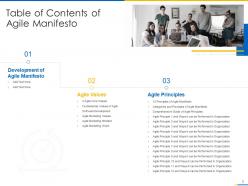
Slide 3: This slide shows Table of Content for the presentation.
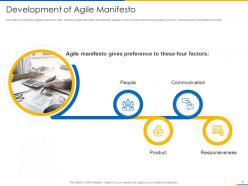
Slide 4: This slide provides the glimpse about the main factors of agile manifesto development based on their preferences such as people, product, communication and responsiveness.
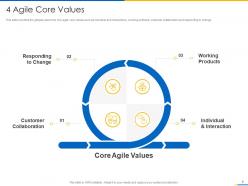
Slide 5: This slide presents the glimpse about the four agile core values such as individual and interactions, working software, customer collaboration and responding to change.
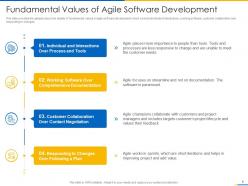
Slide 6: This slide displays the glimpse about the details of fundamental values of agile software development which covers individuals & interactions, working software, customer collaboration and responding to changes.
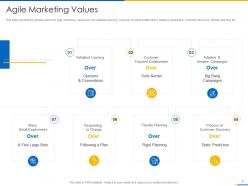
Slide 7: This slide represents the glimpse about the agile marketing values such as validated learning, customer focused collaboration, adaptive campaigns, customer discovery, flexible planning, etc.
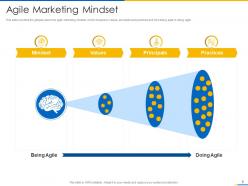
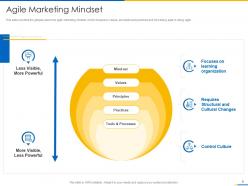
Slide 8: This slide showcases the glimpse about the agile marketing mindset which focuses on values, principles and practices and from being agile to doing agile.
Slide 9: This slide provides the glimpse about the agile marketing mindset which focuses on values, principles and practices and from being agile to doing agile.
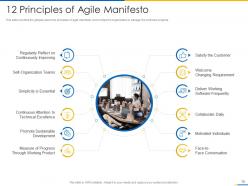
Slide 10: This slide shows the glimpse about the principles of agile manifesto which helps the organization to manage the software projects.
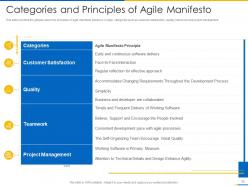
Slide 11: This slide presents the glimpse about the principles of agile manifesto based on 4 major categories such as customer satisfaction, quality, teamwork and project management.
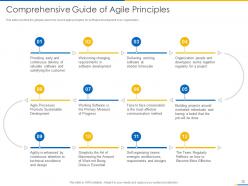
Slide 12: This slide represents the glimpse about the twelve agile principles for software development in an organization.
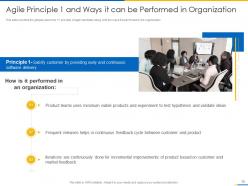
Slide 13: This slide showcases the glimpse about the 1st principle of agile manifesto along with the ways it is performed in the organization.
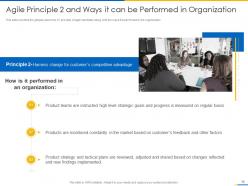
Slide 14: This slide provides the glimpse about the 2st principle of agile manifesto along with the ways it is performed in the organization.
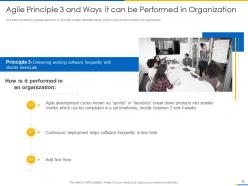
Slide 15: This slide shows the glimpse about the 3st principle of agile manifesto along with the ways it is performed in the organization.
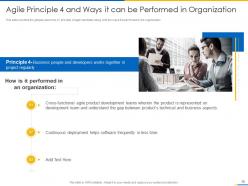
Slide 16: This slide presents the glimpse about the 4st principle of agile manifesto along with the ways it is performed in the organization.
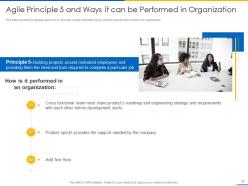
Slide 17: This slide displays the glimpse about the 5th principle of agile manifesto along with the ways it is performed in the organization.
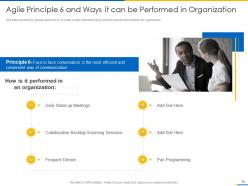
Slide 18: This slide represents the glimpse about the 6th principle of agile manifesto along with the ways it is performed in the organization.
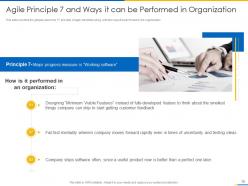
Slide 19: This slide showcases the glimpse about the 7th principle of agile manifesto along with the ways it is performed in the organization.
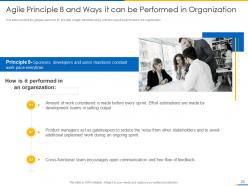
Slide 20: This slide shows the glimpse about the 8th principle of agile manifesto along with the ways it is performed in the organization.
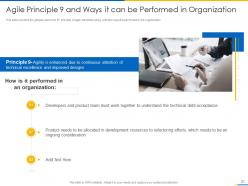
Slide 21: This slide presents the glimpse about the 9th principle of agile manifesto along with the ways it is performed in the organization.
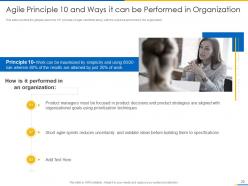
Slide 22: This slide displays the glimpse about the 10th principle of agile manifesto along with the ways it is performed in the organization.
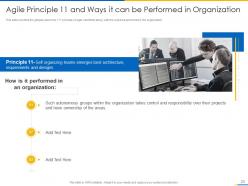
Slide 23: This slide represents the glimpse about the 11th principle of agile manifesto along with the ways it is performed in the organization.
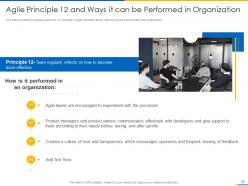
Slide 24: This slide showcases the glimpse about the 12th principle of agile manifesto along with the ways it is performed in the organization.
Slide 25: This slide shows Icons for Agile Manifesto.
Slide 26: This slide is titled as Additional Slides for moving forward.
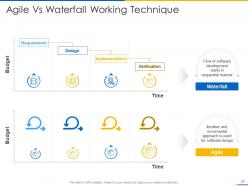
Slide 27: This slide shows Agile Vs Waterfall Working Technique.
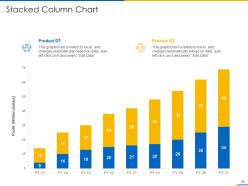
Slide 28: This slide showcases Stacked Column Chart with two products comparison.
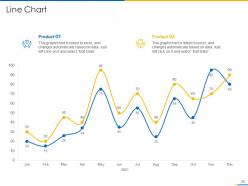
Slide 29: This slide displays Line Chart with two products comparison.
Slide 30: This is About Us slide to show company specifications etc.
Slide 31: This is Our Mission slide with related imagery and text.
Slide 32: This is Our Team slide with names and designation.
Slide 33: This is Our Target slide. State your targets here.
Slide 34: This slide shows Puzzle with additional textboxes.
Slide 35: This is a Thank You slide with address, contact numbers and email address.
Agile manifesto powerpoint presentation slides with all 35 slides:
Use our Agile Manifesto Powerpoint Presentation Slides to effectively help you save your valuable time. They are readymade to fit into any presentation structure.




FAQs for Agile manifesto
So the four values are basically: talk to people instead of hiding behind processes, ship working stuff rather than writing endless docs, collaborate with customers instead of just sticking to contracts, and pivot when things change rather than following some rigid plan. I mean, sounds super obvious right? But it actually changes everything about how you run projects. You end up having way more conversations with your team and users instead of drowning in paperwork. Quick feedback becomes your best friend. Honestly? Just start talking to people more and cut those feedback cycles way down.
Honestly, it just means talk to your team instead of hiding behind tools and processes all the time. Face-to-face conversations beat rigid workflows every single day. I've watched teams spend forever tweaking their project management setup when they could've just had a quick chat and fixed everything. You'll get way faster decisions and people actually feel like they matter. Knowledge gets shared better too. Oh and trust me - those informal check-ins with teammates work way better than waiting for status updates in whatever app you're using. Sometimes the old-school approach just wins.
Honestly? Stop thinking of customers as people you need to protect yourself from with bulletproof contracts. Work WITH them instead. Get them involved in sprint reviews, ask for feedback constantly, and expect their requirements to change - because they always do anyway. Rather than spending forever writing detailed contracts that predict every scenario (spoiler: impossible), just collaborate throughout the whole project. Regular check-ins beat rigid terms every time. Your products will be better and you'll actually build real relationships instead of just... transactional stuff.
Build flexibility right into how you plan stuff. Short cycles work way better than those massive long-term roadmaps - like quarterly check-ins where you can actually pivot. Honestly, I've watched teams cling to dead plans just because they wrote them down once. Treat your plans like rough drafts, not holy scripture. Set up feedback loops with customers so you catch problems early. The real trick? Make sure your team sees changing direction as smart, not like you failed. Regular retrospectives help too - though those can get a bit boring if you're not careful.
Honestly, self-organizing teams are what make Agile actually click. Your team gets to decide how they'll tackle work instead of waiting around for management approval on every tiny decision. Way faster that way. It connects to that whole "people over processes" thing - teams find their groove naturally. I've seen it work best when everyone owns their piece rather than just taking orders from above. Oh, and the technical decisions thing is huge too. If you're rolling out Agile, just give your team real autonomy to organize themselves. Trust me, micromanaging kills the whole vibe.
So basically, working software beats endless documentation because actual code is what users care about. Documentation still matters - trust me, you'll hate yourself later if you leave zero notes. But here's the thing: most teams go overboard writing these massive docs that nobody reads anyway. Focus on building stuff that actually works first. Then document the important bits - like the weird edge cases or why you made certain decisions. Just don't spend three days writing a novel about a simple feature when you could've built two more features instead.
Oh man, the biggest thing people get wrong? Thinking Agile means zero docs or planning. But the Manifesto says value working software *over* documentation - not skip it entirely. Teams assume it's just "move fast, break stuff" (thanks Silicon Valley lol) when it's actually about staying flexible while keeping discipline. Structure is still needed! Just not the rigid kind that can't adapt. Honestly, most teams should just re-read the Manifesto together and hash out what "over" really means day-to-day. Makes a huge difference.
Oh yeah, remote Agile definitely works! Video standups are a must - way better than Slack updates. Digital boards work great for sprint planning too. I'd actually do retros more often since you can't just read the room like before. The people-first thing becomes huge when everyone's isolated at home. Track outcomes, not hours logged (learned this the hard way). Create those random coffee chat moments on purpose since they won't happen naturally. Honestly? Just pick one thing to fix this sprint and see what happens. Don't overthink it.
Yeah, the Agile Manifesto has this whole principle about sustainable development - basically saying teams should work at a pace they can maintain forever. No more death march sprints (thank god). Working software beats endless documentation, so you're not wasting time on paperwork nobody reads. Plus responding to change means you won't spend months building the wrong product. Oh, and focusing on people over processes creates way healthier team dynamics. Honestly, just start tracking your team's velocity and watch for burnout patterns between sprints.
Honestly, ditch the velocity obsession and focus on what actually matters. Are your teams talking to stakeholders? Getting real features to users regularly? Customer feedback loops tell you way more than burndown charts ever will. I'd start surveying both customers and teams monthly about satisfaction and communication quality. Track how often you pivot based on actual user needs - that's where the magic happens. Retrospective outcomes matter too. Some managers get all excited about story points, but they're totally missing the point. Quick delivery and adaptability beat perfect charts every time.
Dude, Agile completely changes how you lead - no more micromanaging every little thing. You become more like a coach who clears roadblocks instead of someone barking orders. Honestly, most managers hate this shift at first because it feels weird not controlling everything. Your job becomes asking "how can I help?" rather than demanding status updates all the time. Trust your team's expertise more. Create space for them to experiment and make decisions. I know it sounds scary giving up control, but collaborative leadership actually gets way better results than the old command-and-control BS.
Honestly, you've gotta bake reflection right into your routine or you'll lose it. Monthly retrospectives work great - but focus on the actual Manifesto values, not just "how's our process going?" Ask the hard question: are we still putting people over paperwork, or did we get sucked back into ceremony hell? Put those principles somewhere visible (sounds cheesy but it works). Have different people lead the discussions each time. Trust me, the second you stop checking in on this stuff, boom - you're back to old habits. Oh and make it feel alive, not like homework.
So the Agile Manifesto is like the foundation - it's all about the core values like putting people first, working software, and being flexible with change. Scrum and Kanban? Those are just specific ways to actually *do* those things day-to-day. You could totally nail all the Scrum ceremonies but still be missing the point if you're not really buying into the mindset, you know? I've seen teams get super rigid about their process and lose sight of what Agile's actually about. When you're picking a framework or changing things up, just make sure it's actually helping you live those four main values.
Agile basically forces you to get better through retrospectives every sprint. Look at what sucked, what worked, celebrate wins. The whole "change over plans" mindset means you're adapting based on real feedback instead of following some roadmap that's probably outdated anyway. Teams feel safer admitting when stuff goes wrong because there's emphasis on people over process. Honestly, most sprint reviews I've seen are just checkbox meetings, but if you actually use them for learning? Game changer. Each iteration becomes a chance to course-correct rather than just shipping features blindly.
Honestly, the worst part is how companies say they want agile but still demand exact timelines and scope - like, pick one! Most places have these rigid approval processes and command-and-control managers who can't let go. Departments work in silos, everything needs upfront planning. Leadership talks about autonomy but freaks out when teams actually make decisions. You can flip processes pretty fast, but changing how people think? That's the real nightmare and takes forever. My advice - start with just one team, show some wins, then expand. Don't try to transform everything at once or you'll burn out.
-
Easily Understandable slides.
-
Use of icon with content is very relateable, informative and appealing.
-
The content is very helpful from business point of view.
-
Very well designed and informative templates.
-
Very well designed and informative templates.
-
Out of the box and creative design.
-
Best way of representation of the topic.