


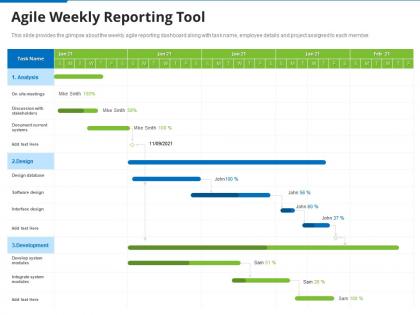
Agile weekly reporting tool agile proposal effective project management it




Try Before you Buy Download Free Sample Product
 Impress Your
 Audience
 100%
100% Editable
 Save Hours
 of Time


Our Agile Weekly Reporting Tool Agile Proposal Effective Project Management IT are topically designed to provide an attractive backdrop to any subject. Use them to look like a presentation pro.
People who downloaded this PowerPoint presentation also viewed the following :
Agile weekly reporting tool agile proposal effective project management it with all 2 slides:
Use our Agile Weekly Reporting Tool Agile Proposal Effective Project Management IT to effectively help you save your valuable time. They are readymade to fit into any presentation structure.
FAQs for Agile weekly reporting tool agile proposal effective
Key features include real-time dashboards, sprint tracking, burndown charts, velocity metrics, and customizable reporting templates. These capabilities streamline project visibility by automating progress updates, identifying bottlenecks early, and enabling data-driven decisions, with many development teams finding that comprehensive reporting tools ultimately enhance team productivity and stakeholder communication.
Agile reporting tools enhance team collaboration by providing real-time visibility into sprint progress, centralizing communication around user stories, and enabling transparent tracking of blockers and dependencies. These platforms streamline daily standups through automated progress updates, facilitate cross-functional alignment with shared dashboards, and ultimately deliver faster problem resolution and improved sprint outcomes across development teams.
Real-time data serves as the foundation of agile reporting tool effectiveness by enabling immediate decision-making, continuous performance monitoring, and rapid response to changing conditions. Through instant data processing, organizations streamline project tracking, enhance team collaboration, and minimize delays, with many finding that real-time insights ultimately deliver competitive advantage and improved operational efficiency.
Agile reporting tools integrate with project management software through APIs, webhooks, and native connectors that enable seamless data synchronization across platforms like Jira, Trello, and Azure DevOps. These integrations streamline workflow visibility, automate report generation, and consolidate team metrics, with many organizations finding that unified dashboards enhance decision-making speed and project transparency.
Key metrics include sprint velocity, burndown charts, team productivity, defect rates, and cycle time. These measurements enhance project visibility by tracking progress, identifying bottlenecks, and optimizing resource allocation, with many development teams finding that consistent monitoring ultimately delivers faster delivery cycles and improved product quality.
Agile reporting tools help identify bottlenecks by tracking sprint velocity, monitoring task completion rates, and analyzing workflow patterns through real-time dashboards and burndown charts. These tools enable project managers to quickly spot delayed deliverables, resource constraints, and process inefficiencies, with many development teams finding that automated reporting streamlines problem resolution and enhances overall project delivery timelines.
Best practices for visualizing data in agile reporting tools include using clear, intuitive dashboards, implementing real-time data updates, creating role-specific views, maintaining consistent visual standards, and prioritizing actionable metrics over vanity numbers. These approaches streamline decision-making by enhancing transparency, reducing interpretation time, and enabling faster sprint adjustments, with many development teams finding that strategic visualization ultimately delivers improved project velocity and stakeholder alignment.
Agile reporting tools cater to different stakeholders through customizable dashboards and role-specific views, delivering technical metrics like sprint velocity and code quality for developers, while providing high-level progress summaries and ROI analytics for executives. These platforms enable seamless information sharing across organizational levels, with many companies finding that automated, audience-tailored reporting enhances decision-making speed and strategic alignment.
Common user challenges when adopting agile reporting tools include resistance to change from traditional methods, difficulty integrating with existing systems, learning curve for new interfaces, data quality inconsistencies, and establishing standardized reporting processes across teams. While these hurdles initially slow implementation, organizations in sectors like software development, marketing, and project management find that proper training, phased rollouts, and stakeholder engagement ultimately deliver improved transparency and faster decision-making capabilities.
Agile reporting tools support continuous improvement by providing real-time visibility into sprint metrics, team velocity, and workflow bottlenecks, enabling data-driven retrospectives and adaptive planning. These platforms streamline performance tracking, identify process inefficiencies, and facilitate transparent communication across development teams, ultimately delivering faster iteration cycles and enhanced project outcomes.
Educational resources for agile reporting tools include vendor documentation, online training platforms, agile certification programs, community forums, and hands-on workshops. These resources enhance team proficiency by providing best practices, real-world case studies, and practical implementation strategies, with many organizations finding that structured training accelerates adoption and maximizes reporting efficiency across projects.
Agile reporting tools facilitate sprint reviews and retrospectives by providing real-time progress visualizations, automated burndown charts, and comprehensive team velocity metrics that streamline evaluation processes. These platforms enable teams to quickly identify bottlenecks, celebrate achievements, and capture actionable insights during retrospectives, ultimately delivering more focused discussions and faster sprint improvements.
Cloud-based agile reporting tools offer automatic updates, seamless collaboration, and scalable storage, while on-premises solutions provide enhanced data security, customization control, and regulatory compliance capabilities. Organizations in financial services and healthcare increasingly leverage cloud solutions for real-time team coordination and cost efficiency, while those with strict data governance requirements find on-premises deployments deliver greater control and compliance assurance.
An agile reporting tool assists in forecasting and planning iterations by analyzing historical velocity data, tracking sprint completion rates, and identifying team capacity patterns across previous cycles. These insights enable project managers to predict realistic timelines, allocate resources more effectively, and adjust scope proactively, with many development teams finding that data-driven planning reduces overcommitment while enhancing delivery predictability.
Agile reporting tools support risk management by providing real-time visibility into project metrics, automated alerts for potential issues, and comprehensive dashboards that track risk indicators across sprints. Through continuous monitoring and data visualization, teams can identify bottlenecks, resource constraints, and scope creep early, enabling proactive mitigation strategies that minimize project delays and budget overruns.
-
Topic best represented with attractive design.
-
Awesome presentation, really professional and easy to edit.