


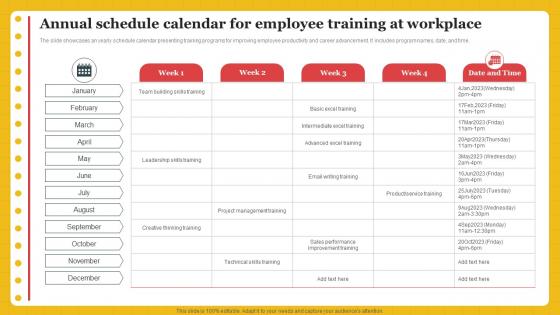
Annual Schedule Calendar For Employee Training At Workplace




Try Before you Buy Download Free Sample Product
 Impress Your
 Audience
 100%
100% Editable
 Save Hours
 of Time


The slide showcases an yearly schedule calendar presenting training programs for improving employee productivity and career advancement. It includes program names, date, and time.
People who downloaded this PowerPoint presentation also viewed the following :
Annual Schedule Calendar For Employee Training At Workplace with all 6 slides:
Use our Annual Schedule Calendar For Employee Training At Workplace to effectively help you save your valuable time. They are readymade to fit into any presentation structure.





FAQs for Annual Schedule Calendar For Employee
Key components include training objectives aligned with business goals, scheduled sessions with clear timelines, resource allocation for materials and instructors, progress tracking mechanisms, and feedback collection systems. These elements work together by ensuring systematic skill development, maximizing resource efficiency, and enabling continuous improvement, with many organizations finding that structured calendars increase training completion rates while reducing costs and enhancing employee performance outcomes.
Organizations align training calendars with business goals through strategic workforce planning, skills gap analysis, performance data review, and quarterly objective mapping. By connecting leadership development programs to succession planning, technical training to product launches, and compliance education to regulatory requirements, companies enhance operational efficiency while building competitive advantages that directly support revenue growth and market positioning.
**INPUT**: What are the best practices for scheduling training sessions to maximize employee participation? **OUTPUT**: Best practices include conducting availability surveys, offering multiple time slots, scheduling during low-activity periods, providing advance notice, and creating recurring calendar blocks for consistent training rhythms. These approaches enhance participation by accommodating diverse schedules, minimizing workflow disruption, and establishing predictable learning opportunities, with many organizations finding that strategic scheduling increases attendance rates while ultimately delivering stronger skill development and employee engagement across departments. [Word count: 60 words]
Technology enhances employee training calendar management through automated scheduling systems, cloud-based platforms, mobile accessibility, real-time updates, and integration with HR databases. These digital solutions streamline administrative tasks, enable instant notifications across departments, and provide analytics on completion rates, with many organizations finding significantly improved training compliance and reduced coordination overhead.
Selecting training topics requires evaluating skills gaps through assessments, aligning with business objectives and regulatory requirements, considering career development pathways, and analyzing performance data across departments. Organizations should balance technical skills with soft skills development, prioritize high-impact areas like leadership and compliance, while ensuring content addresses both immediate operational needs and long-term strategic goals for competitive advantage.
Training program effectiveness is measured through participant feedback surveys, pre and post-training assessments, performance metrics tracking, and return on investment calculations. These evaluation methods enable organizations to analyze skill development, knowledge retention, and behavioral changes, with many companies finding that comprehensive measurement frameworks ultimately enhance training quality, optimize resource allocation, and deliver measurable improvements in employee performance and productivity.
Feedback serves as the foundation for refining training calendars by identifying skill gaps, assessing program effectiveness, measuring engagement levels, and revealing emerging learning needs. Through regular surveys, performance metrics, and participant evaluations, organizations continuously optimize their training schedules, content relevance, and delivery methods, ultimately ensuring programs remain aligned with evolving business objectives and employee development requirements.
Organizations balance mandatory training with optional development opportunities by scheduling compliance sessions during core hours while offering skill-building programs during flexible periods, integrating both into quarterly cycles, and creating personalized learning paths. This strategic combination enables employees to meet regulatory requirements while pursuing career growth, with many companies finding that optional sessions complement mandatory training, ultimately delivering higher engagement and improved retention rates.
**INPUT**: What strategies can be employed to ensure that training sessions accommodate different learning styles? **OUTPUT**: Effective training accommodates different learning styles through visual presentations, hands-on workshops, auditory discussions, written materials, and interactive simulations. These approaches enable organizations to enhance knowledge retention, improve employee engagement, and accelerate skill development, with many companies finding that diverse training methods ultimately deliver better performance outcomes and higher training ROI. [Word count: 52 words]
Cross-departmental training incorporates into employee training calendars through scheduled rotation programs, collaborative project workshops, knowledge-sharing sessions, and interdisciplinary skill-building modules. Organizations streamline this by alternating monthly focus areas, pairing departments for joint training initiatives, and creating cross-functional teams, ultimately enhancing communication, breaking down silos, and delivering improved operational efficiency across all business units.
Effective communication methods include email announcements, intranet portals, digital dashboards, mobile apps, and team meetings. These approaches streamline information delivery by providing multiple touchpoints, automated reminders, and accessible formats, with many organizations finding that combining digital platforms with manager-led discussions ultimately enhances participation rates and ensures consistent awareness across departments.
Training calendars should be updated quarterly to maintain relevance, with ongoing adjustments based on industry changes, regulatory requirements, performance gaps, and emerging technologies. This strategic approach enables organizations to align training with business objectives, seasonal demands, and workforce development needs, while many companies find that regular updates ultimately deliver improved employee engagement, enhanced skill development, and stronger competitive advantage in an increasingly dynamic business environment.
Common pitfalls include overloading schedules with excessive training, failing to align programs with business objectives, ignoring employee skill gaps and career aspirations, and neglecting to gather feedback for continuous improvement. These scheduling missteps often result in reduced engagement, wasted resources, and missed development opportunities, with many organizations finding that strategic planning and employee input significantly enhance training effectiveness and retention.
Organizations leverage employee input through skills assessments, departmental feedback sessions, performance review insights, and direct surveys about learning preferences and career goals. This collaborative approach enables companies to design targeted training programs that address real knowledge gaps, boost engagement levels, and align development opportunities with both individual aspirations and business objectives, ultimately delivering higher completion rates and measurable skill improvements.
Key ROI metrics include completion rates, skill assessment scores, employee engagement levels, productivity improvements, and retention rates. These measurements enable organizations to evaluate training effectiveness by tracking performance gains, reduced turnover costs, and enhanced operational efficiency, with many companies finding that comprehensive metrics ultimately deliver measurable competitive advantage and strategic workforce development.
-
SlideTeam is my one-stop solution for all the presentation needs. Their templates have beautiful designs that are worth every penny!
-
Graphics are very appealing to eyes.