


Ansoff gap planning and analysis model and method




Try Before you Buy Download Free Sample Product
 Impress Your
 Audience
 100%
100% Editable
 Save Hours
 of Time


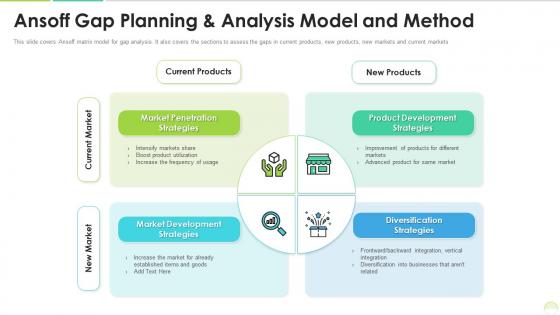
This slide covers Ansoff matrix model for gap analysis. It also covers the sections to assess the gaps in current products, new products, new markets and current markets.
People who downloaded this PowerPoint presentation also viewed the following :
Ansoff gap planning and analysis model and method with all 2 slides:
Use our Ansoff Gap Planning And Analysis Model And Method to effectively help you save your valuable time. They are readymade to fit into any presentation structure.
FAQs for Ansoff gap planning and analysis
So the Ansoff Matrix is basically four ways to grow your business. Market penetration = selling more of what you already make to customers you already have. Pretty straightforward. Then there's market development - same products, but you're going after new customer groups. Product development does the opposite: new stuff for your existing customers. Diversification is where things get spicy though - you're doing both new products AND new markets at once. It's like the business equivalent of juggling while riding a unicycle. Obviously that one's the riskiest, but if it works, the payoff can be huge.
So the Ansoff Matrix is basically a risk calculator for growth ideas. Market penetration (same products, same customers) = safest bet. Diversification (new everything) = you're rolling the dice hard. Product development and market development fall somewhere in between since you're only switching up one thing at a time. I actually think of it like a heat map - the more new stuff you're doing, the hotter it gets risk-wise. What's cool is it makes you honest about what you actually know vs what you're just hoping will work out. Worth sketching out your ideas on it before you commit to anything big.
Look at Apple - they got existing smartphone users to switch to iPhones, then jumped into totally different stuff like streaming with Apple TV+. Tesla's interesting too, they took electric cars from tech nerds to regular people. Starbucks expanded from just coffee into food and random merchandise (though honestly their sandwiches are kinda meh). Amazon's probably the craziest example - books to cloud services to buying Whole Foods. You could map out your company's options the same way. Might help you spot growth opportunities you haven't thought of yet.
Honestly, start with how much risk you can stomach and what resources you've got. Market penetration is your safest play - stick with what you know. Diversification? That's like rolling dice, but the payoff could be massive. Think about your team's strengths too. Got killer R&D? Product development might be your thing. Strong distribution network? Market development could work. I'd probably look at your competitive spot and timeline for returns first though. Just be real about what you're actually good at, then pick whichever option matches that without keeping you up at night worrying.
So basically, just match your digital marketing to each Ansoff box. Market penetration? Pump up what you're already doing - more ad budget, better email open rates for current customers. For product development, push new features to your existing audience through the same channels you always use. Market development gets fun though - same products, totally different demographics or regions, which means new platforms. Diversification is honestly pretty risky since it's new everything, but sometimes you gotta do it. I'd start by mapping what you're doing now to see what's missing.
Honestly, you can't pick an Ansoff quadrant without solid research backing you up. Market penetration? You'll need competitor pricing data and customer satisfaction scores. New markets mean digging deep into different customer segments - what they actually need, not what you assume. Product development is tricky because existing customers often want features that'll surprise you. Diversification though... that's where research becomes absolutely crucial since you're basically flying blind otherwise. I learned this the hard way at my last job. Don't just go with your gut on strategic moves - the data will save you from expensive mistakes.
Honestly, stick with bottom-left first - market penetration with what you've already built. Don't get distracted by shiny new products yet. You gotta nail product-market fit before anything else makes sense. After that? Go for new customer segments since you're working with something that already clicks. Product development sounds exciting but it's risky as hell when you're still figuring out your model. Same with diversification - that's like jumping into the deep end when you can barely swim. Quick tip: figure out where you are on the matrix right now, then plan maybe 6 months ahead without bouncing around too much.
So the Ansoff Matrix is actually a solid jumping-off point for other strategy stuff. I'd pair it with SWOT analysis first - helps you figure out if you can actually pull off each growth option. Then maybe throw in Porter's Five Forces if you're looking at new markets. BCG Matrix works great too since it shows your current position while Ansoff maps out future moves. Oh, and scenario planning is clutch for testing different paths. Honestly though, BCG and Ansoff together are kind of a power combo. Start with Ansoff to see your options, then use the other tools to reality-check everything.
So market penetration = same product, push harder to existing customers. More ads, better deals, that stuff. Product development flips it - same customers, new products. Honestly? Market penetration's way less risky since you already know what works. With new products, you're basically hoping your customers will actually want whatever you cook up next (and they might not). I'd figure out if you've actually hit your limit with current customers first. Like, have you really squeezed all the juice out of that orange? If not, why complicate things with new products yet.
Honestly, the hardest part is that each option has completely different risks and costs. Market penetration looks simple but you're still scrapping for customers in a packed space. R&D for new products will eat your budget alive - learned that the hard way. Entering new markets means figuring out totally different customer habits and how to actually reach them, which drags on forever. Diversification is straight-up risky unless you've got serious cash and can wait it out. Really look at what you can handle financially first, then whatever timeline you're thinking? Double it.
Pick your KPIs based on which quadrant you're in. Market penetration? Watch market share growth and customer acquisition costs. New geographic regions or customer segments for market development are harder to measure since you're starting from scratch - honestly the most annoying one to track. Product development needs adoption rates for new features plus customer feedback scores. Diversification throws you a curveball because you need both market AND product metrics. Set your baselines first, then check quarterly. Stick to 3-4 core metrics though, otherwise you'll get buried in spreadsheets and lose focus.
The biggest myth? That you're supposed to start with market penetration and go clockwise through the whole thing. Total BS. People treat it like some rigid playbook when honestly, it's just meant to help you brainstorm different growth paths. Here's what's funny - everyone thinks diversification is automatically the scariest move, but sometimes your current market is actually circling the drain faster than a new one would be. Also heard people say it only works for huge corporations. Nah, startups use this stuff constantly. Don't follow it like a recipe - just use it to see what options you've got and figure out what actually makes sense for where you're at right now.
So the Ansoff Matrix and product lifecycles are basically best friends - they work together perfectly. If your products are getting stale or declining, that's when you pivot to market development or diversification for growth. New product development? That fits right into the introduction stage. Market penetration works best during growth phases when you're fighting for market share (which can get pretty brutal, honestly). Here's the thing though - where your products sit in their lifecycle should totally dictate which Ansoff quadrant you focus on. Just overlay them next time you're strategizing and boom, your growth path becomes super obvious.
Definitely works for nonprofits! Just switch "products" to "programs" and "markets" to the communities you serve. Market penetration becomes helping more people in your current area with existing programs. With market development, you're taking current services to new groups. Product development? New programs for the people you already work with. Diversification is both - new programs AND new populations. I've seen nonprofits use this framework and it's surprisingly helpful for spotting blind spots. Try plotting what you're doing now on the matrix. You'll probably find some obvious growth areas you hadn't considered.
So diversification is when you're doing both - new product AND new market. Super risky since you don't know the customers or have experience with the product. Amazon going from books to cloud services is a perfect example. Most companies honestly should nail the other three strategies first before attempting this one. You need tons of cash and patience because you're basically learning two things at once. The upside can be massive though! Just don't expect quick wins. It's like learning to juggle while riding a unicycle - doable but probably not your first move.
-
Colors used are bright and distinctive.
-
Innovative and attractive designs.
-
Easy to edit slides with easy to understand instructions.
-
Designs have enough space to add content.