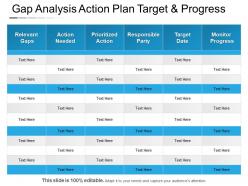
Gap analysis action plan target and progress powerpoint guide
Try Before you Buy Download Free Sample Product
Audience
Editable
of Time
Choose this gap analysis action plan target and progress PowerPoint guide slideshow which can be used as a simple tool for presenting an organizational presentation and discuss the circumstances and factors to raise the performance level of your business. The strategy and management training PowerPoint presentation can also be used at an organization level or as a part of project management, or for strategy development as well. The analyze and bridge gap PowerPoint presentation facilitates the presenter to analyse and focus on the different perspectives such as; organization, business direction, business processes and technology. The template enables the user to make the planning also to get an outcome of a tight partnership between human resource management and the finance organization which is related to the systematic identification and analysis of what your organization is going to need in terms of the size, type, experience, knowledge and skills of its workforce to achieve its objectives. Initiate the process which is used to generate business intelligence and inform the organization of the current, transition and future impact of the external and internal environment on the organization by using the PPT designed by the professionals of the Slideteam studio. Our Gap Analysis Action Plan Target And Progress Powerpoint Guide are instrumental in cost cutting. It is a highly inexpensive device.
People who downloaded this PowerPoint presentation also viewed the following :
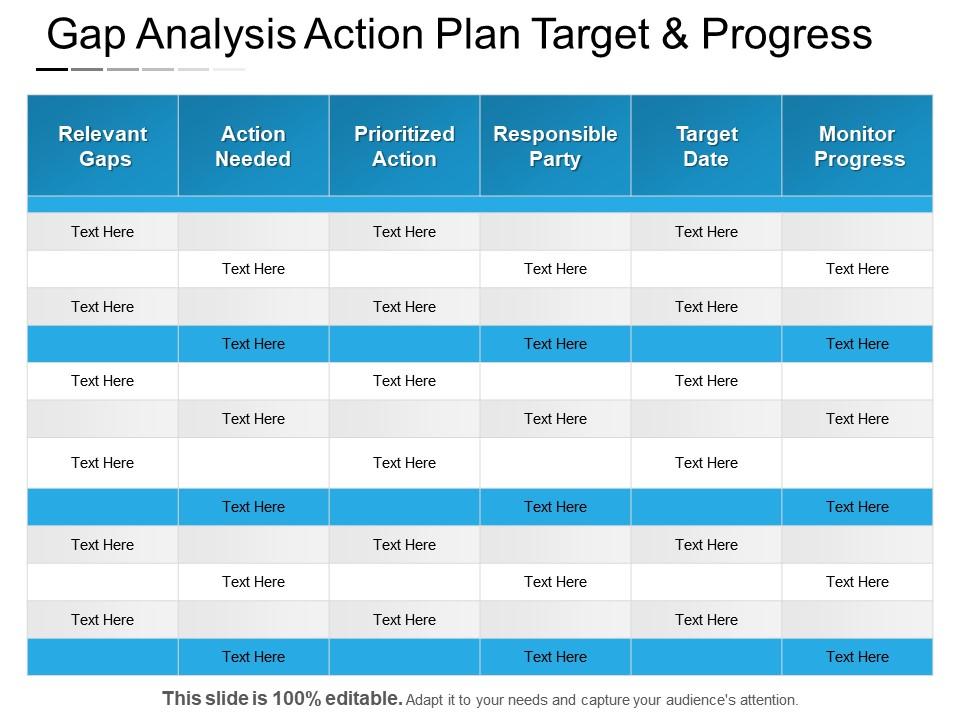
Gap analysis action plan target and progress powerpoint guide with all 5 slides:
Instruct folks on handling emergencies with our Gap Analysis Action Plan Target And Progress Powerpoint Guide. Enable them to cater for jolts.
FAQs for Gap analysis action plan target and
Key components of a gap analysis action plan include current state assessment, desired future state definition, specific gap identification, prioritized improvement initiatives, and detailed implementation timelines. These elements work together by establishing clear baselines, setting measurable targets, and creating structured roadmaps, with many organizations finding that comprehensive action plans accelerate closing performance gaps while ensuring accountability and resource allocation efficiency.
Organizations effectively identify their current state versus desired future state through comprehensive data collection, stakeholder interviews, performance metric analysis, process mapping, and competitive benchmarking. This strategic assessment enables companies across industries like manufacturing, healthcare, and financial services to pinpoint operational inefficiencies, resource gaps, and improvement opportunities, ultimately delivering targeted action plans that streamline operations and accelerate strategic transformation.
Key metrics include timeline adherence, resource utilization rates, milestone completion percentages, cost variance tracking, and performance indicator improvements against baseline measurements. These metrics enable organizations to monitor implementation effectiveness across departments like operations, finance, and customer service, while identifying bottlenecks early and ensuring strategic objectives are met within budget and timeframe constraints.
Stakeholder involvement and feedback ensure gap analysis accuracy by providing diverse perspectives, identifying blind spots, validating findings, and securing buy-in for implementation strategies. Through collaborative engagement, organizations streamline change management, enhance solution relevance, and minimize resistance to recommended actions, with many companies finding that inclusive gap analysis processes deliver faster implementation timelines and sustainable operational improvements.
Common pitfalls include setting unrealistic timelines, failing to prioritize gaps by business impact, inadequate stakeholder engagement, and insufficient resource allocation planning. Organizations often overlook change management requirements and implementation dependencies, with many finding that successful gap analysis action plans require clear accountability structures, regular progress monitoring, and flexibility to adapt strategies based on emerging challenges and market conditions.
Gap analysis action plans adapt to industry-specific requirements by incorporating sector regulations, operational workflows, competitive pressures, and performance metrics. Healthcare organizations focus on patient safety and compliance standards, while manufacturing emphasizes production efficiency and quality controls, with financial services prioritizing risk management and regulatory adherence, ultimately delivering targeted improvements aligned with each industry's strategic priorities.
Gap analysis tools include SWOT analysis software, performance dashboards, project management platforms like Asana or Monday.com, business intelligence tools such as Tableau, and specialized assessment software like GAP360. These technologies streamline data collection, automate comparison processes, and generate visual reports, with many organizations finding that integrated platforms enhance collaboration while delivering faster insights and more accurate strategic planning outcomes.
Organizations should prioritize gaps by assessing business impact, implementation complexity, resource requirements, and strategic alignment with company objectives. High-impact, low-complexity gaps typically receive immediate attention, while resource-intensive strategic gaps require phased approaches, with many companies finding that addressing customer-facing gaps first delivers faster competitive advantage and measurable outcomes.
Change management plays a crucial role by facilitating employee buy-in, managing resistance, and ensuring smooth transitions during gap analysis implementation. It addresses the human element through structured communication, training programs, and stakeholder engagement, with many organizations finding that effective change management significantly improves adoption rates, minimizes disruption, and ultimately delivers sustainable improvements across operations.
Gap analysis action plan insights drive strategic decision-making by identifying performance gaps, resource allocation needs, priority areas for improvement, and competitive positioning opportunities. These insights enable organizations to make data-driven investment decisions, streamline operational focus, and allocate resources more effectively, with many companies finding that structured gap analysis ultimately delivers faster strategic pivots and enhanced competitive advantage in increasingly dynamic markets.
Best practices for communicating gap analysis findings include creating executive summaries with key insights, using visual dashboards to highlight critical gaps, conducting stakeholder-specific presentations tailored to different departments, and establishing clear timelines with actionable next steps. These communication strategies enhance organizational buy-in by translating complex data into digestible formats, while ensuring all teams understand their role in closing identified gaps, ultimately delivering faster implementation and sustained competitive advantage.
Gap analysis action plans should be reviewed quarterly for operational gaps and annually for strategic initiatives, with additional reviews triggered by major organizational changes, market shifts, or performance deviations. Many organizations find that establishing regular review cycles enables them to adapt quickly to evolving business conditions, maintain momentum on improvement initiatives, and ensure resources remain aligned with current priorities, ultimately delivering sustained competitive advantage.
Unaddressed gaps can lead to operational inefficiencies, competitive disadvantage, regulatory non-compliance, increased costs, and strategic misalignment with market demands. These risks compound over time, with many organizations finding that delayed action results in larger resource requirements, missed opportunities, and potentially irreversible market position losses, ultimately threatening long-term business sustainability and growth.
Organizations balance short-term fixes with long-term strategic improvements by implementing phased approaches that address immediate operational needs while building toward comprehensive transformation. This strategic combination enables companies to maintain business continuity, secure quick wins that fund larger initiatives, and systematically develop sustainable capabilities, with many finding that early tactical successes create momentum and stakeholder buy-in for broader strategic investments.
Teams executing gap analysis action plans should receive training in analytical methodologies, project management frameworks, data collection techniques, stakeholder communication protocols, and change management principles. Organizations typically provide workshops on gap assessment tools, resource allocation strategies, and performance measurement systems, with many finding that comprehensive training in both technical skills and collaborative processes ultimately delivers more accurate analyses, smoother implementation timelines, and sustainable organizational improvements.
-
Innovative and Colorful designs.
-
Colors used are bright and distinctive.