


Ansoff matrix for growth strategy ppt design




Try Before you Buy Download Free Sample Product
 Impress Your
 Audience
 100%
100% Editable
 Save Hours
 of Time


Commission the services of our Ansoff Matrix For Growth Strategy Ppt Design. Receive a lifetime of dedication.
People who downloaded this PowerPoint presentation also viewed the following :
Ansoff matrix for growth strategy ppt design with all 5 slides:
Identify areas where errors can crop up with our Ansoff Matrix For Growth Strategy Ppt Design. Figure out the chances of bungling.


FAQs for Ansoff matrix for growth
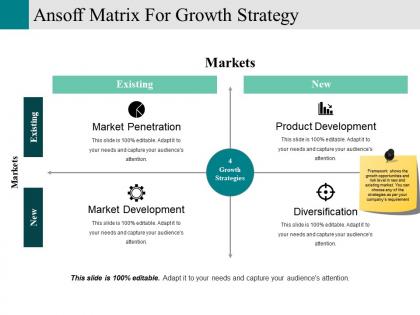
So there's this framework with four growth strategies. Market penetration means selling more current stuff to your existing customers. Then you've got market development - same products but finding new customer groups. Product development is the flip - new products for your current customers. Diversification combines both new products AND new markets. Honestly, diversification scares me a bit since you're gambling on everything being unfamiliar. It's definitely the riskiest move. The whole point is thinking through where you want to grow based on what you can handle risk-wise. Try plotting out what you're already doing to see if you're spread too thin in one area.
The Ansoff Matrix is perfect for this - it breaks growth into four boxes you can actually work with. Map out your current products and markets first, then look at each option. Market penetration is your safest play, while diversification is risky but could pay off big. Product development and market development sit somewhere in between. Honestly, I'd pick one direction and stick with it rather than jumping around. The whole point is having a clear risk-reward picture so you're not just throwing ideas at the wall. Which quadrant feels right given what you've got to work with?
Market penetration is honestly your safest growth move. You're just selling more of your current stuff to people who already know you exist. No need to create new products or chase down random customers - way less risky that way. Most companies start here because it makes sense, right? Just figure out what's stopping your existing customers from buying more. Maybe your prices suck, or they don't see your ads enough, or it's hard to actually get your product. Fix those roadblocks and you'll probably see results pretty fast.
So basically, it comes down to what you're switching up. Product development = making new stuff for your current customers. Market development? You're taking what you already sell and finding totally new people to buy it. Apple with AirPods is perfect product development - same iPhone crowd, shiny new gadget. Starbucks going global is the flip side, same coffee but different countries. Honestly, I think product development feels riskier because you never know if people will actually want your new thing. With market development you at least know the product works somewhere already, right? You're just betting new audiences will dig it too.
Diversification sits in the riskiest spot on the Ansoff Matrix because you're tackling two major challenges simultaneously - new markets AND new products. No experience in either area means higher failure rates and serious resource drain. Think of it like learning to drive while studying a foreign language... technically possible but pretty brutal! You'll face risks like completely misreading customer needs, underestimating competitors, and stretching your resources way too thin. Honestly, I've seen companies crash hard trying this without proper prep. Make sure you've done solid market research first and have enough cash reserves to survive the inevitable mistakes while you figure things out.
Look at where you're actually strong first - that's what matters here. Got market dominance and know your customers inside out? Go with market penetration and squeeze more from existing clients. Strong company but want to expand geographically? Market development's your move. Know your customers really well but need new products? Product development works. Diversification though... honestly it's pretty risky unless you've got serious cash to burn. I'd map out where you actually have real advantages (not just wishful thinking) then pick whatever plays to those strengths. Makes way more sense than crossing your fingers.
So it really depends on what part of the Ansoff matrix you're tackling. Market penetration? Track market share growth and how fast you're getting new customers. If you're doing market development, look at new customer segments and geographic expansion - basically revenue from markets you haven't touched before. Product development is more about adoption rates for new stuff, R&D ROI, and how quickly you can get things to market. Diversification's honestly the hardest since you're venturing into totally unknown territory, but focus on overall portfolio performance and risk-adjusted returns. Don't just default to generic revenue metrics for everything though - match your KPIs to whatever strategy you're actually running.
Honestly, the Ansoff Matrix is surprisingly useful for digital stuff. Market penetration lets you digitize what you're already doing for current customers. Market development means using digital channels to find new people. Product development is about creating digital products for your existing customers. But diversification? That's where things get interesting - totally new digital business models. The whole point is avoiding that "digitize everything!" panic mode most companies fall into. Plot your current digital projects on it first to spot the gaps. Way better than just throwing money at random tech initiatives.
So when things get rough, the Ansoff Matrix is actually pretty useful for figuring out what's worth your time. Market penetration becomes your best friend - basically just doubling down on what you already do well instead of trying crazy new stuff. Product development and market expansion? They're riskier but honestly, you might catch opportunities while competitors are hiding under rocks. Diversification though - forget about it unless you've got money burning a hole in your pocket. I'd start by mapping out where your current projects fit, then just be brutal about cutting the risky ones. It's not sexy, but it works.
Amazon's probably the best example - books to AWS is insane when you think about it. Apple did something similar going from computers to basically owning your entire digital life. Healthcare and fintech get really weird with it too, like you'll see a payment app suddenly offering loans or something. Oh, and consumer goods companies use the matrix but they're way more cautious about it. Tech just seems to have this "why not?" attitude that other industries don't. If you're looking at this for work, definitely check out case studies from your specific industry - the patterns become super obvious once you know what to look for.
So the Ansoff Matrix basically gives you four different ways to grow your business, and each one hits your competitive advantage differently. Market penetration? You're scrapping for share in your current space - could mean price wars or just crushing it on customer service. With product development, you get to use those solid customer relationships you've already built. Market development flips it - same product, new places to sell it. Diversification is honestly the scary one. Highest risk but man, if it works out the payoff can be massive. The trick is figuring out which path actually matches what you're already good at and what resources you've got to work with.
Look at Apple - they're masters at getting existing iPhone users to upgrade constantly. Netflix did the opposite thing, keeping their DVD customers but completely switching to streaming. Pretty genius move. Starbucks went global with the same coffee concept, just new countries. Then there's Amazon, who somehow went from selling books to dominating cloud services (still blows my mind that worked). The key thing all these companies figured out first was what they were actually good at. When you're putting together your pitch, grab examples like these that actually match what you're trying to do.
Look, start with market penetration - own your local scene where you can actually give personal service that Amazon can't. Your existing customers? Perfect for developing new specialized products they need. Jumping into adjacent markets is solid too since you're not stuck in corporate red tape. But honestly, diversification is sketchy unless you've got money to burn - learned that one the hard way watching friends try it. The real advantage is speed. While big companies are still in meetings, you're already testing stuff. Don't think small, think fast.
Honestly, the matrix is just a brainstorming tool - don't treat it like some holy strategy bible. Companies love cramming messy market realities into those four clean boxes, but they miss so much nuance around competition and how customers actually behave. Teams waste forever arguing about which quadrant they're in instead of doing anything productive. And diversification? Looks great on paper but can totally drain your resources if you're not smart about it. I've seen way too many companies get analysis paralysis from this thing. Use it to get ideas flowing, then move on.
Don't just use Ansoff by itself - combine it with other frameworks for way better insights. SWOT analysis first so you know what you're actually capable of before picking a growth direction. Porter's Five Forces tells you if the industry's even worth entering. BCG Matrix? That shows which products can bankroll your expansion plans. I'd also throw in some scenario planning to see how your strategy holds up when things go sideways (and they always do). Map everything out together and you'll catch stuff you'd totally miss otherwise. Takes more work but honestly, it's worth it.
-
Great product with highly impressive and engaging designs.
-
Best way of representation of the topic.