


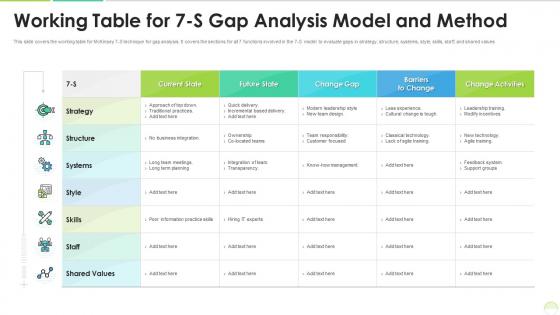
Working table for 7 s gap analysis model and method




Try Before you Buy Download Free Sample Product
 Impress Your
 Audience
 100%
100% Editable
 Save Hours
 of Time


This slide covers the working table for McKinsey 7 S technique for gap analysis. It covers the sections for all 7 functions involved in the 7 S model to evaluate gaps in strategy, structure, systems, style, skills, staff, and shared values.
People who downloaded this PowerPoint presentation also viewed the following :
Working table for 7 s gap analysis model and method with all 2 slides:
Use our Working Table For 7 S Gap Analysis Model And Method to effectively help you save your valuable time. They are readymade to fit into any presentation structure.
FAQs for Working table for 7 s gap analysis
You're basically doing a company health check across seven areas - strategy, structure, systems, shared values, style, staff, and skills. Sounds boring but it's actually pretty useful. Instead of just fixing random problems, you get the full picture of what's broken. Find the gaps between where you are now and where you need to be. Then figure out what's causing the biggest headaches first. Honestly, most companies skip this step and wonder why nothing ever gets better. Once you've mapped everything out, you can actually prioritize what needs fixing and make a real plan.
Here's what I'd do - map out where you are now across all seven parts of the 7s framework (strategy, structure, systems, shared values, style, staff, skills). Then sketch out your ideal future state using those same elements. Honestly, comparing them side by side is kind of a reality check. You'll spot the misalignments pretty quickly. Those gaps? That's your actual to-do list right there. I'd tackle the biggest ones first - the stuff that's really holding you back. Don't overthink it too much.
So the 7s model breaks down into hard and soft elements. Hard ones - Strategy, Structure, Systems - are the concrete stuff you can actually measure and tweak pretty easily. Then you've got the soft elements: Shared Values sits in the middle, plus Staff, Skills, and Style. These are honestly a pain to pin down but usually matter way more than people think. Everything's connected though, which makes changing organizations such a headache. You can't just swap your strategy and expect it to work if your culture's totally misaligned. For gap analysis, just map out where each element is now vs where it needs to be, then spot the disconnects between them.
Honestly, just compare where you are now vs where you want to be for each of the 7 elements. Map out your current strategy, structure, systems - all of them. Then figure out your ideal state. The hard part? Being real about what's actually broken (trust me, nobody wants to admit their processes suck). Check how the elements connect too since they affect each other. Maybe start with one area and get your team involved - they'll spot things you miss. Oh, and write down the specific gaps you find. Otherwise you'll forget half of them by next week.
Dude, you NEED leadership on board from the start or you're screwed. They have to actually champion this thing and explain why it matters to everyone else. Plus they need to give teams real time to participate - not just squeeze it between other meetings, you know? I've watched so many of these fail because executives just went through the motions. The worst part? When all your recommendations just collect dust afterward. Make sure they promise upfront they'll actually do something with what you find. Otherwise you're just wasting everyone's time doing busy work.
Honestly, start with employee surveys to get the broad view across your org. Focus groups and one-on-one interviews are where you'll dig into the real issues though. Sometimes just walking around and watching how things actually work shows you stuff people won't say in formal settings - kind of obvious but most managers skip this part. Document reviews help too, plus analyzing performance data. I'd go surveys first for the big picture, then validate what you find through interviews. Oh, and don't overthink it - people usually know what's broken.
So those 7s gaps you find? That's basically your fix-it list right there. Look at where you're falling short across all seven areas - strategy, structure, systems, skills, style, staff, shared values. Then figure out what's actually blocking your big goals first. Think of it like a health checkup but for your company (weird analogy but it works). Rank everything by what'll make the biggest difference and what you can realistically pull off. Don't try to fix everything at once though - that never works. Hit the urgent stuff first, then build out your timeline for the rest.
Yeah, culture's huge in the 7s model - honestly it's what makes or breaks everything else. Your gap analysis has to dig into whether people's actual behaviors match where you're trying to go. I've watched companies nail their strategy on paper but totally bomb because nobody bought into it culturally. The unwritten rules matter way more than you'd think. Short sentences work better here. If your culture's fighting against your changes, you're screwed - fix that piece first or nothing else will stick. It's like trying to plant seeds in concrete otherwise.
Honestly, just start with a simple survey using Google Forms or SurveyMonkey to get feedback on all those 7S things - structure, strategy, systems, you know the drill. The visual mapping is where it gets interesting though. Miro or Lucidchart work great for showing current vs future state, and that's usually when teams finally get it. Once you've got data, dump it in Excel or Tableau to find patterns. Asana's solid for tracking whatever improvements you decide on. Don't overcomplicate it - one survey first, see what happens.
Honestly? The complexity will hit you like a truck - juggling all seven pieces at once is brutal. Your team's gonna push back hard on the cultural introspection stuff, nobody wants their leadership style dissected. Getting good data is another nightmare since you need both numbers AND the touchy-feely insights. Takes forever if you actually do it right too. Most companies I've seen just rush through or skip the messy cultural bits entirely, focusing only on the easy structural stuff. Oh, and definitely pilot it with one team first. Trust me on that one - you'll thank yourself later when you're not debugging process issues across the whole company.
Honestly, cross-functional teams are clutch for this stuff. HR spots the people problems, ops knows where processes are failing, and leadership sees the big picture gaps. Getting them all in one room means you're not just guessing from your corner of the office. It's like that blind men and elephant thing - except now everyone can actually see what they're dealing with. Plus people are way more likely to actually follow through on changes when they helped figure out what was broken in the first place. Just have each team share what they found, then connect the dots together.
Okay so basically you gotta figure out which of the 7 S's is broken first. Strategy problems? Time to rework your plan or get everyone on the same page. If it's Structure, maybe shuffle the org chart around. Skills gaps are pretty straightforward - either train people up or bring in new talent. Systems issues usually mean your processes suck or you need better tech. Style gaps are more about leadership - might need some coaching there. Staff problems could mean reshuffling roles or having some tough performance conversations. Shared Values is honestly the hardest one because you're basically trying to change company culture. My advice? Start with whatever's easiest to fix and build from there.
So I'd definitely run the 7s Gap Analysis right after doing SWOT or PESTLE. SWOT shows you the external stuff - opportunities, threats, whatever. But then you need to figure out if your company can actually handle what you found. That's where 7s comes in clutch. It makes you look at everything internally - your strategy, how you're structured, your people, processes. Honestly, I think it's super practical because it connects all the dots. Like, sure you spotted an opportunity in your SWOT, but can you realistically go after it? The 7s will tell you. I always use them together now.
Yeah, it totally works for both! Big companies just need to go deeper into each of the 7 elements across all their departments and layers of management. Small businesses can use the exact same framework but keep things way simpler. Actually, smaller companies often see better results because they're not stuck dealing with endless red tape - they can just fix the gaps right away. The trick is matching how deep you analyze to how complex your company actually is. I'd start with a quick look at all seven areas first, then figure out which gaps would make the biggest difference for you specifically.
Okay so the biggest trap? Thinking you need to tackle all seven elements at once - that'll just burn you out. Most people expect it to be like a recipe with clear steps, but it's really more about diagnosing what's misaligned between your strategy, structure, systems, skills, staff, style, and shared values. Here's what kills me though - everyone obsesses over the "hard" stuff like strategy and structure while ignoring the "soft" elements. Big mistake. Research shows it's actually the soft stuff (your culture, leadership style, people) that drives real change. Start by honestly assessing where you stand across all seven areas, then pick maybe 2-3 of your worst gaps to focus on first.
-
Enough space for editing and adding your own content.
-
The content is very helpful from business point of view.