


Key Steps Of QA QC Process For Quality Management




Try Before you Buy Download Free Sample Product
 Impress Your
 Audience
 100%
100% Editable
 Save Hours
 of Time


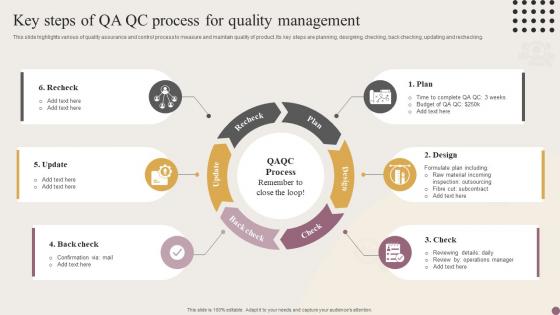
This slide highlights various of quality assurance and control process to measure and maintain quality of product. Its key steps are planning, designing, checking, back checking, updating and rechecking.
People who downloaded this PowerPoint presentation also viewed the following :
Key Steps Of QA QC Process For Quality Management with all 6 slides:
Use our Key Steps Of QA QC Process For Quality Management to effectively help you save your valuable time. They are readymade to fit into any presentation structure.





FAQs for Key Steps Of QA QC Process
So QA is like putting up guardrails before you drive - it's all about setting up processes and standards upfront to prevent problems. QC happens after, where you're actually testing and inspecting to catch defects. I honestly mixed these up for the longest time lol. QA runs through your whole project while QC kicks in at specific checkpoints. Both are pretty crucial though - QA stops problems from happening, QC finds the ones that slipped through. Try mapping out which of your current activities are preventive vs detective, that usually helps clarify things.
Honestly, good QA is just catching problems before they blow up your budget. Map out clear checkpoints where you're actually reviewing stuff against your standards - not just going through the motions. Most teams screw this up because they think everyone knows what "done" looks like. Spoiler: they don't. Get the right people reviewing at the right times. Document everything so nothing slips through. I'd start by looking at your current process and finding the obvious gaps. Trust me, there are always gaps you didn't see before.
So for QA tools, you'll probably want Selenium or Cypress for web testing - both are solid. Jira's pretty standard for bug tracking too. Most teams do unit testing, integration testing, and user acceptance testing to catch stuff at different stages. Code reviews are honestly where you'll find the most bugs though, way more effective than people think. Oh and definitely set up CI/CD pipelines so tests run automatically when you push code. I'd start with just one automated tool that matches whatever tech you're using. Don't try to do everything at once or you'll go crazy.
Look, automation's a game changer for QA stuff. Start with whatever's sucking up most of your time right now - maybe regression testing or those boring compliance checks. Automated scripts will catch problems way faster than doing everything manually, plus your team won't be stuck doing the same tedious tasks over and over. Real-time dashboards are pretty sweet too. Honestly, I'd focus on data validation and reporting workflows first since those are usually the biggest time wasters. Don't go crazy though - pick one thing, get it working, then expand from there.
Think of documentation as your backup plan and GPS combined. Track every test you run and record results religiously. When stuff breaks - and trust me, it will - those notes become lifesavers for troubleshooting. Auditors go crazy for detailed records too, so you're covered on compliance. Write everything like you're leaving instructions for the next person. They shouldn't have to track you down later asking "what did you mean here?" Keep it current and thorough. Honestly, I've seen too many people get burned by skipping this step.
Honestly, the best way is tracking how many bugs your team catches vs what slips through to customers. That ratio is everything. I'd also watch your cycle times and rework costs - shows if processes actually help or just slow things down. Customer satisfaction scores matter too, obviously. The tricky part is making sure defects drop while you're still shipping fast. Oh, and first-pass yield rates are super telling if you're into that level of detail. Don't overthink it though - pick like 3-4 metrics that actually matter to your situation and check them monthly. You'll see patterns pretty quick.
Ugh, time constraints are the worst - everyone thinks testing is just a "quick check" when it's definitely not. Requirements are always vague or missing, and getting teams to actually communicate? Good luck with that. Documentation is usually garbage, scope changes halfway through (obviously), and stakeholders act like testing is optional. Oh, and you're probably doing like three projects at once with zero extra resources. Honestly, the only thing that saves you is being super clear about expectations from day one and writing everything down. Even the obvious stuff - trust me on this one.
Build those industry standards straight into your QA workflow from the start. Figure out what applies to you first - ISO, FDA, ASTM, whatever. Then map everything to your actual testing and documentation. Honestly, the audit part is tedious but you can't skip it. Train your people and keep them in the loop when things change. The whole point is making compliance happen automatically instead of scrambling later. Set up checklists and gates so bad work can't get through. Trust me, it's way easier than fixing problems after they've already caused headaches.
Honestly, stakeholder feedback totally changes your QA game. You'll actually catch stuff that matters to real users instead of wasting time on random edge cases nobody cares about. Their input shows you which quality metrics to prioritize and what testing criteria actually make sense. Plus they spot blind spots your team completely missed - happens more than you'd think. The trick is getting their feedback throughout the process, not just dumping everything on them at the end. Set up regular check-ins during QA cycles so you can pivot early instead of realizing you've been testing the wrong things for weeks.
Honestly, you've gotta get leadership on board first - if the C-suite isn't actually doing quality stuff themselves, forget it. Put those metrics everywhere, not just buried in QA reports. Everyone should see how their work affects the end result. Cross-training helps too since people don't realize how connected everything is. Look, I know it sounds cheesy but celebrating wins actually works - even if it's just ordering pizza when teams nail their quality goals. Pick one person from each department to be your "quality champion" (hate that term but whatever). They can translate all the QA jargon into normal people speak. Bottom line: quality can't just be QA's problem anymore.
Start with hands-on stuff, not boring manuals. Pair newbies with your best people for shadowing - that's where the real learning happens. Simple checklists help at first, then try role-playing scenarios like finding defects or when machines go haywire (which is honestly pretty often). Don't just show them what to do, explain why each step matters. Document it all because people definitely forget details later. I'd set up a buddy system for their first few weeks too. Regular refreshers are clutch since even experienced folks get rusty on procedures.
Start with the stuff that'll absolutely wreck your system if it breaks - that's your critical path. Map out what depends on what first, then hit the risky areas while you've got time to actually fix things. Business-critical features obviously come before the shiny extras. Your team's bandwidth matters too though. I always create some kind of testing matrix that balances the technical nightmares with what the business actually cares about. Honestly, just figure out your "if this fails we're screwed" scenarios and work backwards from there.
Track your defect detection rate first - that's the percentage of bugs you catch before release. Escape rate is brutal but necessary (shows what slips through to customers). Cost of quality matters too since it covers both prevention and fixing stuff later. Honestly, cycle time for testing gets overlooked but it's super useful. First-pass yield rates are solid indicators too. Don't overthink the baseline part - just measure where you're at now, then set targets that aren't completely unrealistic. Those three core metrics will tell you if your QA process actually works or if you're just going through the motions.
Build feedback loops into every stage - that's honestly the game changer. Have your team do regular retrospectives where you dig into what bombed and what actually worked. Track stuff like defect rates and cycle times (the data's gonna shock you sometimes, trust me). Then take those insights and tweak your processes or testing protocols. Don't just wing it and hope things get better naturally. Pick one metric this month and watch for patterns. Also, customer complaints are pure gold for spotting blind spots you'd never catch otherwise.
Honestly, AI automation is where everyone's headed right now. Shift-left testing too - catching bugs early instead of waiting till the end. Risk-based testing is smart because, let's be real, you can't test everything with the same intensity. DevOps teams are making continuous testing pretty much mandatory at this point. Cloud platforms help you scale without buying tons of hardware, which is nice for budgets. My advice? Don't go crazy with automation right away. Pick your most boring, repetitive tests first and automate those. Then expand once you've got the hang of it.
-
It makes easy work of my work presentations. I’ve never had to be nervous about my presentations for meetings.
-
The customer care of SlideTeam is very responsive. I was having a payment issue and they fixed it for me in no time.