




 0 Comment
 Customer Reviews

A requirement is a need to achieve an objective or solve a problem. In business endeavors, it is essential that you have a list of all that you require in one place before you start. For instance, a five-star chef first ensures that he has all ingredients (requirements in place) for their or the restaurant’s signature dish. More important, these ingredients must be in the right quantity, place, or order.
If you know your requirements and have the means to gather these when needed, you are on the road to success. Connecting the requirements to their ultimate use is what makes businesses unique. For instance, Apple's Late co-founder Steve Jobs was the first to think of design as a mobile phone requirement of a customer. He was also the first to tailor this customer requirement and establish a trade of treating it as a closed ecosystem. In business, anticipating requirements means being aware of challenges like stakeholder conflicts, cost overruns, accounting for unforeseen events, a need for course correction, risks, etc., while developing a project, service, or product. Requirements gathering is, then, an ideal way to collect relevant information or tools in one place according to the users and assign tasks to complete or execute the project.
Ready-to-use Requirements Gathering Templates
SlideTeam’s requirements gathering templates will help you manage business necessities, their gathering process, project timeline, technical needs, budgeted cost estimations, roles and responsibilities of your employees, etc.
Here is a list of the Top 10 Requirements-Gathering Templates that are the foundation of how consumers communicate with businesses about their requirements. Our templates will save you time and effort in the requirement-gathering process while you work on collaborative projects.
Template 1: Requirement Gathering Methods PowerPoint Presentation Slides
Attach all essential documents with this amazing template and make it accessible to everyone on your team. Through this PPT design, you can assign a task directly and designate the assignee and due date; after that, project managers only have to track progress. Get it now without any second thought.

Template 2: Requirements Gathering Template With Interface Analysis
This template is the best option for working on complex products and systems. You can capture requirements more accurately and track the goals and progress of your business. With help of this template, identify boundaries, know all the inputs & outputs, make observations, understand the functionality, use case diagram, prototyping, etc., to produce the final service or product.

Template 3: Five Business Requirements Gathering PowerPoint Template
Assess the business and technical requirements for the project, as well as find the business solution to meet the needs with this presentation template. It helps to outline stakeholder engagement & mapping, put forward assumptions, documentation checks, and technical needs, and handle project progress. Gather the project’s requirements from start to end in a meaningful manner using this PPT template.

Template 4: Requirements Gathering Template With Initial Requirements And Interface Analysis
Allows you to define the project plan along with its purpose, timelines, scope, goals, milestones, dependencies, assumptions, etc. With this fantastic template, capture the thoughts of the users on the objectives and goals of the project and mention the kind of issues that can plague a project. Download it today and relax a little from the worries.

Template 5: Requirements Gathering Templates With Configuration and Solution
Present your ideas and view the requirements stakeholders for making a cohesive map of requirements, ideas, risks, and solutions with this template. You can add images and associated content, as this is an editable template. Therefore, the project managers will be able to illustrate a step-wise guide to collect essential project requirements and convey their message with more conviction.

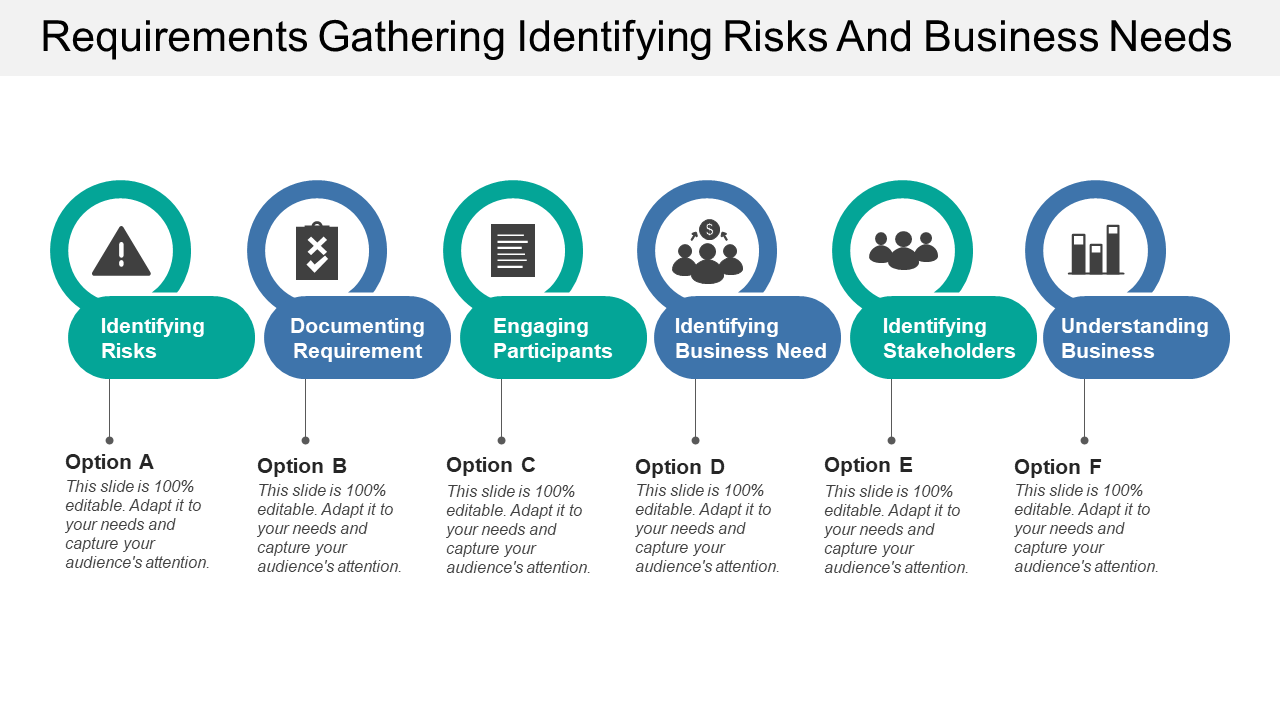
Template 6: Requirements Gathering Template for Identifying Risks And Business Needs
This out-of-the-box requirement-gathering template excels in important things, including risk management, Q&A testing, product line management, tracking interdependencies, etc. This incredible template creates map timelines, assigns roles to individuals, makes a blueprint of the project, sets milestones, etc., to minimize risks and fulfill business needs. What are you waiting for? Just get it now.
Template 7: Requirements Gathering Template With Prototype and Feedback
This template helps review the process of streamlined requirements with safety standards. It not only gathers requirements but also keeps track of verification, traceability, and defects of the product through prototyping and feedback. This fantastic template highlights the steps to cater to the demands and suggestions of the stakeholders during the project.

Template 8: Requirements Gathering Pyramid Template Showing Business and System Requirement
This PPT design contains ultimate slides such as eye-catching infographics, self-explanatory headings, and thoroughly-researched points. This template gives an interactive visual effect of the business, user, and system requirements in a pyramid shape. It has user-friendly access controls that help manage stakeholders and define project goals in the shortest possible time.

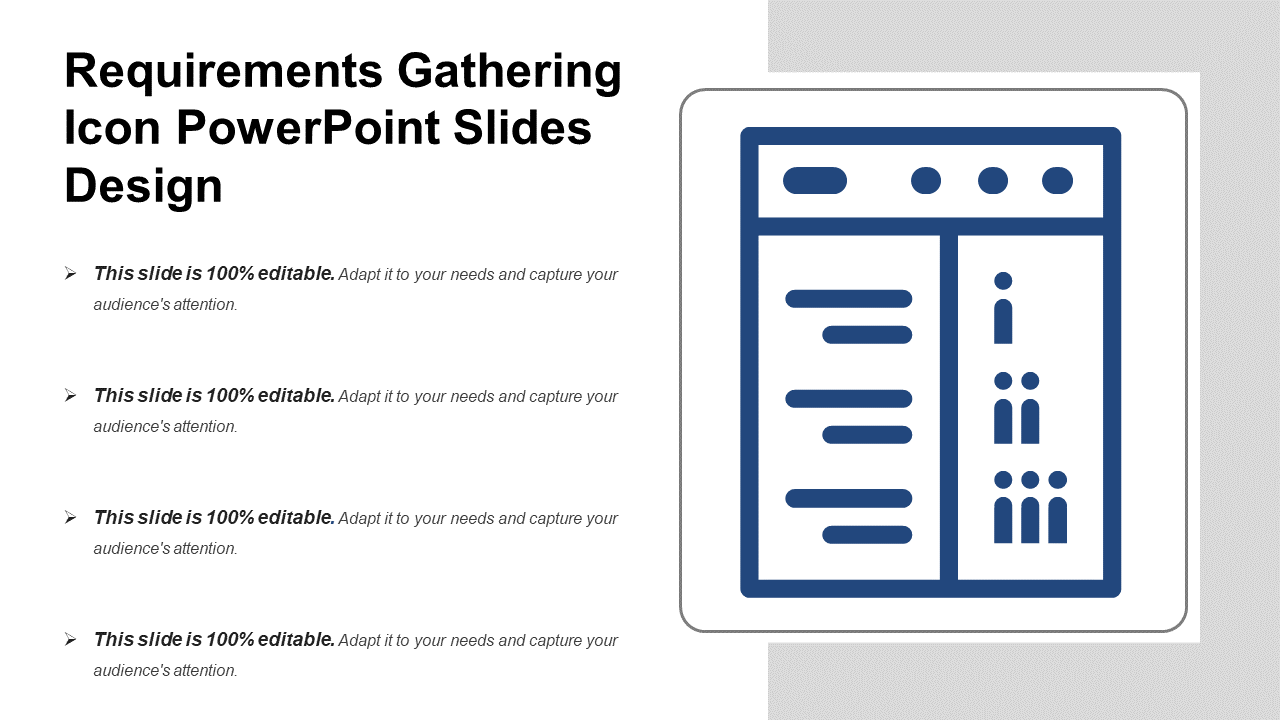
Template 9: Requirements Gathering PowerPoint Slides Design
If your business needs a more comprehensive platform, opt for this PPT template. Through this extensive template, you can trace gathered requirements, discuss these detail with the top management and edit it as per the need. You can define user roles, discuss the project’s requirements between software developers in weekly sprints and satisfy their needs.
Template 10: Requirements Gathering Pyramid Design Covering Business User and System
This innovative template defines relevant workflows between the high authorities of the business, the users, the project managers, and the teams. This PPT Template showcases the involvement of departments and members like team leaders, project managers, and senior executives of the company in an informative way. Don’t think so much! Download it today.

The Final Thought
Our requirement gathering templates are helpful for defining specifications for individual and whole requirements. Our solid, standardized, battle-tested templates provide clarity and aid navigation for business leaders. The collection of our requirement-gathering templates depicts project needs and avoids pitfalls that might terminate the project.
FAQs on Requirements Gathering
1. What is a requirement-gathering example?
Requirement gathering is just the first milestone that ensures the smooth execution of the project. Requirement gathering is more about business requirements, user requirements, system requirements, and technical requirements. For requirement documentation, it is critical that you know about the functions and features of a project or product and explains them well. With the right requirement-gathering tool, project managers can exude rare and valued professionalism.
2. What are the five stages of requirements gathering?
Before building any solution for a project or a business challenge, developers should understand this concept in detail. The five stages of requirement gathering are:
- Identify relevant stakeholders: Depending on your project, find qualified stakeholders or representatives like users, decision-makers, executives, system administrators, key suppliers, distributors, etc. In early meetings, ask questions from stakeholders before you start soliciting requirements.
- Define Project Objectives and Goals: Clearly establish business goals as well as actionable and measurable objectives of the company for decision-making.
- Requirements Elicitation: Organize questionnaires, surveys, interviews, follow-up meetings, etc. To get requirements from your stakeholders.
- Document and Confirm Requirements: Write down the gathered requirements in a simple and understandable format. The requirement documents include (but are not limited to) system specifications, the company’s design, vendor-supplied requirements, a database, a spreadsheet, etc., that the whole team can access. Verify the requirements with stakeholders and review them once.
- Prioritize the Requirements: Due to unexpected challenges, priorities change, so accept those changes and challenges. Set the requirements based on how these changes and challenges impact the objectives and goals of your project.
3. What are the steps in requirement gathering?
Follow the below-mentioned guidelines for the requirement-gathering process:
- Gather the opinions of the key stakeholders and analyze these in the project plan for incorporation.
- Organize surveys, presentations, user stories, questionnaires, meetings, and brainstorming sessions for collecting the required data and information for the project.
- Now, note down documents for necessary information, such as the title of the project, scope, goals, timeline, stakeholder information, milestones, technical and business requirements, etc., in a sequence.
- With realistic analysis and feedback, map assumptions and requirements, including potential risks, limitations, needs, risk mitigation methods, etc., to handle such situations.
- Get formal, informal, internal, and external approvals for the project to ensure that the project will commence without any hurdles.
- Monitor and evaluate the project working through the meetings, steering committees, midline analysis, etc., to check if it is running smoothly or not. If not, take appropriate action to make it work.
4. Which tool is used for requirement gathering?
There are many requirement-gathering tools available. Among them, the MindManager tool is the best requirement. You can easily create a central dashboard of information to visualize data clearly, including links and attachments. Some characteristics of these tools are:
- Highly adaptable layouts that meet needs
- Sorted quickly by using tags and filters
- Allows project teams to collaborate in real-time to co-edit documentation.
- Establish a strong connection between stakeholders and team members
- Mind mapping software and powerful visualization tool
- Flexible customer support
5. What are the six most common challenges when gathering requirements?
The six common challenges that every business personnel face while gathering requirements are:
- Undocumented Processes
- Lack of Access to End-Users
- Conflicting Requirement
- Communication Problem
- Stakeholder Design
- Focusing on Visual Aspects rather than on Functional
6. What is the aim of requirements gathering?
The requirements-gathering process is divided into seven parts: user requirements, system requirements, user interface requirements, functional requirements, software interfaces, change management, workflow activities, and risk management. The aim is to identify the exact needs of the project, product, or business from start to finish. It is the initial phase or stage of the project management process, but you must manage it throughout the project timeline.




![Top 12 Requirements Traceability Matrix Templates to Deliver Successful Projects [Free PDF Attached]](https://www.slideteam.net/wp/wp-content/uploads/2022/06/Top-12-Requirements-Traceability-Matrix-Templates_1.png)

![[Updated 2023] Top 15 MoSCoW Method Templates to Prioritize Project Requirements](https://www.slideteam.net/wp/wp-content/uploads/2021/04/03_1013x441-4.png)


