


Business Quality Assurance Powerpoint Presentation Slides





Try Before you Buy Download Free Sample Product
 Impress Your
 Audience
 100%
100% Editable
 Save Hours
 of Time


Quality assurance ensures every product service bearing the companys name is the same. Check out our insightfully designed template on Quality Assurance. It highlights the importance of taking a risk based approach to quality management and outlines the key elements of the process, including assessing, controlling, communicating, and reviewing quality concerns. Our quality assessment deck provides detailed insights into various tools and methodologies used for quality risk assessment, essential for ensuring customer health and safety. It also covers the risk tolerance capacity of stakeholders and offers a tracker to identify potential risks in the future. Additionally our QRM PPT provides a step by step overview of the risk assessment process, including risk identification, analysis, and evaluation. It further covers the risk control process and various risk management methodologies, including risk ranking and filtering, fault tree analysis, and many more. Our quality control module concludes by highlighting the significance of risk tolerance capacity and providing a risk tracker. It is an excellent resource for anyone looking to better understand Quality Risk Management and its relevance in the pharmaceutical industry. Get instant access.
People who downloaded this PowerPoint presentation also viewed the following :
Content of this Powerpoint Presentation
Slide 1: This slide introduces Quality Assurance. Commence by stating Your Company Name.
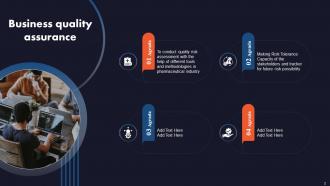
Slide 2: This slide depicts the Agenda of the presentation.
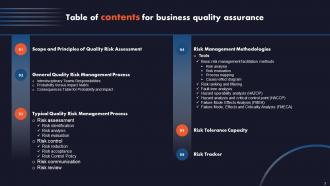
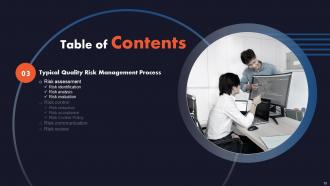
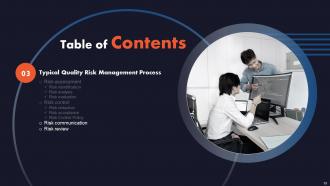
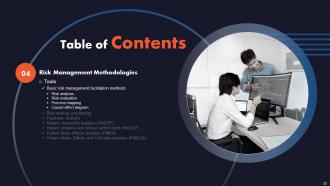
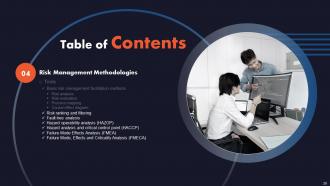
Slide 3: This slide includes the Table of contents.
Slide 4: This slide highlights the Title for the Topics to be covered further.
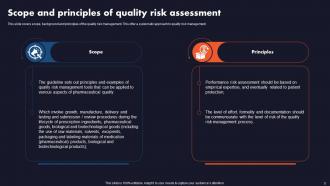
Slide 5: This slide reveals the Scope and principles of quality risk assessment.
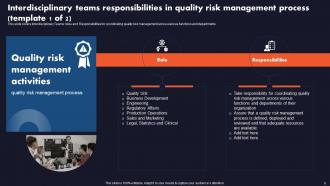
Slide 6: This slide shows the Interdisciplinary teams responsibilities in quality risk management process.
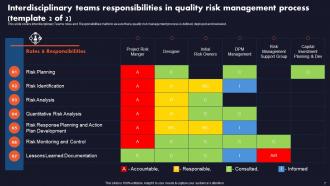
Slide 7: This slide continues the Interdisciplinary teams responsibilities in quality risk management process.
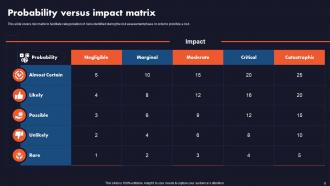
Slide 8: This slide covers risk matrix to facilitate categorization of risks identified during the risk assessment phase.
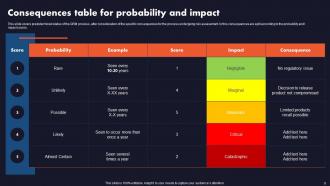
Slide 9: This slide mentions the Consequences table for probability and impact.
Slide 10: This slide contains the Heading for the Contents to be covered in the next template.
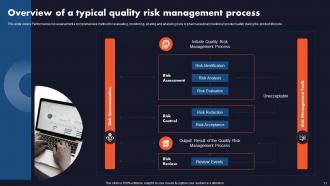
Slide 11: This side portrays an Overview of a typical quality risk management process.
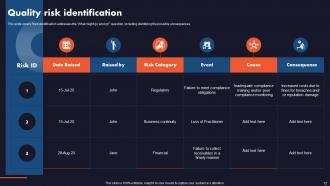
Slide 12: This slide deals with the Quality risk identification.
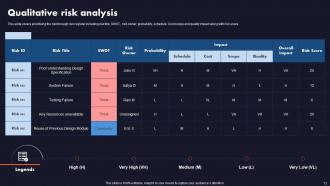
Slide 13: This slide presents the Qualitative risk analysis.
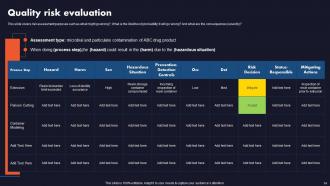
Slide 14: This slide indicates the Quality risk evaluation.
Slide 15: This slide depicts the Title for the Ideas to be discussed in the following template.
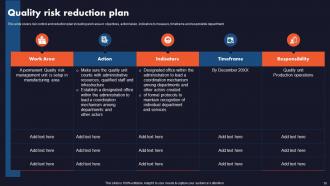
Slide 16: This slide highlights the Quality risk reduction plan.
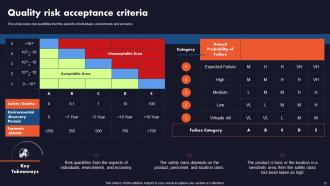
Slide 17: This slide covers risk quantifies from the aspects of individuals, environment, and economy.
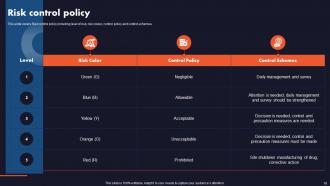
Slide 18: This slide talks about the Risk control policy.
Slide 19: This slide indicates the Heading for the Ideas to be covered next.
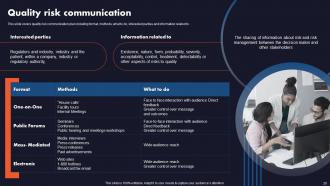
Slide 20: This slide portrays the Quality risk communication.
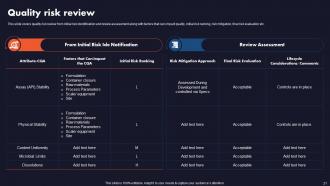
Slide 21: This slide indicates the Quality risk review.
Slide 22: This slide reveals the Title for the Contents to be discussed further.
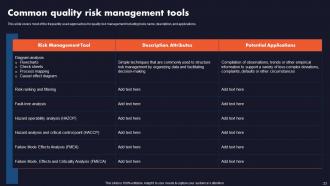
Slide 23: This slide states the Common quality risk management tools.
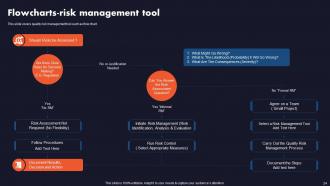
Slide 24: This slide illustrates the Flowcharts-risk management tool.
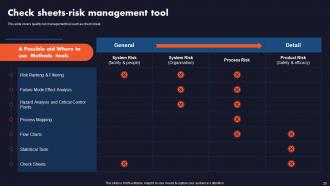
Slide 25: This slide outlines the Check sheets-risk management tool.
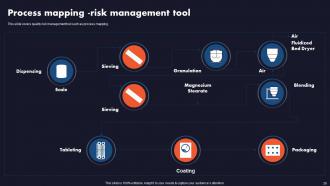
Slide 26: This slide covers quality risk management tool such as process mapping.
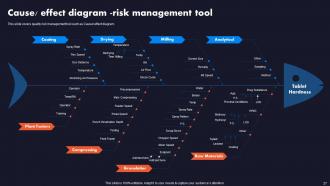
Slide 27: This slide highlights the quality risk management tool such as Cause/ effect diagram.
Slide 28: This slide contains the Heading for the Topics to be covered next.
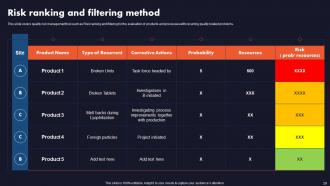
Slide 29: This slide states the Risk ranking and filtering method.
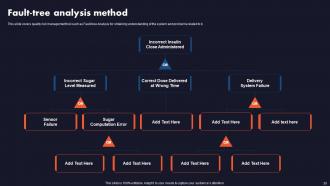
Slide 30: This slide deals with the Fault-tree analysis method.
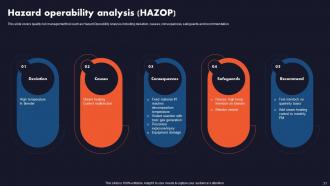
Slide 31: This slide covers quality risk management tool such as Hazard Operability Analysis.
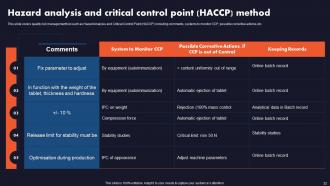
Slide 32: This slide highlights the Hazard analysis and critical control point (HACCP) method.
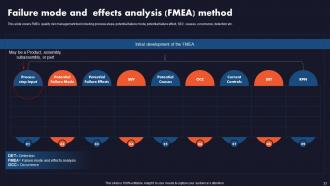
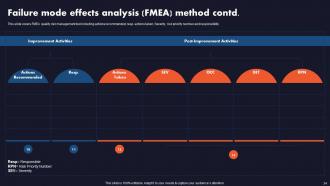
Slide 33: This slide talks about the Failure mode and effects analysis (FMEA) method.
Slide 34: This slide continues the Failure mode effects analysis (FMEA) method.
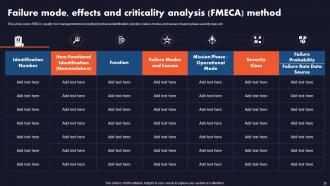
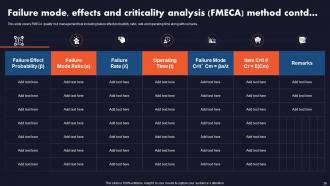
Slide 35: This slidementions about the FMECA quality risk management tool.
Slide 36: This slide showcases the FMECA quality risk management tool.
Slide 37: This slide includes the Title for the Topics to be discussed further.
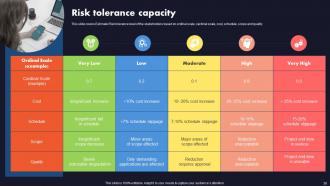
Slide 38: This slide portrays the Risk tolerance capacity.
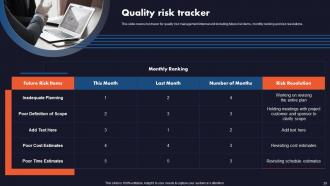
Slide 39: This slide illustrates the Quality risk tracker.
Slide 40: This is the Icons slide containing all the Icons used in the plan.
Slide 41: This slide is used for depicting some Additional information.
Slide 42: This is Our team slide. State your team-related information here.
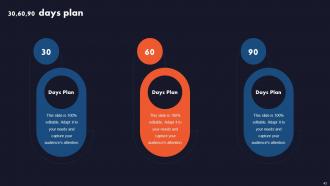
Slide 43: This is the 30,60,90 days plan slide for effective planning.
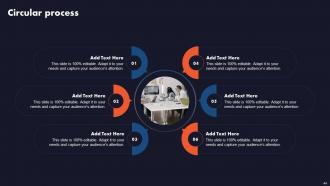
Slide 44: This slide displays the Circular process.
Slide 45: This is the Idea generation slide for encouraging fresh ideas.
Slide 46: This slide contains the Post it notes for reminders and deadlines.
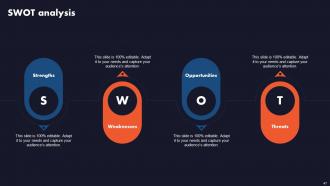
Slide 47: This slide reveals the SWOT analysis.
Slide 48: This is the Puzzle slide with related imagery.
Slide 49: This slide exhibits the company Timeline.
Slide 50: This is the Thank You slide for acknowledgement.
Business Quality Assurance Powerpoint Presentation Slides with all 55 slides:
Use our Business Quality Assurance Powerpoint Presentation Slides to effectively help you save your valuable time. They are readymade to fit into any presentation structure.









FAQs for Business Quality Assurance
Honestly, start by writing down what you're actually doing now - most places wing it more than they admit. Get clear standards everyone can follow, then set up regular check-ins to see if it's working. Train your people properly too. Management has to actually care or you're screwed from the start. Don't dump everything on your QA team though - quality should be everyone's problem. Track complaints and use that info to fix stuff. Regular audits catch problems before they blow up. Focus on your biggest gaps first instead of trying to fix everything at once.
Track your defect rates and customer complaints - those are the obvious ones. But dig deeper into process stuff too, like how many bugs your team catches during development vs after release. That ratio tells you way more than people realize. Test pass rates and inspection coverage matter too. I'd set up a basic monthly dashboard and review trends quarterly with the team. The goal is seeing more issues caught early while customer reports drop. Nothing fancy needed - just consistent tracking so you can actually spot what's working and what isn't.
Training your team is seriously the make-or-break factor for QA. I can't stress this enough - it's what separates good companies from the ones constantly putting out fires. Your employees need to actually understand the quality standards and know their tools inside out. That way they'll catch problems early instead of letting them snowball. Confidence matters too. When people know what they're doing, they take real ownership of the results. Don't just do some one-off training session and call it good though. You need regular check-ins and refresher courses to keep everyone sharp.
Honestly, automating your QA stuff is a game changer. Start with just one repetitive test process - you'll be shocked how much time it frees up. The real-time analytics are what got me hooked though. You start seeing error patterns you'd totally miss doing things manually. Cloud tools are clutch for team collaboration too, especially if anyone's working remotely. I mean, catching bugs before customers do? That alone pays for itself. Don't overthink it - pick one workflow and automate it. Once you see how smooth everything runs, you'll want to automate everything else.
Honestly, most people think QA is just bug hunting at the end of projects - totally wrong. It's really about stopping problems before they happen. Good QA actually speeds things up and saves money by catching stuff early, even though everyone assumes it slows everything down. Here's what drives me crazy though: thinking only the QA team handles quality. Nope. Everyone should care about quality in whatever they're doing. My advice? Stop playing whack-a-mole with problems after the fact. Get your whole team talking about quality from the start instead.
Make quality everyone's problem, not just QA's. Get your CEO talking about it in meetings - people actually pay attention when leadership cares. Train folks so they know what "good" looks like. Most screw-ups happen because people are rushing or confused about standards anyway. Set up ways for teams to catch issues early without getting blamed for finding them. Oh, and celebrate wins publicly! Maybe try a monthly quality champion thing where people nominate coworkers who killed it. Honestly, recognition works way better than you'd think for getting people to care about doing things right.
So QA is all about stopping problems before they happen - you're improving processes, training people, setting up better systems. QC comes after the fact. That's when you're testing stuff and catching issues before customers see them. Honestly, I think of it like this: QA builds better workflows so you don't need as much firefighting later. QC is the actual firefighting. Way better to focus on QA upfront because it saves you tons of headaches down the road. Both matter, but prevention beats cleanup every time.
Start with Google Forms for feedback and basic checklists - they're free and actually work pretty well. Write down what you're doing right and where stuff breaks (sounds obvious but most people skip this). Pick one area instead of trying to fix everything at once. Your current team can learn to catch problems early - way cheaper than hiring experts. Whatever system you pick, stick with it even if it feels too simple at first. I'd focus on tracking the stuff customers actually care about. You can always add more later once you get the hang of it.
Track your defect rates and customer satisfaction scores first - those tell you the most. Time-to-resolution matters too. First-pass yield is huge (basically how much work gets done right the first time without fixes). Don't go crazy measuring everything though. I've seen teams drown in metrics that nobody actually uses. Focus on maybe 4-5 things that'll actually change how you make decisions. Cost of quality is worth tracking if you're trying to justify budget stuff to management. Training effectiveness and process compliance are good once you get the basics down. Start small, then add more later.
Honestly, your customers are like free QA testers who actually know what they're doing. They'll find bugs and weird edge cases your internal team totally missed. Plus people use products in the most random ways - trust me on this one. When you start seeing the same complaints pop up multiple times? That's gold. It means something in your process is definitely off. Just grab feedback however you can - surveys, support tickets, even quick user calls. Then actually give that info to your QA folks so they can fix their test cases. It's way better than flying blind.
Look, QA basically stops your customers from getting pissed off at broken stuff. Catching problems before they ship means people don't bail for your competitors - which honestly happens way more than companies think. It builds trust, right? Customers know your products actually work. Companies with solid QA see like 20-30% better retention rates, which is pretty huge. I'd start by looking at where you're getting the most complaints and defect issues. That'll show you where better quality control would have the biggest payoff. Trust me, it's worth the investment upfront.
Figure out what standards actually matter for your business first - ISO 9001, Six Sigma, whatever applies to your field. Build those requirements right into your QA from the start instead of trying to add them later (learned that the hard way). Your team needs to get why these standards exist, not just tick boxes. Run internal audits regularly so you catch problems before the real auditors show up. Oh, and create some kind of calendar tracking when certifications expire - you don't want those sneaking up on you. The key is making compliance part of your normal workflow rather than this separate thing you scramble to deal with.
Jira's solid for bug tracking and project stuff. TestRail handles test cases well too. Selenium's your best bet for automation - takes forever to set up but saves you tons of time later. Confluence pairs nicely with Jira if you need documentation. Oh, and Postman's really easy for API testing, way better than some of the clunkier options out there. Monday.com or Asana work great for workflow visibility. My advice? Pick whatever fixes your biggest headache first. Don't try to implement everything at once or you'll go crazy. Build it out piece by piece.
Start by figuring out where things usually go wrong in your processes - honestly, most companies have the same problem spots over and over. Then set up checkpoints there to catch stuff before it becomes a real issue. Think of it like installing smoke detectors instead of just calling the fire department after your house burns down. Train your people to spot red flags early, do regular process checks, and create ways for problems to bubble up fast. The whole thing is really about changing how you think - from reactive to proactive, you know? Pick one process first and show it works before rolling it out everywhere.
Dude, those big QA disasters like Boeing's 737 MAX mess? Classic example of rushing to beat deadlines and cutting costs on safety stuff. Samsung's exploding phones too - nightmare. Here's what I've noticed: when QA teams get stuck in their own bubble instead of working with developers, things go sideways fast. Companies ignore their testers' warnings all the time, which is honestly just asking for trouble. The communication breakdowns are what really kill products though. Your QA people need to talk directly to the bosses and actually have power to stop launches when something's sketchy.
-
World-class PowerPoint designs that are fully customizable!
-
Every time I ask for something out-of-the-box from them and they never fail in delivering that. No words for their excellence!