


Logistics Company Organization Chart Supply Chain Company Profile Ppt Demonstration




Try Before you Buy Download Free Sample Product
 Impress Your
 Audience
 100%
100% Editable
 Save Hours
 of Time


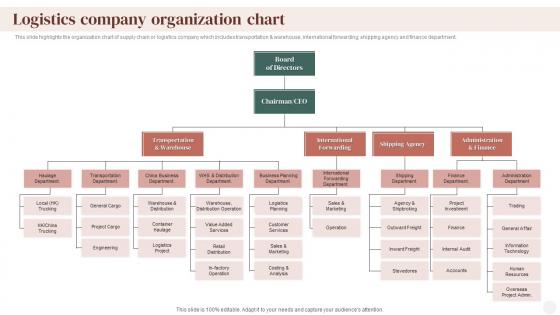
This slide highlights the organization chart of supply chain or logistics company which includes transportation and warehouse, international forwarding, shipping agency and finance department.
Logistics Company Organization Chart Supply Chain Company Profile Ppt Demonstration with all 6 slides:
Use our Logistics Company Organization Chart Supply Chain Company Profile Ppt Demonstration to effectively help you save your valuable time. They are readymade to fit into any presentation structure.
-
Logistics Company Organization Chart Supply Chain Company Profile Ppt Demonstration
-

Logistics Company Organization Chart Supply Chain Company Profile Ppt Demonstration
-

Logistics Company Organization Chart Supply Chain Company Profile Ppt Demonstration
-

Logistics Company Organization Chart Supply Chain Company Profile Ppt Demonstration
-

Logistics Company Organization Chart Supply Chain Company Profile Ppt Demonstration
-

Logistics Company Organization Chart Supply Chain Company Profile Ppt Demonstration
FAQs for Logistics Company Organization Chart Supply Chain Company
So most logistics companies break down like this: Operations is the big one - that's your warehousing, trucking, distribution stuff. Then you've got Supply Chain Management, Customer Service, Sales, and IT. Finance and HR are always lurking around too, obviously. What's kinda cool is how different companies split up Operations though. Some do it by transportation type, others by regions or customer types. Really depends on their thing. You might see random departments like Compliance or Quality Control if they deal with weird regulations or whatever. Honestly just peek at some logistics company websites - check out their "leadership" or "about us" pages. You'll get a way better feel for how they actually structure things than me just telling you.
Look, clear accountability makes everything run smoother when you've got a million moving pieces. Your teams know exactly who does what, so info flows faster and problems get fixed quicker. Specialized departments? Game changer - people actually get good at their specific thing instead of being pulled in every direction. Honestly, logistics is messy enough without adding "who's supposed to handle this?" drama. Just make sure your structure actually matches how work flows. Nothing's worse than packages sitting there because two departments are playing hot potato with responsibilities.
So tech completely flips your org chart - some jobs disappear, new ones pop up. Data analysts and automation engineers are everywhere now (my buddy's logistics team is basically all tech people at this point). But you're cutting traditional roles since software does route planning and inventory automatically. Warehouses need fewer floor supervisors, more IT folks running the systems. Here's the thing though - figure out what tech you're actually rolling out first. Then decide who runs it vs what manual stuff you can ditch. Don't put the cart before the horse on this one.
Honestly, just create different divisions for each market - way easier than trying to force one structure everywhere. International stuff needs local managers who actually get the regulations and cultural weirdness (learned that the hard way). Your domestic ops can be flatter since it's all about speed there. Each market has totally different headaches - compliance here, crazy delivery expectations there. Map out what each one actually needs first, then build your reporting around that. The whole thing should bend based on what you're dealing with. Don't overthink it.
Oh man, the biggest headache is definitely trying to balance corporate control with giving your regional teams enough freedom to actually do their jobs. Time zones and different regulations make everything way more complicated than it should be. Reporting gets super messy too since logistics touches literally everything - ops, sales, customer service, you name it. What kills me is companies that don't plan for growth. Like, your structure at 50 people is gonna completely fall apart at 500. Start basic and just commit to reviewing/changing things regularly as you scale up. Trust me on this one.
Basically, domestic teams wear way more hats - like your warehouse guy also doing transport planning. International is totally different though. You need specialists for everything because of all the customs headaches. Dedicated trade compliance people, customs brokers, documentation coordinators. Each country's got its own weird rules too, so you'll want regional experts. Honestly, the regulatory stuff alone will make your head spin. Start by figuring out which markets you're actually targeting first. That'll help you decide what roles are must-haves versus just nice additions to the team.
So your org structure is basically what controls how info moves around and whether teams actually work together or not. Too many management layers? Messages get completely mangled on their way up and down - like that old telephone game we used to play as kids. Flatter structures help warehouse, transport, and customer service talk directly to each other, which is great. But then nobody knows who's supposed to make the final call on stuff. You've gotta find what works for your company size and set up good communication channels. Especially when things get crazy during shipping season - that's when everything falls apart if you don't have it figured out.
Dude, trust me on this - having a solid org chart saves your ass when logistics goes sideways. You'll know exactly who handles shipping delays or routing screwups without playing phone tag. No more "wait, wasn't that your job?" drama between teams. Plus it shows which departments actually need to talk to each other - warehouse, transport, customer service, all that. I mean, it seems obvious but you'd be surprised how many companies wing it. Just make sure everyone can actually access the thing and update it when people move around.
Look, when supply chain disasters hit, having clear hierarchy is a lifesaver. You need everyone knowing who makes what calls fast. Last time our supplier vanished overnight, we would've been toast without proper escalation paths already mapped out. Frontline workers report up, regional folks coordinate sideways, executives approve emergency cash – the whole thing flows. Short answer: drill your team on who calls who BEFORE things go sideways, not when you're panicking at 2am trying to find someone with spending authority. Trust me on this one.
Honestly, having a solid org chart cuts through so much BS. No more "that's not my department" when stuff goes wrong with shipments or inventory. People know who they report to and what they're supposed to handle - makes accountability way easier. You can spot bottlenecks quicker too since you know exactly who should be dealing with what step. The trick is actually making sure everyone sees it and gets their role, not just sticking it somewhere random. I've seen too many companies create these things and then nobody even knows where to find them.
Honestly, the biggest thing I'm seeing is companies going way flatter - like, they're pushing decisions down to the managers actually running day-to-day ops instead of having everything go up the chain. New roles are popping up everywhere too, especially data scientists and automation people (wild how those jobs barely existed a few years back). Oh, and the whole department silo thing? Pretty much dead. Everyone's working cross-functionally now because supply chain problems need all hands on deck. My advice would be to keep your structure flexible though - this stuff changes fast and you don't want to be stuck reorganizing every six months.
So here's what I've seen at most logistics companies - customer service usually reports up to like a Chief Customer Officer or VP of Customer Experience. Operations goes under the COO or VP of Ops. But honestly, they're super connected day-to-day through shared metrics and workflows. The real action happens with middle management though. Account managers, ops coordinators, logistics specialists - they're constantly talking between both sides. Communication between these teams has to be bulletproof because when stuff hits the fan with shipments, everyone needs to jump on it fast. Some companies are trying out hybrid roles too, which makes sense.
Dotted lines work great for this - just connect people from different departments to show they're collaborating. I've also seen companies make separate boxes for cross-functional teams that sit next to the main chart. Like a "Customer Experience Task Force" with folks from ops, customer service, and IT. Matrix charts are another option where people report to two places, but honestly? Those get confusing real quick. Different colors or shapes help distinguish temporary teams from permanent roles. The trick is keeping it clean so you don't clutter up your main structure - nobody wants to stare at a hot mess trying to figure out who does what.
Don't overcomplicate your org chart with crazy hierarchies. Logistics is fast-paced so you need clean communication lines. Include those cross-functional relationships - ops, dispatch, and customer service are constantly talking to each other anyway. I've watched companies stack like 5 management layers between drivers and executives, which is honestly ridiculous. Your warehouse, transportation, and planning teams should connect directly instead of going through their managers every time. Keep updating it too because roles change fast and nobody wants to guess who handles what anymore.
Honestly, org charts are way more useful than people think. You can spot talent gaps before they bite you - like realizing you're loaded with managers but short on actual warehouse people. Great for seeing who's promotion-ready too. I always look at mine when planning hires because it shows exactly where the holes are. Plus succession planning becomes so much easier when you can visually see your team structure. Sometimes you'll notice weird stuff like having three people with the same skills in one department while another's totally understaffed.
-
Love the template collection they have! I have prepared for my meetings much faster without worrying about designing a whole presentation from scratch.
-
I didn’t expect such a good service for the money I am paying. But, they exceed my expectations. Great work SlideTeam.