


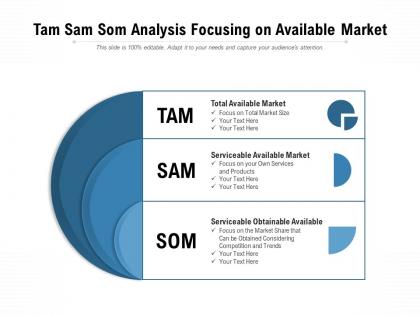
Tam sam som analysis focusing on available market




Try Before you Buy Download Free Sample Product
 Impress Your
 Audience
 100%
100% Editable
 Save Hours
 of Time


Interact with your colleagues through our Tam Sam Som Analysis Focusing On Available Market. Impress them with the feasibility of your ideas.
Tam sam som analysis focusing on available market with all 2 slides:
Impress folks with the feasibility of your ideas with our Tam Sam Som Analysis Focusing On Available Market. It allows you to interact with your colleagues.
FAQs for Tam sam som analysis focusing
TAM is basically if you owned the entire market - like, every single customer. SAM gets more realistic about who you can actually reach with your product as it is now. Then SOM is what you'll probably capture short-term given your budget, competition, all that stuff. Most startup decks totally butcher these numbers tbh. They just slap on some crazy growth projections. But done right? TAM shapes your big picture vision. SAM helps figure out your launch strategy. And SOM - that's what you actually put in your financial projections so you don't look delusional to investors.
Look, don't just grab one data source and call it a day - that's where most people mess up. Start with those big market research reports for your top-down numbers. Then flip it and work bottom-up using your actual customer data and what you're charging. Cross-check everything against what competitors are doing and industry benchmarks. For SOM, be honest about what you can realistically capture in 3-5 years given your current growth and resources. I always tell people this stuff isn't set in stone - you've got to keep updating as you learn more from real customers.
So there are basically three ways to figure out TAM. You can go top-down - grab some industry report and filter it down to your slice. Bottom-up is the opposite - start with your unit economics and build up from customer estimates and revenue per user. Then there's value theory, which is honestly kind of a pain but sometimes more realistic. You calculate how much value you're creating and guess what chunk you could actually grab. I'd definitely use two methods though, because these estimates can go completely off the rails. Just start with whatever data you trust most.
Look at your SAM to see what you can actually win with what you've got right now. Rank segments by how much you could realistically grab - bigger slice = higher priority. Don't just chase huge TAM numbers (made that mistake before, ugh). Check out the competition in each segment too. Map your top 3-5 by SAM size first, then figure out where you've got real advantages. Honestly, competitive positioning matters more than people think. Start there and you'll spot where you can actually take meaningful share instead of just hoping for the best.
Look, market research is what separates real TAM/SAM/SOM numbers from total BS. Without it, you're basically throwing darts blindfolded. Primary research shows you who'll actually buy your stuff, while secondary gives you the big picture market sizing. I can't tell you how many decks I've seen with completely fictional SAM numbers that crumble the second someone asks follow-up questions. Super embarrassing. Use multiple methods to double-check your estimates - start with industry reports for your TAM baseline, then do surveys or interviews to figure out what you can realistically capture. Cross-validation is everything here.
Look, TAM/SAM/SOM basically proves to investors you actually get your market - not just guessing wildly. Start big with TAM to show the total opportunity exists. SAM narrows it down to what you can realistically reach with your business model. Then SOM is your honest short-term target (this is where most founders get way too optimistic honestly). Investors eat this stuff up because it shows you think strategically and did your homework. Just make sure your SOM numbers actually match what you're asking for funding-wise. Don't be that founder whose projections are completely detached from reality.
Honestly, the worst thing you can do is get too optimistic with your projections. I've watched so many people claim they'll grab like 10% market share right out the gate - total pipe dream. Don't just throw around huge TAM numbers either. Just because there's a billion-dollar market doesn't mean you can actually reach all of it. Geographic limits matter. So does competition. Your actual serviceable market is way smaller than you think. Oh, and definitely cross-check your data from multiple sources. Being conservative with your projections will save you from looking completely delusional to investors.
Look, TAM/SAM/SOM data is actually super useful for figuring out where to put your marketing dollars. Small SOM compared to SAM? Go deeper in your current market instead of wasting cash on broad campaigns. When TAM looks massive but SAM is limited, that's when you know it's time to explore adjacent markets or build new products. I see so many companies blow their budget trying to capture everything when they haven't even nailed their realistic slice yet. Use SOM for setting actual conversion goals and SAM to time your expansion moves right. Master your SOM first - the flashy big numbers can wait.
Honestly just start with Excel or Google Sheets - they're way more powerful than people think for this stuff. You can do all your TAM/SAM/SOM math and make decent charts without spending a dime. If you need fancier visuals later (like for a big presentation), Tableau and Power BI are solid choices. There's also specialized tools like CB Insights or Pitchbook, but those can get pricey. I'd say stick with Excel plus some good market research first - you'll probably get most of what you need that way. Why overcomplicate it?
Trends are huge for TAM estimates, especially with emerging tech. You can't just look at current numbers - adoption rates depend on so much more. Take AR/VR or autonomous cars. Regulatory changes, infrastructure buildout, how consumers actually behave... that stuff matters way more than the tech itself sometimes. I totally screwed up a blockchain analysis once because I ignored all the regulatory drama brewing. What works is picking 3-5 major trends that'll either speed up or kill adoption, then testing your TAM against different scenarios. Bottom-up calculations are great, but you've got to layer in the trend analysis or you'll be way off.
Yeah, TAM SAM SOM is actually great for product decisions. Look at your total addressable market to find gaps where customers aren't getting what they need - that's where you innovate. Your SAM shows which features to build first based on what you can realistically reach. I've watched so many teams waste months on features that seemed cool but nobody actually wanted. SOM keeps you honest about adoption rates before you dive in. Quick reality check though - if your analysis shows the market segment is tiny, maybe skip that shiny feature and focus elsewhere.
Look, a tiny SOM means you're basically scrapping for leftovers with every competitor out there. Pricing gets brutal, acquiring customers costs way more, and you'll need some serious creativity just to stay afloat. Investors run when they see small addressable markets - they want scale, not niche plays. But honestly? Sometimes it just means you're thinking too narrow about who could actually use your stuff. I'd take another hard look at your market breakdown before freaking out. Maybe there's adjacent markets or different customer types you haven't considered yet. Worth exploring before you pivot everything.
Your geographic reach basically shrinks all those market size numbers - TAM, SAM, SOM. Start with the global market size (TAM), then your SAM gets smaller based on where you can actually operate. SOM shrinks even more since it's what you'll realistically capture in those areas. But here's the thing - it's not just about drawing lines on a map. Local rules, cultural stuff, shipping costs... they all mess with your calculations. I learned this the hard way when I thought expanding to Canada would be easy (spoiler: it wasn't). You've got to be realistic about where you can serve customers well, not just where you think you could maybe possibly operate someday.
Track your market growth rates and how competitor shares are shifting around. Customer acquisition costs tell you a lot too. Revenue per customer and churn? Those numbers don't lie. New players entering the space can totally change your addressable market - same with regulatory stuff or tech disruptions. Sometimes I think surveys are underrated for spotting unmet needs that your models might miss. Do quarterly check-ins comparing real metrics against your original TAM-SAM-SOM projections. You'll probably find the actual opportunity looks way different than what you first mapped out.
Dude, you really need to keep tracking your TAM/SAM/SOM regularly - like every quarter, not just when you're raising money. Most companies totally blow this off after their initial pitch deck, which is crazy. Regular analysis helps you catch market shifts early and spot opportunities your competitors miss. You can pivot faster, spend your budget better, and know exactly when to jump into new markets. It's honestly like having a crystal ball for your business strategy. Think of it as your early warning system - works for both incoming threats and those random goldmine opportunities that pop up. Make it a habit, not a one-off thing.
No Reviews