


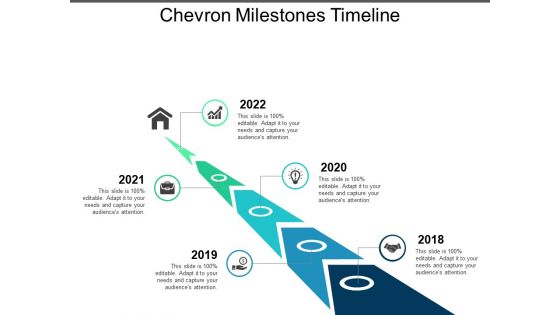
Chevron milestones timeline





Try Before you Buy Download Free Sample Product
 Impress Your
 Audience
 100%
100% Editable
 Save Hours
 of Time


Create standardized curriculum with our Chevron Milestones Timeline. Give everyone equal exposure.
People who downloaded this PowerPoint presentation also viewed the following :
Content of this Powerpoint Presentation
Description:
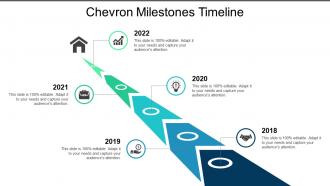
This image depicts a template for a Chevron Milestones Timeline, a visual representation designed to showcase key events or achievements over a period of time. It's structured to highlight the years 2018 through 2022, with icons and text placeholders that suggest different kinds of milestones such as financial goals, innovation landmarks, strategic initiatives, operational highlights, and other significant corporate events. Each year is represented by a circular node connected by a chevron-patterned line, indicating progression.
Use Cases:
This customizable timeline slide showcases milestones from 2018-2022, suitable for strategic presentations across different industries seeking to highlight key accomplishments.
1. Technology:
Use: Product development tracking
Presenter: Project managers
Audience: Stakeholders and investors
2. Healthcare:
Use: Medical advancements summary
Presenter: Healthcare administrators
Audience: Medical professionals and board members
3. Education:
Use: Institutional development history
Presenter: University deans
Audience: Faculty and academic committees
4. Finance:
Use: Fiscal milestone visualization
Presenter: Financial analysts
Audience: Shareholders and decision-makers
5. Real Estate:
Use: Property portfolio evolution
Presenter: Real estate developers
Audience: Investors and property management teams
6. Manufacturing:
Use: Process improvement chronology
Presenter: Operations managers
Audience: Production teams and quality assurance staff
7. Marketing:
Use: Campaign effectiveness over time
Presenter: Marketing strategists
Audience: Marketing team and brand managers
Chevron milestones timeline with all 5 slides:
Don't go by conjecture with the help of our Chevron Milestones Timeline. They contain only established facts.



FAQs for
So Chevron goes way back - started as Pacific Coast Oil in 1879, became Standard Oil of California by 1906. Finding oil in Saudi Arabia in 1938 was massive for them internationally. Then they got really big through mergers - Gulf Oil in 1984 made them a "supermajor," and that Texaco deal in 2001? $45 billion, which was insane money back then. These days they're trying to get into cleaner energy stuff while still doing the regular oil business. Honestly, looking at those merger years shows you how they basically bought their way to the top globally.
So Chevron used to be all about drilling and refining tech back in the day. Around 2010 though, they completely switched gears and started their own venture capital thing. Now they're buying up smaller companies instead of doing everything themselves. Wild how they went from pure oil focus to messing around with geothermal, hydrogen, carbon capture - the whole nine yards. They're big on AI and automation now too. I actually think it's smart they're hedging their bets like this. Their annual reports have the full timeline if you're curious, but yeah - total transformation from traditional R&D labs to tech partnerships.
Yeah, Chevron's actually done some pretty big stuff on the sustainability front. Net-zero upstream emissions by 2050 - that's ambitious for an oil giant. They've dumped billions into carbon capture tech and cut methane emissions by around 50% since 2016, which isn't nothing. Now they're getting into renewable diesel and hydrogen projects too. Look, they're still an oil company at heart, so take it with a grain of salt. But the environmental pressure is clearly making them pivot. Their latest sustainability report has all the specific numbers if you need hard data for whatever you're working on.
Look, Chevron's been pretty smart about timing their moves. Back in the 70s oil shocks, they went international hard and pumped money into finding new reserves. When prices tanked in the 80s? Technology upgrades and cutting fat everywhere. The 2000s were honestly a mess for the whole industry, but they stuck to profitable projects and grabbed Texaco when they could. These days they're dabbling in renewables - though let's be real, oil's still their bread and butter. Main thing is they don't blow all their cash during good years. They save it for when everything goes sideways again.
Yeah, Chevron's basically grown by buying everyone else out. That massive Texaco deal in 2001 - $36 billion - totally changed everything for them. Doubled their size instantly and got them into markets they'd never touched before. They also grabbed Gulf Oil back in the '80s, which was huge news then. Plus they're always snagging smaller companies here and there to round out what they need. It's actually pretty smart how they've stayed neck-and-neck with the other big oil players. When you're looking at their strategy, just focus on how each buyout either expanded where they operate or what tech they could access.
Oh man, Chevron's actually done some cool stuff over the years. Their deepwater drilling in the Gulf of Mexico was huge, plus they nailed enhanced oil recovery with CO2 injection. They were early on 3D seismic imaging too - total game changer for finding oil. Hydraulic fracturing tech, carbon capture, geothermal projects. The Tengiz expansion is pretty wild with all that modular construction. Honestly their patent portfolio alone would probably keep you busy for hours if you're digging into energy innovation examples. Worth a look for sure.
So Chevron's big moves - they grabbed Unocal in 2005 for $18 billion, which was smart because it gave them huge reserves in Asia and Thailand. Their Tengiz deal in Kazakhstan from the '90s has been printing money ever since. Australia's where they really went big with Gorgon and Wheatstone LNG projects, making them a major Pacific player. Lately they're all-in on Permian shale and those crazy profitable Guyana offshore fields. Honestly, they've always gone for the long-term plays instead of quick cash grabs - probably why they've stayed competitive.
So Chevron's been doing some pretty solid community stuff, honestly. Kazakhstan and Angola are where you'll see the biggest impact - they've built schools, healthcare facilities, trained tons of locals for energy jobs. Their Central Asia program created like 100k jobs, which is actually impressive. They do environmental cleanup too, mostly fixing damage from older operations. Oh and they publish annual sustainability reports that break down all the investment numbers by region - super helpful if you need specific data. Not sure what your project angle is, but those reports are probably your best starting point.
Yeah, Chevron's really stepped up their governance lately - like, massively. The shareholder pressure has been wild, so they've been adding independent directors with environmental backgrounds and tying exec pay to sustainability goals. Their board oversight on climate stuff got way more serious too. Oh, and they created specific committees for ESG issues, which honestly makes sense given all the scrutiny they're under. The disclosure practices are much better now. If you're digging into this, definitely check their proxy statements from 2020 onward - that's when things really shifted.
Okay so Chevron's had three big turning points that really matter. They went all-in on natural gas in the 2010s - honestly brilliant timing since everyone was ditching coal. After 2020 hit, ESG stuff got real so they pivoted hard into carbon capture and renewable fuels. Their acquisition game has been pretty ruthless too (remember that whole Anadarko thing?). Now they're throwing money at hydrogen and biofuels. Pro tip: just watch their quarterly capex numbers if you want to know where they think the market's actually going. Way more telling than their PR statements.
Yeah so Chevron basically ditched the whole "put everything in one place" strategy - smart move honestly. Now they're spreading suppliers around different regions instead of gambling on one area. The big thing is they dumped tons of money into digital tracking systems that let them pivot fast when oil prices go crazy or supply chains break down. Contract terms got shorter too so they can stay flexible. Oh and if you want specifics on what tech they're actually using, their investor presentations have all the details broken down pretty well.
So Chevron's been killing it with partnerships lately. The Gorgon LNG thing in Australia is massive - they're working directly with the government there. Then you've got their deepwater stuff with Total and ExxonMobil, which honestly makes sense since those projects are crazy expensive. Kazakhstan's Tengiz expansion is another big one with tons of international players involved. But here's what's interesting - they're pivoting hard into renewables now. ESG pressure's real, I guess. Check out their geothermal work in Indonesia and the carbon capture deals. That's where you'll see their actual strategy heading.
So Chevron's doing this "lower carbon, higher returns" thing with their R&D spending. They're putting cash into making their current oil/gas operations more efficient, but also betting on carbon capture, hydrogen, biofuels - you know, the newer stuff. Smart move honestly, since they can't just ditch everything overnight and go full renewable. Most of their investments either cut costs now or set them up for whatever energy looks like in 10 years. They're not throwing away what they're good at, just adding new tricks. Oh, and their annual tech report is actually worth checking out if you want to see where their money's going.
So the big turning points - Paris Climate Agreement in 2015 got them into climate stuff, then their 2021 net zero pledge. Hurricane Katrina was actually huge for them realizing they needed better community ties (makes sense when you think about it). Their Human Energy campaign in the 2000s started all the education investments. Oh, and 2022 was when they dropped serious cash on lower carbon tech - not just talk anymore. These explain why they're so focused on climate action and community partnerships now. Honestly their whole approach makes way more sense when you see how it evolved.
So Chevron basically sets up local compliance teams in each region since regulations are totally different everywhere - like California's environmental rules versus North Sea safety stuff. Smart move, honestly. They don't try to force the same process everywhere, which would be a disaster. Each team handles their own regional requirements but corporate still oversees everything for consistency. Oh and their annual sustainability reports are actually pretty detailed if you want specifics. They break down compliance performance by geography and list upcoming deadlines. Way more useful than you'd expect from corporate reporting.
No Reviews