


Cloud Based Services Powerpoint Presentation Slides




Try Before you Buy Download Free Sample Product
 Impress Your
 Audience
 100%
100% Editable
 Save Hours
 of Time


Cloud computing is a burgeoning industry that enables businesses to move away from on premise IT infrastructure and instead depend on internet based services. Check out our efficiently designed Cloud based Services template that gives a brief idea about cloud service provider companies, an overview of cloud computing, architecture and types, etc. In this presentation, we have covered how different industries utilize cloud computing, standard cloud service models such as infrastructure as a service IaaS, platform as a service PaaS, and software as a service SaaS. In addition, this PPT contains the introduction of IaaS, its characteristics, types of IaaS environments, service provided by service providers, pros and cons, reasons to choose the IaaS model, and top service providers for IaaS. Also, the presentation includes the PaaS introduction, types, elements included in PaaS, and SaaS introduction and types of SaaS solutions. Furthermore, this template compares three cloud service models, namely IaaS, PaaS, and SaaS, and provides a checklist to implement each model. Lastly, this Cloud based Services deck comprises a 30 60 90 days plan and a roadmap to implement cloud service models in the organization. Get access to this 100 percent editable template now.
People who downloaded this PowerPoint presentation also viewed the following :
Content of this Powerpoint Presentation
Slide 1: This slide introduces Cloud-Based Services. State Your Company Name and begin.
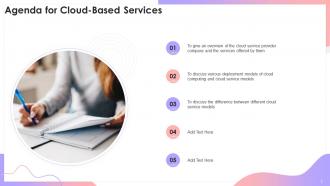
Slide 2: This is an Agenda slide. State your agendas here.
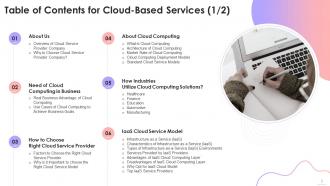
Slide 3: This slide presents Table of Content for the presentation.
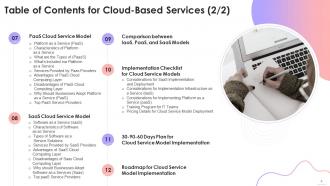
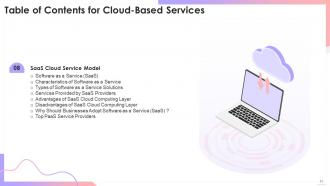
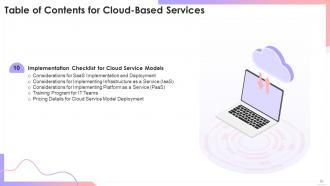
Slide 4: This is another slide continuing Table of Content for the presentation.
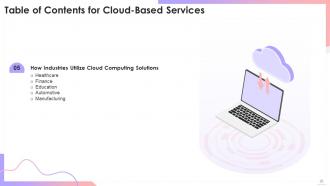
Slide 5: This slide highlights title for topics that are to be covered next in the template.
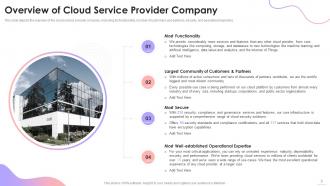
Slide 6: This slide shows overview of the cloud service provider company, including its functionality, number of customers and partners.
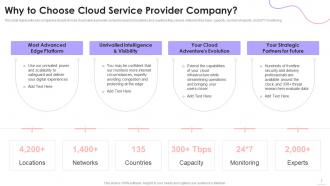
Slide 7: This slide represents why companies should choose cloud service provider company based on locations and countries they served.
Slide 8: This slide highlights title for topics that are to be covered next in the template.
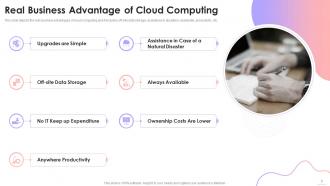
Slide 9: This slide shows Real Business Advantage of Cloud Computing.
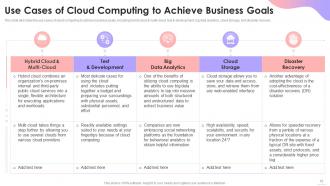
Slide 10: This slide displays Use Cases of Cloud Computing to Achieve Business Goals.
Slide 11: This slide highlights title for topics that are to be covered next in the template.
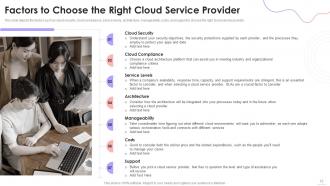
Slide 12: This slide shows Factors to Choose the Right Cloud Service Provider.
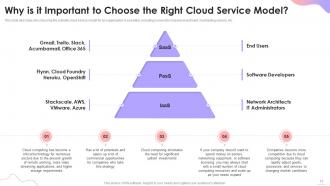
Slide 13: This slide presents Why is it Important to Choose the Right Cloud Service Model.
Slide 14: This slide highlights title for topics that are to be covered next in the template.
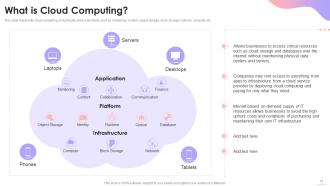
Slide 15: This slide represents cloud computing, including its various elements such as monitoring, content, etc.
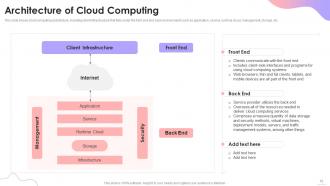
Slide 16: This slide shows cloud computing architecture, including client infrastructure that falls under the front end and back end.
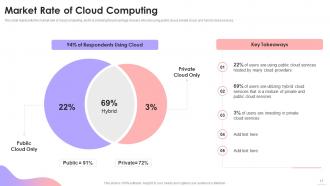
Slide 17: This slide represents the market rate of cloud computing, and it is showing the percentage of users who are using public cloud.
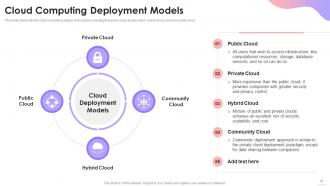
Slide 18: This slide presents cloud computing deployment models, including the public cloud, private cloud, hybrid cloud, etc.
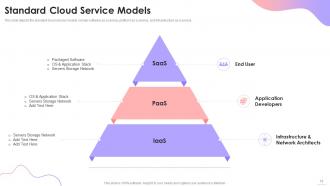
Slide 19: This slide shows standard cloud service models, namely software as a service, platform as a service, and infrastructure as a service.
Slide 20: This slide highlights title for topics that are to be covered next in the template.
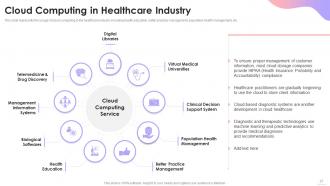
Slide 21: This slide represents the usage of cloud computing in the healthcare industry.
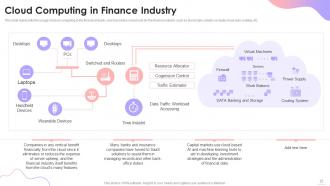
Slide 22: This slide displays the usage of cloud computing in the finance industry, and it provides many tools for the finance industry.
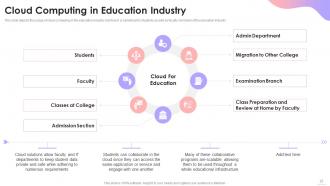
Slide 23: This slide depicts the usage of cloud computing in the education industry and how it is beneficial for students.
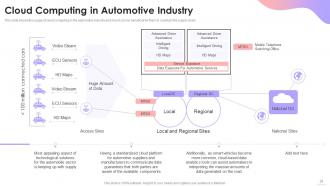
Slide 24: This slide shows the usage of cloud computing in the automotive industry and how it can be beneficial for them.
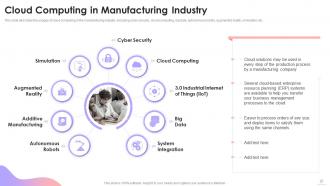
Slide 25: This slide displays Cloud Computing in Manufacturing Industry.
Slide 26: This slide highlights title for topics that are to be covered next in the template.
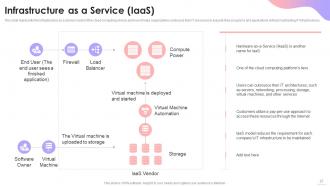
Slide 27: This slide represents the infrastructure as a service model of the cloud computing service.
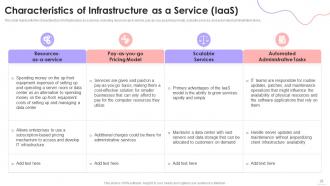
Slide 28: This slide presents the characteristics of infrastructure as a service, including resource-as-a-service, pay-as-you-go, etc.
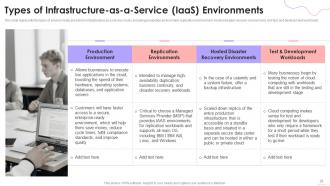
Slide 29: This slide displays the types of environments provided in infrastructure as a service model.
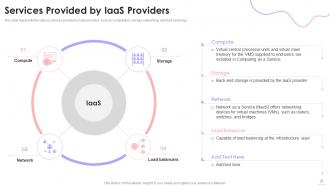
Slide 30: This slide shows various services provided by IaaS providers, such as computation, storage, networking, and load balancing.
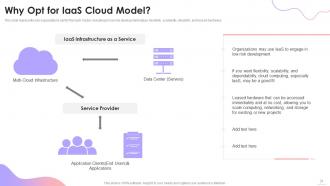
Slide 31: This slide represents why organizations opt for the IaaS model, including its low-risk development nature, flexibility, etc.
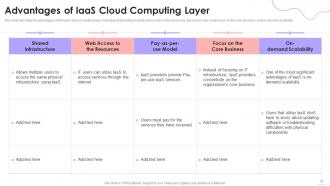
Slide 32: This slide describes the advantages of the IaaS cloud computing layer, including shared infrastructure, web access, etc.
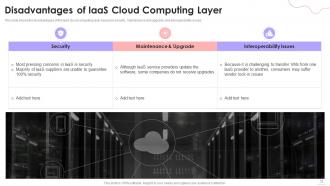
Slide 33: This slide presents Disadvantages of IaaS Cloud Computing Layer.
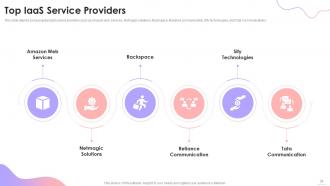
Slide 34: This slide depicts some popular IaaS service providers such as Amazon web services, Netmagic solutions, Rackspace, etc.
Slide 35: This slide highlights title for topics that are to be covered next in the template.
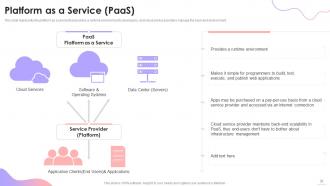
Slide 36: This slide shows platform as a service that provides a runtime environment to developers.
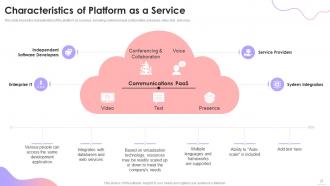
Slide 37: This slide shows the characteristics of the platform as a service, including conferencing & collaboration, presence, video, etc.
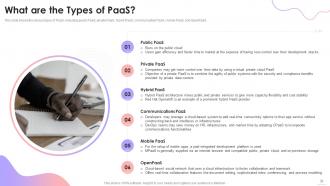
Slide 38: This slide presents the various types of PaaS, including public PaaS, private PaaS, hybrid PaaS, etc.
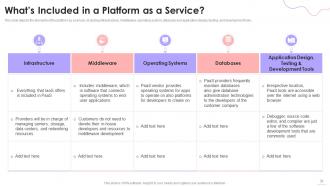
Slide 39: This slide depicts the elements of the platform as a service, including infrastructure, middleware, operating system, etc.
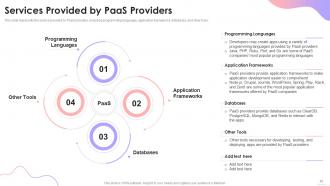
Slide 40: This slide represents the service provided by PaaS providers, including programming languages, application frameworks, etc.
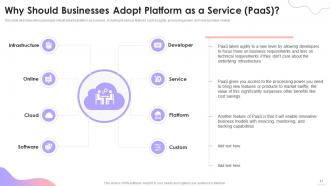
Slide 41: This slide describes why businesses should adopt a platform as a service, including its various features.
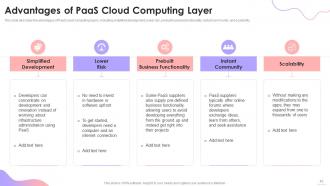
Slide 42: This slide shows Advantages of PaaS Cloud Computing Layer.
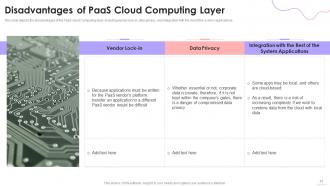
Slide 43: This slide presents Disadvantages of PaaS Cloud Computing Layer.
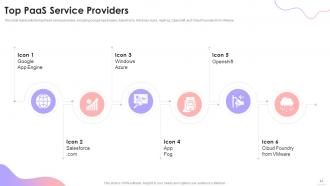
Slide 44: This slide represents the top PaaS service provides, including Google App Engine, SalesForce, etc.
Slide 45: This slide highlights title for topics that are to be covered next in the template.
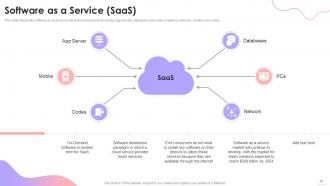
Slide 46: This slide displays software as a service model of cloud services that includes app servers, databases, personal computers, etc.
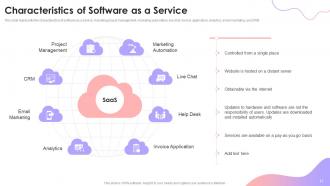
Slide 47: This slide represents the characteristics of software as a service, including project management, marketing automation, etc.
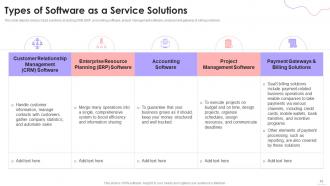
Slide 48: This slide presents Types of Software as a Service Solutions.
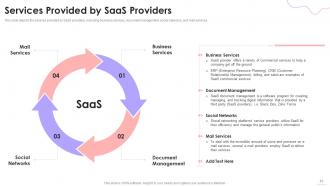
Slide 49: This slide depicts the services provided by SaaS providers, including business services, document management, etc.
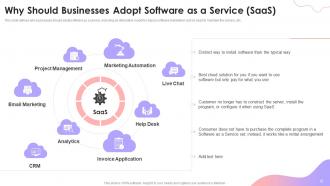
Slide 50: This slide defines why businesses should adopt software as a service.
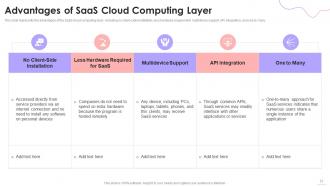
Slide 51: This slide represents the advantages of the SaaS cloud computing layer.
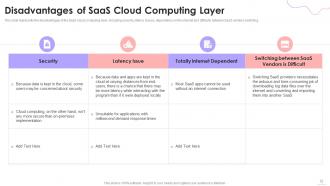
Slide 52: This slide shows Disadvantages of SaaS Cloud Computing Layer.
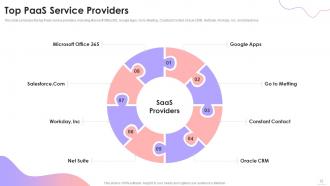
Slide 53: This slide comprises the top PaaS service providers, including Microsoft Office365, Google Apps, GoTo Metting, etc.
Slide 54: This slide highlights title for topics that are to be covered next in the template.
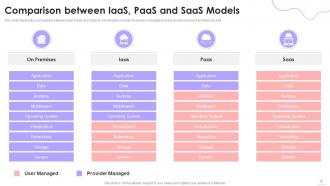
Slide 55: This slide represents a comparison between IaaS, PaaS, and SaaS by showing the number of services.
Slide 56: This slide highlights title for topics that are to be covered next in the template.
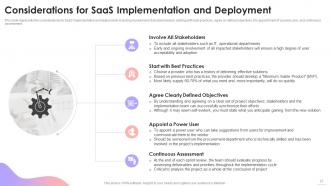
Slide 57: This slide represents the considerations for SaaS implementation and deployment, including involvement of all stakeholders.
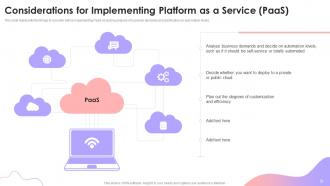
Slide 58: This slide presents the things to consider before implementing PaaS, including analysis of business demands.
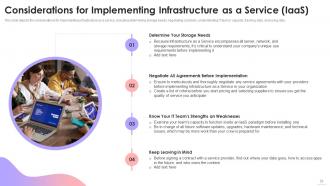
Slide 59: This slide shows Considerations for Implementing Infrastructure as a Service (IaaS).
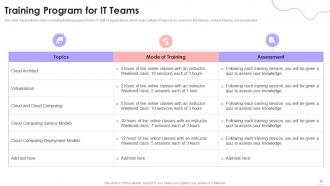
Slide 60: This slide represents the cloud computing training program for the IT staff of organizations.
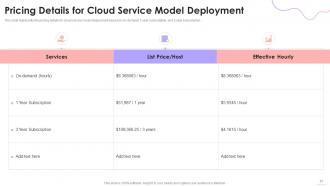
Slide 61: This slide shows Pricing Details for Cloud Service Model Deployment.
Slide 62: This slide highlights title for topics that are to be covered next in the template.
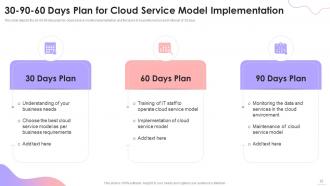
Slide 63: This slide depicts the 30-60-90 days plan for cloud service model implementation.
Slide 64: This slide highlights title for topics that are to be covered next in the template.
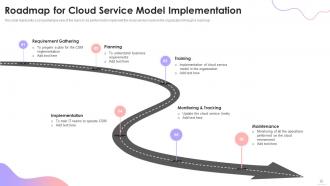
Slide 65: This slide represents a comprehensive view of the tasks to be performed to implement the cloud service model.
Slide 66: This slide displays Icons for Cloud-Based Services.
Slide 67: This slide is titled as Additional Slides for moving forward.
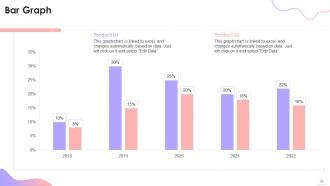
Slide 68: This slide presents Bar chart with two products comparison.
Slide 69: This is About Us slide to show company specifications etc.
Slide 70: This slide shows Post It Notes. Post your important notes here.
Slide 71: This is Our Mission slide with related imagery and text.
Slide 72: This slide depicts Venn diagram with text boxes.
Slide 73: This is a Timeline slide. Show data related to time intervals here.
Slide 74: This slide contains Puzzle with related icons and text.
Slide 75: This is a Thank You slide with address, contact numbers and email address.
Cloud Based Services Powerpoint Presentation Slides with all 80 slides:
Use our Cloud Based Services Powerpoint Presentation Slides to effectively help you save your valuable time. They are readymade to fit into any presentation structure.





FAQs for Cloud Based Services
Dude, the money savings alone are worth it - you're not stuck paying for servers that just sit there doing nothing most of the time. Your team can grab files from literally anywhere, which has been a lifesaver since everyone went remote. Scaling is stupid easy too, just adjust what you need with a few clicks. Oh, and no more panicking about crashes in the middle of the night because that's their problem now, not yours. The security stuff is pretty solid too, way better than what most small companies can afford on their own. I'd say try their file storage first and go from there.
So it's basically about control vs ease, you know? IaaS gives you raw computing power but you're managing everything yourself - perfect for custom setups or weird legacy stuff. PaaS is the sweet spot IMO, handles the infrastructure headaches while you focus on building. Then there's SaaS where you just log in and use it (like Office 365). Honestly, I always tell people to ask themselves: do I want to build something from scratch, customize existing tools, or just use what's already there? That usually makes the choice pretty obvious.
So here's the deal with cloud security - you need to nail down who does what first. Your provider covers infrastructure stuff, but data protection and access controls? That's on you. Get multi-factor auth set up immediately (seriously, password breaches are insane right now). Encryption for everything moving around and stored is huge too. Regular audits help catch weird stuff early. Oh, and backups - can't stress this enough. The trap most people fall into is thinking the cloud provider handles all security. They don't. Map out responsibilities before moving anything critical.
Honestly, cloud services are a game changer for disaster recovery. Your data automatically lives in multiple places, which is huge - no more praying your backup server didn't get fried along with everything else. The recovery speeds most providers offer? Way better than the old school tape-and-pray method. Sure, it'd cost you a ridiculous amount to build that kind of redundancy yourself. One thing though - you've gotta actually test your recovery stuff regularly. Don't just assume it works. Also figure out what your provider handles vs what's on you.
Honestly, cloud tools are a game changer for remote teams. You can all edit the same doc at once, hop on video calls without planning ahead, and nobody's ever working on outdated files. Real-time collaboration is pretty seamless - share screens, access everything from anywhere with wifi. I used to hate the constant "wait, which version are we using?" chaos. Automatic saves fixed that nightmare. Just don't go overboard picking like 15 different apps that don't talk to each other. Find a few that actually work together and you're set.
Dude, start with an audit of what you're actually running right now - I bet you've got dev servers just sitting there burning money. Turn off anything you're not using! Auto-scaling is your friend here, plus reserved instances can save you tons if you know you'll need certain resources long-term. Spot pricing works great for batch jobs too. The cloud providers have decent cost monitoring tools built in, though honestly they could be better. Right-sizing is huge - most people way over-provision their instances. Just tackle the biggest money pits first and you'll see savings pretty quickly.
Yeah, cloud computing definitely has environmental costs - those data centers are power hogs and need constant cooling. But honestly? It's way more efficient than everyone running their own servers. Pick providers going green (AWS, Google, Microsoft all have renewable energy stuff). Don't over-provision your instances, try serverless when it makes sense. Oh and this one's huge - actually audit what you're using! I can't tell you how many forgotten dev environments I've found just burning money and energy 24/7. Those add up fast.
Yeah, compliance stuff can really bog down cloud moves - sometimes for months. First thing is figuring out what regulations hit your data (HIPAA, GDPR, SOC 2, whatever). Then you gotta vet providers hard before signing anything. Most big cloud companies have tons of certifications now, which helps. But honestly, some companies just freeze up completely when they see all the requirements - and I get it, the penalties are scary. You still have to configure everything right on your end though. My advice? Map out your compliance needs first, then work backwards from there.
Honestly, data migration is gonna be your biggest headache - plus figuring out when to actually do it without killing everyone's work day. Your apps probably won't just magically work in the cloud either, so expect some tweaking. Cloud pricing is weird compared to what you're used to, makes budgeting a pain. If you're in something heavily regulated, the security stuff will drag things out forever. Oh, and definitely start small! Pick something unimportant first to test with. Trust me on that one - learned it the hard way.
Honestly, cloud stuff is a game changer for scaling. You can spin up resources when you're busy and dial them back when it's slow - no more paying for servers that just sit there doing nothing (which always bugged me tbh). Traffic spikes won't crash your site anymore, and you're only paying for what you actually need. Want to test a new market? You don't have to drop tons of cash upfront. Just start small with cloud hosting and watch how much smoother everything runs. Way better than the old days of guessing what you'd need.
Honestly, start with security stuff first - check what certifications they have because that's where you'll get burned if you skip it. Pricing is huge too, I've seen people get absolutely wrecked by surprise charges. Performance guarantees are pretty critical if customers actually use your apps. Oh, and test their support team early - some are useless when you need them most. Migration should be straightforward in case you hate them later. My advice? Run a small pilot project first instead of diving in headfirst with everything.
Honestly, most companies just throw money at cloud resources without thinking. You've gotta watch your usage patterns constantly and resize things based on what you're actually using. Set up some monitoring dashboards - they're lifesavers. Auto-scaling helps too, but don't forget to audit regularly and kill off anything sitting there doing nothing. Pick regions close to your users and use CDNs for faster delivery. I learned this the hard way, but treat it like an ongoing thing, not something you do once. Start with a monthly check of your biggest expenses. That'll show you where you're bleeding money.
Edge computing and serverless are the big ones right now. Multi-cloud's getting huge too since nobody wants to be stuck with one vendor. Honestly feels like there's some new "revolutionary" tool every week - it's exhausting but also pretty exciting. Zero-trust security is finally moving from buzzword to actual implementation. Oh, and AI/ML integration isn't optional anymore, it's just expected. If you haven't messed around with serverless functions yet, definitely worth trying. Container orchestration is basically required knowledge now. The cost optimization tools are getting way better though, which is nice since cloud bills can get scary fast!
Ugh, vendor lock-in is the worst - basically you get stuck with one cloud provider because switching becomes insanely expensive and complicated. All your apps get tangled up with their specific tools and APIs. I learned this the hard way at my last job! Once you're trapped, you lose all your negotiating power and can't jump to competitors with better deals or cooler tech. My advice? Plan for portability right from the start. Stick to open standards when you can, avoid their proprietary stuff for anything critical, and actually audit your dependencies regularly. Trust me on this one.
So cloud platforms are getting crazy smart these days. They use AI to auto-scale your stuff and predict server failures before they happen. You know those cost optimization suggestions you keep getting? That's machine learning analyzing your usage patterns. Security threats get detected in real-time now too, which honestly blows my mind - like, we're living in the future. The data processing workflows are way smoother because of it. Definitely check out whatever AI tools your provider has. You'll save yourself hours of tedious work, trust me on this one.
-
The PPT layout is great and it has an effective design that helps in presenting corporate presentations. It's easy to edit and the stunning visuals make it an absolute steal!
-
Exclusive and extensive collection of templates. Really helped me create a professional presentation in just no time.