

Comparaison de deux entreprises - exemples de tableaux, diapositives de présentation





Try Before you Buy Download Free Sample Product
 Impress Your
 Audience
 100%
100% Editable
 Save Hours
 of Time


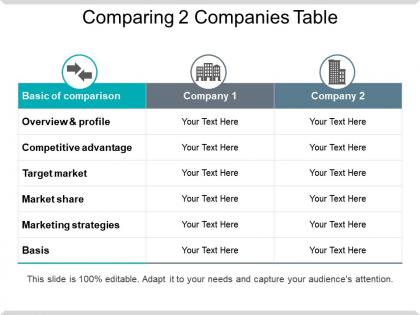
Acquérir des connaissances sur vos concurrents en utilisant la galerie d'images de présentation PowerPoint Comparing 2 Companies Management Of Styles. Cette présentation PowerPoint est un excellent produit pour vous permettre d'examiner les performances de votre entreprise par rapport à vos concurrents. Avec l'aide du diaporama de comparaison radiale PowerPoint, vous pouvez comprendre les valeurs d'image de marque de votre entreprise en analysant l'image de marché de l'entreprise par rapport aux autres entreprises. Le diagramme de flux dans le diaporama PowerPoint comprend des sections pour comparer deux entreprises. Chaque section du tableau de comparaison est liée à cinq préoccupations qui peuvent être modifiées selon les besoins de l'organisation. Ce modèle de diapositive de comparaison de 2 entreprises est un excellent outil pour faire ressortir les contrastes entre deux marques afin de comprendre la force globale de l'équité de la marque. Téléchargez cette intéressante présentation PowerPoint et comparez facilement deux entreprises.
People who downloaded this PowerPoint presentation also viewed the following :
Comparaison de 2 entreprises - Tableau, Présentation PowerPoint, Exemples, Diapositives avec les 5 diapositives
Adressez les préoccupations importantes avec nos exemples de diapositives de tableau de comparaison de 2 entreprises. Assurez-vous que chaque doute soit complètement effacé.
FAQs for Comparing 2 companies table
So basically you're looking at multiple cases side by side to spot patterns and differences. Pick cases that are similar enough to actually compare but different enough to tell you something useful - that's honestly the trickiest part. It's kinda like comparing crime scenes to figure out what the killer's doing differently each time. You'll want to nail down your comparison criteria first, then control for variables by choosing smart examples. Way more revealing than just studying one thing in isolation. Short version: find good cases, compare systematically, see what pops out.
Honestly, charts and visuals are a game-changer for this stuff. Bar charts work great because people instantly see which numbers are bigger. Side-by-side comparisons and heat maps help too - way better than drowning people in spreadsheets. Color coding is clutch when you're juggling multiple variables. I always figure out my main point first, then pick whatever chart type tells that story best. Oh, and before/after visuals are perfect if you're showing changes over time. Your stakeholders will actually pay attention instead of glazing over.
Honestly, comparative analysis works best when you've got several decent options and can't just wing it. Use it for stuff like picking vendors, deciding which product features matter most, or choosing between big strategic moves. It's a lifesaver when everyone on your team has different opinions (which happens constantly, right?). The whole point is getting objective about trade-offs instead of just going with whoever argues loudest. Super helpful when the stakes are high or you know someone's gonna question your decision later. Basically saves you from that "why did we pick this again?" moment six months down the road.
So case studies are like your go-to examples when you want to compare stuff properly. You're not stuck with boring theory - you get actual real situations to dig into. Pick 2-3 cases that are similar in some ways but different in the thing you care about. That's where the good comparisons happen. They show you the "why" behind what you're seeing, not just surface stats. Honestly, I think of them as building your argument with solid evidence. The trick is finding cases varied enough to give you interesting contrasts but not so random they don't make sense together.
Figure out what you're actually trying to prove first - sounds obvious but it'll save you tons of time later. Pick 3-5 metrics that directly answer your question and make sure you can get solid data for all of them. I wasted way too many hours once hunting for numbers that basically didn't exist. Your audience matters too - executives want different stuff than the dev team. Keep it simple though. Too many metrics and people's eyes glaze over. Honestly, run a quick test comparison first to see if your metrics actually show meaningful differences before you commit to the whole thing.
Don't compare things that are totally different - like trying to analyze McDonald's vs fine dining restaurants, you know? Cherry-picking data is another trap I see all the time. Your sample sizes need to match up reasonably well, and watch out for different time periods screwing with your results. Context matters way more than people think. Document everything you did so when someone asks "wait, how'd you get this?" six months later, you're not scrambling to remember. Oh, and be honest about where your analysis falls short - saves you headaches down the road.
So pick like 3-5 competitors and make a spreadsheet comparing pricing, features, customer reviews - the usual stuff. Check out their marketing too, see what messages they're pushing. Honestly, reading their bad reviews is where you'll find gold sometimes. Focus on actual numbers instead of just guessing what they're doing better. Once you map it all out (this part's kinda tedious but worth it), you can either copy what works or find the gaps they're missing. I always look at their distribution channels too - tells you a lot about their strategy.
Start with the basics - t-tests for comparing two groups, ANOVA for multiple ones. Chi-square works well if you're dealing with categories. Your data's probably gonna be messy (mine always is), so Mann-Whitney U or Kruskal-Wallis are good backups when things aren't normal. Regression or MANOVA can handle the complicated stuff with multiple variables. Just match your test to what you're actually trying to figure out. I'd run some basic descriptive stats first to see what you're working with, then move up to the fancier tests. Don't overthink it initially.
Honestly, comparative analysis is just a fancy way of saying "see how you stack up against your competition." You get the data to figure out where you're killing it and where you're... well, not. Spotting those performance gaps helps you find opportunities you might've totally missed otherwise. Think of it as your business reality check - shows you exactly where you stand versus where you could be. Then you can actually prioritize what to fix first or double down on what's already working. Super helpful for setting goals that aren't completely unrealistic too.
Okay so first thing - make sure you're actually comparing similar stuff. Same time periods, similar contexts, all that. Don't cherry-pick data just because it makes your point look better (trust me, the temptation is real). Be honest about where your data sucks or has gaps. Also think about whether your analysis screws over certain groups unfairly. If you're using company data, obviously don't break any confidentiality stuff. Document everything clearly so someone else can check your work and catch what you missed. Honestly, having someone else review it is probably your best bet anyway.
Honestly, tech makes this stuff so much easier than doing it by hand. I use Tableau mostly, but Excel works fine too if that's what you've got. The filtering and visualization features are actually pretty solid. Statistical tools are great for catching patterns you'd totally miss otherwise. Saves me from staring at spreadsheets for hours trying to spot trends. The automated data collection part is where it really pays off though - like, instead of copying numbers around all day, you can spend time figuring out what it all means. Start with whatever you already have and go from there!
So basically you'll want to compare student outcomes between different programs - test scores, graduation rates, that kind of stuff. Pick 2-3 specific curricula you're looking at. Then gather baseline data on similar student populations before you make any decisions. Also check engagement levels and long-term success metrics. Don't forget the budget side either (honestly everyone skips this part but it matters). Teacher satisfaction is worth looking at too. The trick is setting clear comparison points upfront so you're not comparing apples to oranges later.
Dude, you can't just dive into comparing things without knowing the backstory first. Different time periods mean different rules, tech, politics - all that stuff changes what your data actually means. Like, imagine comparing social media usage from 2010 vs now without mentioning smartphones became huge in between. You'll totally miss why the numbers look so different. Your own perspective matters too since you're looking at everything through today's lens. Honestly, I learned this the hard way on a project last year. Just sketch out the major historical stuff upfront and you'll avoid some really embarrassing conclusions.
Dude, Netflix nailed this - they looked at what millions of people watched to predict your next binge, which totally changed how we discover shows. Southwest did something clever too, comparing themselves to bus companies rather than airlines and boom, budget flights were born. Even Google and Facebook just run A/B tests constantly (which is basically comparing two versions of something) to make their products better. The trick is comparing yourself to weird, unexpected things, not just your obvious competitors. That's where the real breakthroughs happen, you know?
Set your criteria before you look at anything - seriously, this saved me from picking my favorite option just because I liked it. Write down what you're measuring and how much each factor matters. Use scoring sheets if you can, they help a lot. Getting another person to review helps too, though I know that's not always realistic. Question your own assumptions as you go - I'm terrible at this but trying to get better. Document everything so someone else could follow your exact steps. Honestly, the whole point is transparency. If another person used your method, they should get pretty much the same answer.
-
Excellent design and quick turnaround.
-
Use of icon with content is very relateable, informative and appealing.