


Corporate Banking Loan Origination Process




Try Before you Buy Download Free Sample Product
 Impress Your
 Audience
 100%
100% Editable
 Save Hours
 of Time


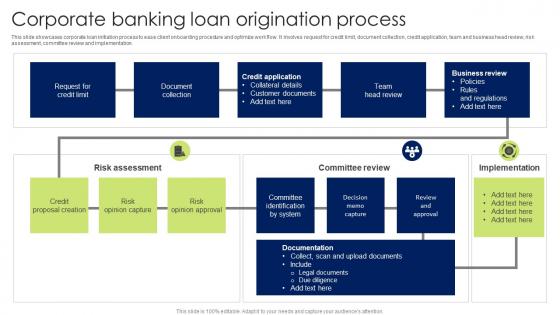
This slide showcases corporate loan initiation process to ease client onboarding procedure and optimize work flow. It involves request for credit limit, document collection, credit application, team and business head review, risk assessment, committee review and implementation.
People who downloaded this PowerPoint presentation also viewed the following :
Corporate Banking Loan Origination Process with all 6 slides:
Use our Corporate Banking Loan Origination Process to effectively help you save your valuable time. They are readymade to fit into any presentation structure.





FAQs for Corporate Banking
So basically you start with the initial inquiry and pre-screening stuff. Then comes the formal application - that's when you're collecting all their financial docs and business paperwork. Credit analysis happens next, and honestly? This is where things get stuck if their documentation is messy. After that it goes to loan committee for approval, then legal does their documentation review. Funding comes last, plus you'll need to monitor them post-closing. Whole process usually takes 30-90 days depending on how complicated the deal is. Just make sure you're keeping clients in the loop because they get antsy when things drag on.
So corporate risk assessment is way more complicated - you're analyzing cash flow, business fundamentals, management teams, the whole industry landscape. Consumer loans? Pretty straightforward credit scores and debt ratios, mostly automated. Corporate deals take forever because there's covenant structures and ongoing monitoring (honestly such a pain). With business lending you'll spend weeks digging through financial statements and collateral valuations. Consumer side just runs through scoring models. Way different timelines too - corporate approvals can drag on while retail loans move fast. Oh and the paperwork difference is insane.
Dude, technology completely changed the game for corporate loans. Digital platforms now pull credit data and financials in real-time - we're talking days instead of weeks for processing. AI handles the initial credit scoring and catches fraud automatically, which is honestly a lifesaver. Most workflows run themselves now, so your people can actually build relationships instead of drowning in paperwork. Oh, and if you're still doing everything manually? You're definitely losing deals to banks that moved faster. The whole industry just operates differently now.
So data analytics is honestly a game changer for credit decisions. Instead of just looking at basic financials, you can dig into cash flow patterns, industry trends, even weird stuff like trade payments or digital footprints. Predictive modeling is where it gets really cool though - you're not just reviewing past performance anymore, you're actually forecasting default risk under different scenarios. Machine learning spots patterns we'd never catch. My advice? Figure out which data points match up with your best loans first, then expand from there. Way better risk picture overall.
Dude, the worst part is constantly hunting down clients for their financials and tax docs - like pulling teeth sometimes. Credit approvals? Total nightmare. You'll be waiting weeks just for risk teams to get back to you, honestly it's ridiculous. Missing one compliance checkbox can tank the whole deal too. Don't even get me started on legacy banking systems that refuse to work together. Here's what helped me though - be super clear upfront about what docs you need and when. Set real timelines, not optimistic ones.
Look, documentation is everything when it comes to lending decisions. You can't properly assess risk without solid financials, cash flow statements, business plans - all that stuff. I've watched deals completely fall apart because someone got lazy with the paperwork upfront. It protects you legally too, which your compliance team will thank you for later. Honestly, half the headaches in this job come from missing docs. Create a checklist and don't budge on what you need from clients. Trust me, being a hardass about paperwork saves everyone time and stress down the line.
Ugh, regulations basically control everything in loan origination. Your underwriting standards? Regulated. Documentation and risk assessment? Also regulated. You've got capital requirements, anti-money laundering stuff, borrower disclosures - it never ends. Honestly the compliance costs mess with your pricing too since you have to build that into everything. The worst part is how fast things change. One new rule can flip your whole strategy overnight, which happened to us twice last year. Get a good compliance team that actually pays attention to updates, trust me on this one.
So banks are obsessed with cash flow - can you consistently pay back what you owe? You'll need 2-3 years of financial statements showing steady EBITDA and debt coverage ratios. Working capital trends matter too. Your industry plays a huge role (some sectors are just death traps honestly). Management experience counts for a lot. Oh, and bring detailed cash flow projections - like really detailed. If there's weird stuff in your financials, explain it before they ask. Trust me on that one.
Honestly, three major things are happening that you can't ignore. ESG stuff is huge now - everyone wants their loan rates tied to sustainability goals. Your clients expect everything digital too, like API connections and workflows that actually work fast (they're spoiled by how smooth consumer apps are). Flexible credit deals are where it's at - revolving facilities, lighter covenants. Banks are also getting way more industry-specific instead of that generic approach. Oh, and definitely audit your digital setup and ESG game first. Without those, you're basically dead in the water for new deals.
Honestly, you can read a bank's whole vibe just by watching how they do loans. Some places pile on crazy approval layers and want like 50 documents - that's your ultra-conservative shops. Others fast-track stuff with way fewer hoops. I've noticed banks where the loan officers get shot down constantly by committees, which is kinda telling about trust issues there. Speed vs being thorough depends totally on their culture too. But here's the real test - watch what happens with those iffy, borderline applications. That's when you see their actual risk tolerance come out.
So loan pricing right now? Fed rates are still pretty high compared to 2020-21, which sets your floor. Banks are looking hard at credit profiles - cash flow coverage, debt ratios, what industry you're in. Collateral matters too obviously. But honestly, the relationship piece is where you can really move the needle. If your client brings deposits or uses treasury services, banks will sharpen their pencils way more. I've seen deals get priced super aggressively just because the borrower had a fat deposit relationship. Package that whole story when you pitch - don't just focus on the loan itself.
Honestly, start with being upfront about timelines - people hate being ghosted during applications. Speed up your doc requests too because nobody wants to dig through files from five years ago (been there, done that). Your biggest win? Get someone who actually answers their phone assigned to each application. Maybe look into one of those tracking portals so customers aren't constantly calling for updates. I'd sit down and figure out what's pissing people off most right now. Fix communication first though - that's usually the real problem, not your actual process.
Look, due diligence is your lifeline in corporate lending. You're checking if everything the borrower says is actually true - their financials, how they run things, whether management knows what they're doing. Most deals live or die right here. Without it, you're just throwing the bank's money at whatever story sounds good that day. I always make checklists for each area I need to dig into. Sounds boring but trust me, it saves your ass when something sketchy pops up later. You'll catch red flags before they become disasters.
Dude, communication literally makes or breaks these deals. I always do a kickoff call explaining the whole process upfront - saves so much headache later. Then I'm super clear about what docs they need and when. Weekly updates are clutch, even if it's just "hey, still waiting on that appraisal." Honestly, most deals that drag from 30 to 60+ days? It's because someone dropped the ball on communication. You'd be surprised how many issues you can catch early with regular check-ins. Being proactive instead of scrambling when problems pop up - that's the difference between smooth closings and total disasters.
You're gonna want to focus on cyber risks first - those can destroy creditworthiness instantly. ESG compliance failures are huge now too, plus supply chain issues that weren't even on our radar a few years ago. Climate stuff is getting scary, especially for ag and real estate clients. Data privacy regulations keep changing and honestly, most credit models haven't caught up yet. The real problem? These things don't happen in isolation - one domino falls and suddenly you've got a mess. I'd start updating your due diligence checklists to dig deeper on this stuff during loan reviews.
-
Like always a great experience with you guys. Always there on the drop of hat to help.
-
Incredibly beautiful designs that will help you get noticed! These eye-catching templates are perfect for corporate presentations that can be altered to fit any occasion or taste.