


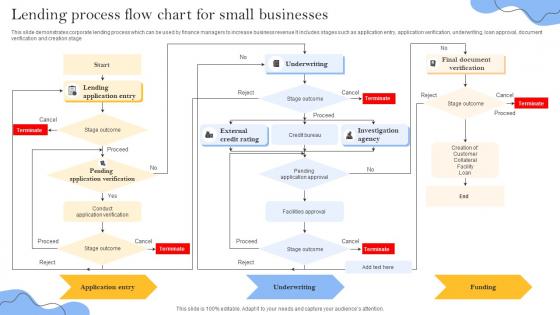
Lending Process Flow Chart For Small Businesses




Try Before you Buy Download Free Sample Product
 Impress Your
 Audience
 100%
100% Editable
 Save Hours
 of Time


This slide demonstrates corporate lending process which can be used by finance managers to increase business revenue It includes stages such as application entry, application verification, underwriting, loan approval, document verification and creation stage
People who downloaded this PowerPoint presentation also viewed the following :
Lending Process Flow Chart For Small Businesses with all 6 slides:
Use our Lending Process Flow Chart For Small Businesses to effectively help you save your valuable time. They are readymade to fit into any presentation structure.





FAQs for Lending Process Flow Chart
So the typical flow goes: application, initial screening, credit check, verifying income/job stuff, collateral evaluation if needed, underwriting decision, then approval or denial, and finally getting the money. Document collection sometimes gets its own step too - really just depends how detailed you want to be. Credit assessment and underwriting eat up most of the time since that's where they're crunching all the risk numbers. Honestly, I'd start by mapping what you're doing now, then stack it against these standard stages. You'll probably spot some weird gaps or places where you're doubling up on work.
Look, that first application is everything. Mess up the data collection and you're gonna be dealing with delays for weeks. I've watched so many deals completely fall apart because people rushed through this part - it's honestly painful to see. Good application = smooth underwriting, since they actually have what they need to make quick decisions. Get all your docs together upfront. Trust me on this. Better data capture means you'll fly through credit checks and verification. Skip this step properly and you'll hate yourself later when everything gets stuck.
So credit assessment is like the bouncer at the door - happens right after someone applies and decides if they get in or get turned away. You're looking at their credit score, income, how much debt they already have, payment history, all that stuff. Honestly, this step can make or break everything because it either moves them to underwriting or straight to the "nope" pile. Without doing this properly, you're just guessing on who to lend to. Oh and make sure your team knows exactly what to look for so everyone's doing it the same way.
Honestly, flowcharts are game-changers for this stuff. Your team finally gets a visual of who's doing what instead of constantly asking "where's that loan application now?" Think of it as GPS for paperwork - way better than playing phone tag about next steps. The visual part makes handoffs way smoother since everyone can actually see the dependencies. Plus you'll spot those annoying bottlenecks before they blow up into real problems. I'd start by sitting down with your team to map out how things work now. Trust me, you'll be shocked at where communication usually falls apart.
Lucidchart and Visio are probably your best bets for detailed flowcharts - both have nice drag-and-drop features. If your team likes collaborating, Miro and Figma are solid choices. I've actually seen people make decent flows in PowerPoint, though it gets messy with complex stuff. ProcessOn and Draw.io won't cost you anything and work pretty well. Bizagi's worth checking out if you want automation features down the line. Honestly? Just start with whatever software you already have. Getting the process mapped out clearly matters way more than which tool you pick.
Honestly, don't save compliance for the end - that's where everything falls apart. Build your credit checks and income verification right into each approval stage instead. Way better to catch problems early than deal with a mess later. Map out what regulations hit at each step (TILA, fair lending, all that fun stuff) and set clear pass/fail points. I've watched too many teams get burned by treating compliance like an afterthought. Automated screening helps a ton here. Trust me, your whole team will be way happier when deals actually flow instead of getting jammed up in bottlenecks down the road.
So you'll want to map out all your major decision points - think of them as gates where things can get stopped. Start with basic eligibility stuff like income and credit minimums. Then you've got the real meat: underwriters doing their risk assessment thing, pricing decisions based on what tier someone falls into, and final approval conditions. Collateral evaluation is massive too if you're doing secured loans (honestly that one trips up so many applications). Each gate either pushes things forward or kicks it to rejection. I'd use those diamond shapes in your flowchart - makes it super obvious where bottlenecks happen and apps get stuck.
So underwriting is basically where all the magic happens - or where dreams get crushed, depending how you look at it. After collecting all the borrower's paperwork, everything goes to underwriters who dig into credit scores, verify income, check risk factors. Honestly the worst part for most people since it's totally out of their hands at that point. Could take days or weeks (I've seen both). Once they approve or deny, then you move to closing and funding. Just be upfront about timing because borrowers will ask every day otherwise.
Honestly, exception handling will drive you crazy - that's the worst part. You map out the happy path thinking you're done, then boom, there are like 12 ways things can go sideways or get stuck in limbo. Plus figuring out responsibilities when multiple teams are involved? Total nightmare. Oh, and here's something counterintuitive - tackle your most complicated, messy scenarios first instead of starting simple. I know it sounds backwards, but trust me on this. You don't want to build a nice flowchart only to scrap half of it when you realize Karen from compliance needs to approve everything over $500.
Honestly, flow charts are game-changers for spotting bottlenecks. Map out every step first - application review, credit checks, underwriting, all of it. Then time how long each stage actually takes versus what it should be. The spots where stuff consistently gets stuck? Boom, there's your problem. Way better than just wondering why things feel slow, you know? I'd track everything for about a week and circle the disaster zones on your chart. It's like finally seeing the mess from above instead of being stuck in it.
Get your team involved first - they know where the real problems are. I always document changes with dates because honestly, you'll have no clue why you did something later. Make it visual enough that someone brand new won't get completely lost. Before you roll anything out, run a few actual loan scenarios through it. Nothing's worse than a flowchart that looks perfect but breaks down with real cases. Oh, and schedule regular reviews or it'll be outdated before you know it. Processes change way faster than we think they will.
Get your stakeholders involved right from the beginning - loan officers, underwriters, compliance people. They'll spot issues you totally missed. Do multiple rounds: concept review first, then detailed walkthrough, final check. The people actually using the system daily? Their input matters way more than what managers think, honestly. I've seen too many projects where they skip this part and end up redoing everything later (such a waste). Document what they suggest and show how you used it. Builds trust in the final process.
So basically, banks love their bureaucracy - tons of approval steps and paperwork. Credit unions are way more chill about it, fewer hoops to jump through. Online lenders? They automate everything but honestly don't care much about verifying your actual income, which is kinda sketchy if you ask me. Community banks still want to meet you face-to-face and do everything manually. The differences really show up in how they check collateral, what credit scores they'll accept, and how fast you get funded after approval. I'd just pick 2-3 different types and compare them side by side.
Yeah, approval is by far the messiest part. Credit checks, risk stuff, getting different departments involved - it's a whole thing. Application intake? Easy. Document collection? Whatever. But approval is where everything you gathered gets picked apart. Honestly, it's kind of brutal how thorough they get. Plus it can circle back if they want more paperwork, so it's not even linear like the other steps. I'd definitely warn whoever you're helping that this part takes forever and has the most variables. Way more complicated than it needs to be, but that's banking for you.
Honestly, color coding is a game changer - green for approved stuff, red for rejections, you know the drill. Icons help people instantly spot decision points vs regular process steps, which is clutch during training. I always use thicker arrows for the main path and thinner ones for alternate routes. Oh, and consistent spacing is way more important than you'd think - makes everything so much easier to scan. Definitely throw in little symbols for each department too. That way your team can immediately see who's responsible for what without squinting at tiny text boxes.
-
Incredibly beautiful designs that will help you get noticed! These eye-catching templates are perfect for corporate presentations that can be altered to fit any occasion or taste.
-
My search for complete decks ended with SlideTeam. Such a surplus collection of HD PowerPoints. Moreover, their standard and widescreen formats have helped me in delivering bullseye presentations.