


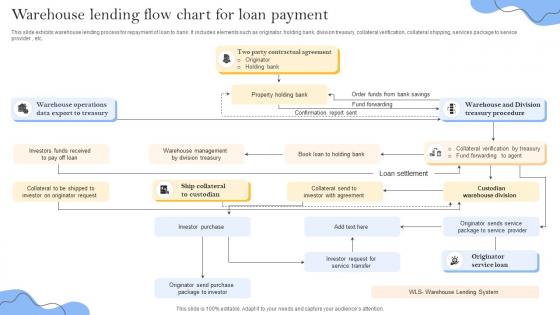
Warehouse Lending Flow Chart For Loan Payment




Try Before you Buy Download Free Sample Product
 Impress Your
 Audience
 100%
100% Editable
 Save Hours
 of Time


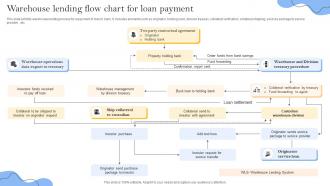
This slide exhibits warehouse lending process for repayment of loan to bank. It includes elements such as originator, holding bank, division treasury, collateral verification, collateral shipping, services package to service provider , etc.
People who downloaded this PowerPoint presentation also viewed the following :
Warehouse Lending Flow Chart For Loan Payment with all 6 slides:
Use our Warehouse Lending Flow Chart For Loan Payment to effectively help you save your valuable time. They are readymade to fit into any presentation structure.





FAQs for Warehouse Lending Flow Chart
Dude, it's basically like having a credit line just for mortgages. You get cash upfront to close loans instead of waiting around with your own money tied up for months. Game changer for volume - you can fund way more deals since you're not stuck waiting for each one to sell before doing the next. Most warehouse lenders have decent rates too and they'll handle a bunch of the annoying operational stuff. Yeah, you're paying interest until you sell to investors, but the extra volume usually covers that easily. I'd honestly just call 3-4 providers and compare what they'll offer you.
Warehouse lending is basically inventory financing for mortgage companies. You get quick cash to buy loans, then flip them to investors super fast - like 30-90 days max. Regular banks care about your overall finances and want longer commitments. These guys? They just want to know the loans are solid and you can move them quickly. The speed is honestly pretty crazy compared to normal commercial lending. If you're doing mortgage origination, the collateral requirements are completely different too. It's way more specialized than I realized when I first heard about it.
Hey! So lenders basically want to see three things when you're going for a warehouse line. First - your money situation. Net worth, how liquid you are, all that boring stuff. Your track record matters a ton too. They're obsessed with seeing management teams who've survived different market cycles because honestly, they've watched way too many newbies flame out spectacularly. Oh, and loan quality metrics are huge. Technology systems and compliance procedures get evaluated hard - plus how fast you can actually process loans. The real key though? Show up with bulletproof financials and prove you actually know how to run this thing day-to-day.
Dude, warehouse lending gets crushed when rates move because you're basically borrowing money short-term to fund mortgages. Your funding costs spike right away, but those mortgages you're sitting on? Still locked at whatever lower rate. That spread just disappears. Higher rates also mean way less mortgage volume - people aren't buying as much. So you're getting hit twice, which honestly sucks. Smart lenders build in some hedging and make sure their credit lines can pivot fast. My buddy at a warehouse shop learned that the hard way in '22.
Dude, you're probably bleeding money if you're still doing everything manually. Digital platforms let you track loans in real-time and automate all those compliance headaches. The analytics part is honestly where it gets interesting - you'll spot patterns way faster and make smarter decisions. Plus some systems connect directly with your originators, which cuts down on stupid mistakes from data entry. I'd definitely start with digitizing loan tracking first since that's where you'll see immediate results. Spreadsheets are fine for like... grocery lists, but not this. Your whole pipeline just moves faster when tech handles the boring stuff.
Warehouse lending is honestly a lifesaver for cash flow. You get immediate funding to close loans instead of waiting around for investors or secondary market sales. Close a loan today, get reimbursed right away by your warehouse lender. No more tying up your capital for weeks - that part used to drive me crazy when I first learned about this stuff. You can focus on originating more loans rather than stressing about funding gaps. It's basically borrowing against your pipeline, so you'll close faster and scale up volume. Just make sure your warehouse agreement terms actually match up with your origination timeline and investor commitments.
Honestly, the biggest headache is credit risk - borrowers can default and you're screwed. Interest rate movements will kill you too since you're locked into loans while rates shift. You'll constantly need funding for these short-term facilities, so liquidity becomes this ongoing stress. Managing all the collateral and loan files? Total operational nightmare if your systems suck. Regulators love to poke around warehouse lending operations. I've seen banks get burned badly on the collateral management side. Your due diligence better be bulletproof. Early warning systems aren't optional either - you need to spot problems before they explode.
Warehouse lending is a pain when it comes to compliance, honestly. You're stuck monitoring two levels of regulations - yours plus all your mortgage originator clients'. Their compliance problems become your credit problems real fast. I learned this the hard way watching a buddy's shop deal with a borrower who got slammed by regulators. Due diligence costs go through the roof, underwriting gets way stricter, and don't get me started on capital requirements. The trick is writing solid compliance monitoring right into your loan agreements from day one. Otherwise you'll be scrambling later.
Cash flow timing is brutal - you're always caught between funding loans and getting them sold. Regulatory stuff will drive you crazy too. Interest rates shifting around means your loan inventory can tank in value fast, which sucks. Documentation delays? They'll screw your whole pipeline, trust me. Operations need to be tight from the start or you're dead in the water. Oh and definitely don't rely on just one warehouse provider - spread that risk around. The ops team investment is huge but you can't skimp there.
So warehouse lenders are gonna go through your finances with a fine-tooth comb - cash flow, liquidity, net worth, all that stuff. Your management team better have solid experience and clean compliance records. They're also checking your loan volume and pipeline because honestly, what's the point of giving you credit if you won't use it? Oh, and they care about your relationships with secondary markets too. Performance metrics from past loans matter big time. Keep everything documented and squeaky clean because these guys don't mess around when it comes to risk.
Dude, warehouse lending is getting wild right now. Tech automation is basically taking over - AI underwriting, digital docs, all that stuff. Compliance is getting way stricter too, which honestly sucks but whatever. The ESG thing caught me off guard though, didn't think that'd happen so quick. Non-bank lenders and fintech are making traditional players sweat with faster turnarounds. Oh and the risk monitoring is all real-time now. If you're not upgrading your tech stack soon, you're gonna get smoked. Same with compliance frameworks - better get on that before regulators come knocking.
Yeah totally, speed and relationships are your secret weapons here. Big banks move like molasses with all their red tape, so you can crush them on turnaround times. Pick a niche - maybe non-QM loans or just focus on your local area where you actually know what's up. The flexibility thing is huge too. You can bend underwriting rules when it makes sense, and honestly, just answering your phone puts you ahead of half these places. Brokers will stick with you even if your rates aren't rock bottom, as long as they know you'll close deals fast. Those relationships are everything.
So warehouse lending is basically what keeps mortgage companies funded between when they make a loan and sell it off to investors. Think of it like a credit line for lenders. When it's working smoothly, more mortgages get approved and housing stays active. But when those credit lines get tight? Mortgage availability tanks pretty quick. We saw this big time in 2008 - honestly kind of a mess. It hits everything from home buying to construction to people's spending. Most folks don't realize how much this behind-the-scenes stuff matters, but it's actually a solid early warning sign for mortgage market trouble.
Yeah, warehouse rates totally affect what you pay. Basically, when lenders get cheaper money through warehouse lines, they can offer you better rates. It's like - their costs go down, so they can (sometimes) pass savings to you. Though honestly, they don't always give you as much as they should. Better warehouse terms mean lenders can undercut each other. Short draw periods, higher rates - that all gets baked into what they quote you. So when you're rate shopping, you're actually benefiting from whichever lender scored the best warehouse deal. Makes sense?
Hey! So for warehouse lending risk stuff - definitely vet your borrowers hard first. Check their track record, finances, how they actually originate loans. Then you gotta monitor the collateral constantly with strict reporting requirements. This gets ugly real quick if you're not watching. Set smart advance rates too and keep reserves based on what loan types you're dealing with. Oh and honestly? Have your exit strategy ready before you need it - portfolio metrics don't lie when things go sideways.
-
Keep doing the good work guys. Surpass the needs and expectations always!!
-
Wow, never been this impressed with any online service provider. Really appreciate the customer support all along from the navigation to purchasing the right products.