

Cost benefit analysis management ppt infographic template example introduction




Try Before you Buy Download Free Sample Product
 Impress Your
 Audience
 100%
100% Editable
 Save Hours
 of Time


Augment your capacity with our Cost Benefit Analysis Management Ppt Infographic Template Example Introduction. They endow you with extra endurance.
People who downloaded this PowerPoint presentation also viewed the following :
Content of this Powerpoint Presentation
The success of any product or service depends on the profits brought in after sales. One of the most effective ways to judge the profitability of any product or service is to execute a thorough cost-benefit analysis. However, designing and estimating a viable cost-benefit analysis is a challenging task. Even the most experienced personnel can fail to cover the crux of the problem.
Hence, the safest bet is to use a pre-designed cost-benefit analysis model. SlideTeams’ 100% customizable and utterly curated cost-benefit analysis template is here to help you. This template will help you showcase and record the minutest elements of the technique and perform a 360°c analysis for better understanding.
You can, thereafter, use the template to either enlighten your audience about a project’s profitability or for the management to make an informed decision about proceeding with the same. Let’s check out the template right away and understand what it has to offer.
Looking for a way to justify the viability of the implementation of your software using the cost-benefit analysis template? This template can be of great help to you.
Template 1: Cost Benefit Analysis Template
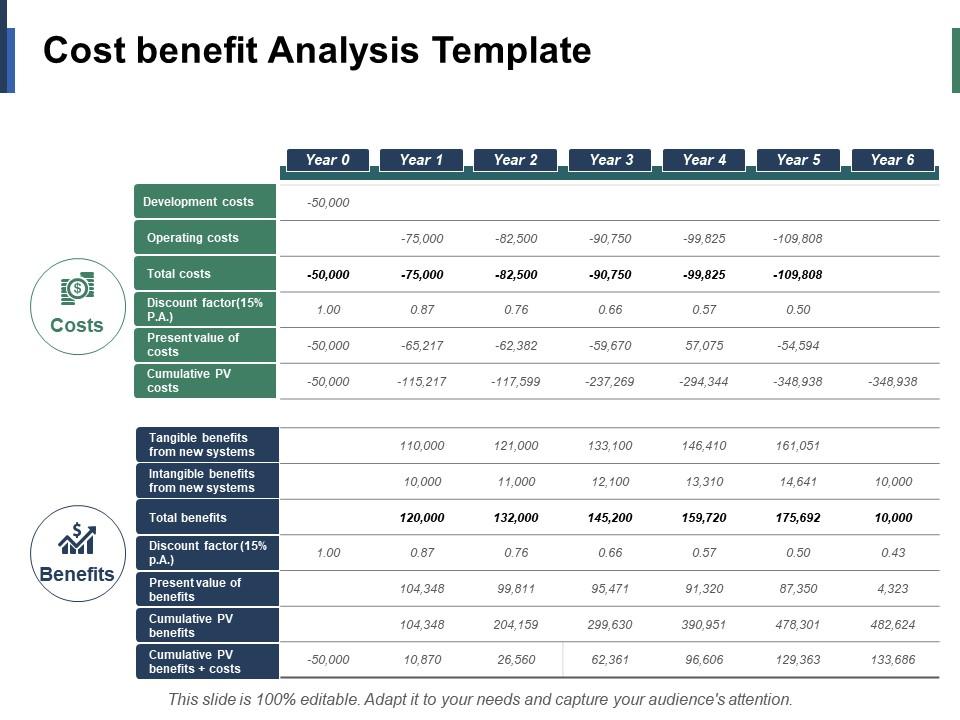
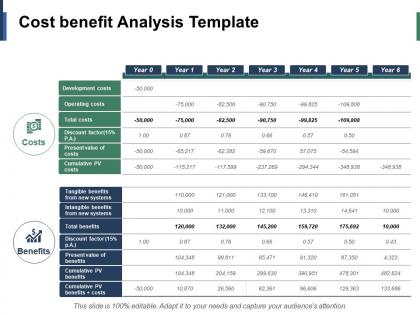
This thorough template allows you to compare the costs born and benefits derived from any project, product, or service in seven years. In the rows of the table, you can showcase costs related to the project like the cost of development, operations, and total costs. You can then deduct the discounts credited, and other overheads as necessary. Similarly, the benefits can be represented as tangible, intangible, and total benefits thereon deducting the discount factors, present value calculations, and more.
Here’s a detailed and multifaceted cost-benefit analysis template for a detailed inspection of the profitability and sanctity of your project.
Summing Up the Cost-Benefit Analysis
Once you record facts and figures in the table of the cost-benefit analysis template, you will get a clear picture of the actual status of the profitability of your project. Thereon, you can make the modifications in numbers to increase profitability, proceed with the present model, or scrap the entire project as necessary. Using this template, even your investors can make an informed decision about whether to invest in your project or not. Thus making it feasible to invite investments to your business.
If you are looking for a way to showcase your cost-benefit analysis report using facts rather than figures then you can get great benefits out of this template.
Cost benefit analysis management ppt infographic template example introduction with all 5 slides:
Capture the moment with our Cost Benefit Analysis Management Ppt Infographic Template Example Introduction. Your thoughts will leave an indelible image.

FAQs for Cost benefit analysis management ppt infographic
So you'll want to map out all your costs first - direct ones and the sneaky indirect stuff too. Then figure out your benefits and compare everything over whatever timeframe makes sense. Discount rates are where most people get tripped up tbh, but you gotta account for how money changes value over time. Don't skip opportunity costs either - like what else could you do with that cash? Oh and try to quantify those fuzzy benefits that are hard to measure. I'd honestly just throw everything into a basic spreadsheet first. Way easier to spot what you're missing that way before diving into calculations.
Look for proxy methods that put real dollar amounts on those intangible benefits. Property values near parks are great for environmental stuff - people literally pay more to live there. Salary gaps can show quality of life value too. Surveys asking willingness-to-pay work, but honestly the data's pretty unreliable half the time. For health benefits, try calculating productivity gains or what you'd save on medical costs. The main thing is being super transparent about your methods. Test different assumptions and see how much your numbers change. Document everything so people actually understand how you got there - stakeholders hate black box calculations.
Honestly, the worst mistakes happen when people get tunnel vision about their assumptions. Don't cherry-pick costs that make your idea look good - I've watched so many projects crash because of this. Double-counting is another big one, plus forgetting opportunity costs entirely. Different timeframes for comparison will mess you up too. Think about ALL the people affected, not just the obvious stakeholders. Implementation always has more risks than you expect (learned this the hard way). Write down your assumptions first thing and get someone else to look them over. Fresh perspective catches stuff you'll miss.
Honestly, cost-benefit analysis works best for the big stuff - major investments, policy changes, new product launches. Basically when there's real money on the line and multiple people involved who need convincing. It's great when you're stuck between several good options and need an objective way to pick one. The trick is being able to put actual numbers on most of your costs and benefits. If everything's just gut feelings or the answer's super obvious anyway, you're probably overcomplicating things. I mean, sometimes you just know what the right call is, you know?
So basically you're looking at opportunity cost - what you're giving up by picking this option instead of your second choice. Most people totally skip this part, which is nuts because it's huge. Say you put your team on Project A - you should count what they would've made on Project B as an added cost. Makes the real picture way clearer. I always tell people to ask "what else could we do with this money/time?" then actually put a number on it. Sounds obvious but honestly most CBAs I've seen miss this completely.
Dude, time value of money is everything in cost-benefit analysis. A dollar now beats a dollar later, so you've gotta discount future stuff back to present value. Otherwise you're comparing totally different things across time periods. Long-term projects? This becomes even more critical. Honestly, I messed this up on my first infrastructure gig - learned real quick! The discount rate you pick can completely flip your conclusions, so don't just wing it. Present everything in today's dollars so people can actually compare things fairly. Makes such a difference.
So sensitivity analysis is basically when you mess around with all the sketchy numbers in your cost-benefit analysis to see what happens. Like, what if your discount rate is actually 8% instead of 5%? Or your cost estimates are totally off? You test different scenarios - best case, worst case, the realistic one. Honestly, most people skip this step but it's huge for credibility. Shows stakeholders you're not just pulling numbers out of thin air. The whole point is figuring out which assumptions actually matter and which ones don't really move the needle. Way better than pretending you know everything for certain.
For speeding up your CBA, NPV is solid for most financial stuff - super straightforward. IRR works better when you're comparing different investments though. Decision matrices with weighted criteria are clutch for bigger strategic calls, or try the balanced scorecard approach. Honestly? Most people way overcomplicate this. Just pick whatever matches how complex your decision is and use it consistently. I always default to NPV when I'm not sure since it handles like 90% of what you'll run into. Don't get stuck in analysis paralysis over which method to use.
Dude, regulatory stuff will totally mess with your numbers if you're not careful. Compliance costs, fines, cleanup expenses - they add up fast and can be way more than your original budget. New rules can literally appear halfway through your project (happened to us last year, what a nightmare). Environmental issues are tricky too because they slow everything down with delays and redesigns. You'll also need to worry about community pushback if things go sideways. Build in extra money for both regulatory changes and environmental fixes right from the start. Get your legal and environmental people involved early - trust me on this one.
So I'd definitely start with sensitivity analysis on your biggest assumptions - that's where you'll get the most value. Run different scenarios too: best case, worst case, and realistic outcomes to see how changes mess with your results. Historical data from similar projects is honestly way better than just guessing (I learned this the hard way). Expert interviews help a lot, especially for tricky stuff like adoption rates. Monte Carlo simulations are pretty overkill unless you're dealing with tons of variables. Oh, and don't forget benchmarking against comparable projects - it's super helpful for validation.
Yeah totally! Just replace "profit" with social impact stuff - like how many people you helped or lives changed. The tricky part is putting numbers on social outcomes, but honestly that's where it gets interesting. Some orgs assign dollar values to their results, others use point systems to compare programs. Short version: map your costs against measurable results for each initiative. It's super helpful when you're deciding where to spend limited resources, plus funders love seeing concrete proof their money actually did something meaningful in the community.
Think of it this way - ex-ante happens before you dive into a project, ex-post comes after you're done. Before starting, you're basically guessing at costs and benefits to figure out if it's even worth doing. That's your ex-ante analysis. Once everything's wrapped up, ex-post is when you look back at what actually happened. And yeah, your original predictions were probably way off lol. Use ex-ante for getting approval and making decisions. Ex-post teaches you what went wrong (or right) so you don't make the same mistakes twice. Both matter, but honestly the learning part is where the real value is.
Oh man, this is such a big thing people miss! Different cultures literally value completely different stuff. Like your community-focused folks? They're thinking generations ahead while business types are obsessing over quarterly numbers. It's wild how much this varies. Risk tolerance is another huge one - some groups trust institutions way more than others. Success means totally different things too. Honestly, the trick is figuring out these different perspectives super early. Then you can actually talk about benefits in ways that matter to each group instead of just... talking past everyone.
So many ways tech can speed this up! Start with automated data collection - no more digging through spreadsheets all day. Excel templates with formulas alone cut my time in half. CBA software lets you run scenarios fast and makes charts that don't look terrible. AI's getting decent at spotting costs you'd miss, though honestly the risk assessment stuff is hit or miss. Machine learning helps with forecasting by finding patterns in old data. Just use whatever your company already pays for first - why reinvent the wheel?
Know your crowd first - execs just want the money stuff upfront while tech people actually care about your methods. Lead with the big numbers: ROI, payback, net benefit. Charts beat spreadsheets every time (trust me on this). Be super transparent about your assumptions so people get where the numbers come from. Don't hide the risks - bring up sensitivity analysis before someone corners you about it. Oh, and make different versions! One-pager for the busy folks, detailed backup for whoever wants to geek out over your math.
No Reviews