


Create your outreach plan how to create a strong e marketing strategy ppt infographics




Try Before you Buy Download Free Sample Product
 Impress Your
 Audience
 100%
100% Editable
 Save Hours
 of Time


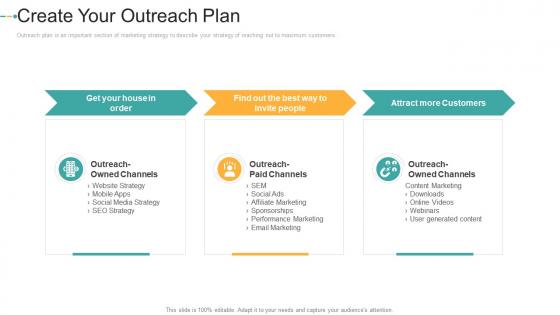
Outreach plan is an important section of marketing strategy to describe your strategy of reaching out to maximum customers.
People who downloaded this PowerPoint presentation also viewed the following :
Create your outreach plan how to create a strong e marketing strategy ppt infographics with all 6 slides:
Use our Create Your Outreach Plan How To Create A Strong E Marketing Strategy Ppt Infographics to effectively help you save your valuable time. They are readymade to fit into any presentation structure.





FAQs for Create your outreach plan how to create a strong e marketing
Key components of an effective e-marketing strategy include search engine optimization, social media marketing, email campaigns, content marketing, and data analytics. These elements work together by enhancing online visibility, engaging target audiences, and driving conversions, with many organizations finding that strategic integration of these components delivers measurable ROI and competitive advantage.
Businesses leverage social media to enhance e-marketing through targeted advertising, influencer partnerships, content marketing, customer engagement platforms, and real-time analytics tracking. These integrated approaches streamline brand visibility, accelerate customer acquisition, and deliver personalized experiences, with retail and hospitality sectors finding that strategic social media integration ultimately drives higher conversion rates and sustained competitive advantage.
SEO serves as the foundation of successful e-marketing strategies by improving search visibility, driving organic traffic, and reducing customer acquisition costs. It enhances content marketing effectiveness, supports social media campaigns, and integrates seamlessly with paid advertising efforts, with many businesses finding that strong SEO ultimately delivers sustained competitive advantage and measurable ROI growth.
Data analytics improves e-marketing decision-making by tracking customer behavior patterns, measuring campaign performance metrics, and identifying high-converting audience segments in real-time. Through predictive modeling and A/B testing, businesses can optimize ad spending, personalize content delivery, and adjust targeting strategies dynamically, ultimately delivering higher ROI and more effective customer acquisition.
The most effective content marketing types for e-marketing strategies include blog posts, video content, social media campaigns, email newsletters, and interactive webinars. These approaches streamline customer engagement by delivering targeted messaging, building brand authority, and nurturing leads through multiple touchpoints, with many organizations finding that strategic content combinations ultimately enhance conversion rates and customer loyalty.
Email marketing integrates with other e-marketing channels through coordinated messaging, shared customer data, and synchronized timing across platforms like social media, content marketing, and paid advertising. This strategic combination enables businesses to create cohesive customer journeys, reinforce brand messages through multiple touchpoints, and leverage cross-channel analytics, ultimately delivering higher engagement rates and improved conversion performance.
Essential e-marketing tools include email marketing platforms, social media management software, analytics tools, CRM systems, and content management systems. These technologies streamline campaign execution, audience targeting, and performance tracking, with many retail and financial services organizations finding that integrated platforms enhance customer engagement, reduce operational costs, and ultimately deliver measurable ROI across digital channels.
Audience segmentation enhances e-marketing effectiveness by enabling personalized messaging, targeted content delivery, and optimized channel selection based on specific customer characteristics and behaviors. This strategic approach allows businesses to increase conversion rates, reduce acquisition costs, and improve customer engagement, with many retail and financial services companies finding that segmented campaigns deliver significantly higher ROI than broad-based marketing efforts.
Key e-marketing metrics include conversion rates, customer acquisition costs, email open rates, social media engagement, and return on ad spend. These indicators streamline performance assessment by tracking revenue generation, audience growth, and campaign effectiveness, with many organizations finding that monitoring multiple touchpoints ultimately delivers deeper customer insights and competitive advantage.
Businesses create seamless customer journeys by integrating email marketing, social media, content marketing, and personalized website experiences across all touchpoints. Through unified customer data platforms and marketing automation, companies like retail brands and financial services deliver consistent messaging, targeted content, and synchronized interactions, ultimately reducing friction and enhancing customer satisfaction while increasing conversion rates.
E-marketing challenges in global markets include cultural differences, language barriers, varying regulations, currency fluctuations, and diverse consumer behaviors across regions. While these complexities require strategic adaptation, companies increasingly find that localized content strategies, multi-currency platforms, and region-specific campaigns ultimately deliver enhanced customer engagement and competitive advantage in international markets.
Mobile optimization transforms e-marketing strategies by enhancing user experiences, improving search rankings, and increasing conversion rates across all digital touchpoints. With mobile traffic comprising over 60% of web browsing, businesses increasingly prioritize responsive design, faster loading speeds, and mobile-first content creation, ultimately delivering higher engagement and competitive advantage in today's mobile-centric marketplace.
Brand storytelling enhances e-marketing strategy by creating emotional connections, differentiating from competitors, increasing content engagement, building customer loyalty, and driving authentic social sharing. Through compelling narratives across digital channels, brands like Nike and Patagonia transform product promotions into meaningful experiences, ultimately delivering higher conversion rates and stronger customer relationships in an increasingly crowded online marketplace.
E-marketing ethical considerations include data privacy protection, transparent advertising practices, honest product representation, consent-based communications, and accessibility compliance. These principles enhance customer trust, reduce legal risks, and build sustainable brand reputation, with many organizations finding that ethical marketing strategies ultimately deliver stronger customer loyalty and competitive advantage in increasingly regulated digital environments.
Businesses can integrate influencer marketing into their e-marketing strategy by partnering with relevant content creators, leveraging authentic product endorsements, utilizing influencer-generated content across channels, and implementing trackable campaign metrics. Through strategic collaborations, companies streamline brand awareness while enhancing customer trust and engagement, with many retail and lifestyle brands finding that influencer partnerships significantly boost conversion rates and expand market reach.
-
Very unique and reliable designs.
-
Presentation Design is very nice, good work with the content as well.