

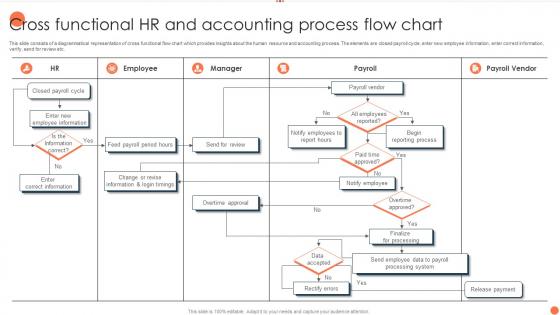
Cross Functional HR And Accounting Process Flow Chart




Try Before you Buy Download Free Sample Product
 Impress Your
 Audience
 100%
100% Editable
 Save Hours
 of Time


This slide consists of a diagrammatical representation of cross functional flow chart which provides insights about the human resource and accounting process. The elements are closed payroll cycle, enter new employee information, enter correct information, verify, send for review etc.
People who downloaded this PowerPoint presentation also viewed the following :
Cross Functional HR And Accounting Process Flow Chart with all 6 slides:
Use our Cross Functional HR And Accounting Process Flow Chart to effectively help you save your valuable time. They are readymade to fit into any presentation structure.





FAQs for Cross Functional HR And Accounting
Okay so basically it just tears down all those stupid department walls that slow everything down. When teams actually talk to each other, decisions happen way faster and you get better ideas because different people bring different perspectives. Your customers notice too - no more getting bounced between sales and support like a ping pong ball. Honestly, the "not my department" thing drives me crazy. You'll also catch tons of wasted effort when teams are accidentally doing the same work. My advice? Pick one project that needs multiple departments and see how much smoother it runs when everyone's actually aligned.
Honestly, pick your communication tools and don't switch around constantly - it drives everyone crazy. I'd set up weekly check-ins with the key people and use something like Slack or Asana so nobody's working blind. Have one person be the go-to contact for each team instead of letting messages bounce around randomly. Write down decisions right after meetings because people remember things differently (learned this the hard way). The biggest thing though? Make sure your team feels comfortable saying "I'm lost" or "we're behind" without getting blamed for it.
Honestly, tech is what saves cross-functional teams from turning into total chaos. Slack and Teams help break down those annoying department walls. Project management tools keep everyone on the same timeline - which is clutch because manual handoffs always get messed up somehow. APIs are a game changer since they let your systems actually talk to each other automatically. Dashboards give teams visibility into what everyone else is doing too. But here's the thing - don't just pile on more apps. Map out where your biggest headaches are first, then find specific tools that fix those exact problems. Otherwise you'll just create more confusion.
Oh man, communication is always the first thing to fall apart. Everyone's got different deadlines and priorities, so aligning people feels impossible sometimes. Power struggles are huge too - nobody wants to give up control over decisions. Most people just aren't used to working outside their own department, which makes things messy. Plus your team members are trying to balance their regular jobs on top of this project. Honestly, the resource thing gets really frustrating. Set up clear rules about who decides what from day one, and spend time getting people to actually like each other first.
Here's what I'd try: get leadership to stop rewarding department heads just for their own team's wins - tie bonuses to actual collaboration instead. Cross-functional project teams work well for bigger stuff. Yeah, people will groan about more meetings, but those quick weekly check-ins between departments actually help once everyone gets used to them. Honestly? Pick something small first where two departments can both look good if they work together. Maybe a product launch or whatever makes sense for your company. Once people see it's not just extra work, the whole silo thing starts breaking down naturally. Success is weirdly contagious that way.
Honestly, start with project delivery times - they'll drop when teams actually talk to each other. Employee satisfaction is huge too (people hate working in silos). Track how fast decisions happen across departments, plus basic quality stuff like defect rates or customer feedback scores. Those usually get better when teams stop just tossing projects over the fence. Communication frequency between groups matters, but don't go crazy measuring everything at once. Pick 2-3 things that actually make sense for your company and see what happens.
Honestly, cross-functional teams are game-changers. You get marketing spotting customer issues that engineering totally missed, finance finding cost cuts nobody else saw - different departments just see different things, you know? It breaks down those annoying silos that usually torpedo good ideas before they even start. My old company was terrible at this, but when we finally tried it, the solutions got way more creative. Diverse perspectives help you catch blind spots you'd never notice otherwise. Just grab people from 3-4 different areas for a small project first and see what happens.
Honestly, the key is getting everyone on the same page about what you're actually trying to accomplish first. Weekly check-ins are your friend here - I'd rather have too many meetings than people working in silos for weeks. Get the right people involved in decisions, not just the loudest voices. Shared dashboards and project tools help, but the real game-changer is creating an environment where people actually speak up when something's going sideways. Nobody wants to be the bearer of bad news, but catching problems early beats scrambling later. Also, make sure each team understands how their piece fits into the whole thing - it sounds basic but you'd be surprised how often that gets missed.
Amazon does this thing with "two-pizza teams" - basically engineers, designers, and product people all work on one feature together. Spotify's got their squad model which is pretty similar. Apple does it too but they're weirdly secretive about everything. Toyota actually started this whole trend back with lean manufacturing on factory floors, which is kinda random but makes sense. The main thing is you gotta break down those silos where departments just toss work to each other. Get people sitting together, sharing the same goals instead of working in separate bubbles.
Start with metrics everyone actually cares about - revenue growth, customer satisfaction, project timelines. Not the random departmental stuff that makes teams compete against each other. Marketing obsesses over leads while sales only wants close rates, which is honestly just stupid. Get everyone in a room regularly to map out how their work connects. Show the dependencies. When marketing's campaign affects sales' pipeline affects customer success - make that visible. Joint planning sessions work way better than you'd think. Bottom line: structure it so your win requires their win too.
Honestly, three things matter most: communication skills, systems thinking, and basic domain knowledge. You're basically a translator all day - one minute explaining tech limits to marketing, next minute telling devs what users actually want. Systems thinking is where you learn how your decisions mess with (or help) other teams. Took me way too long to figure that part out lol. Don't stress about being an expert everywhere, but knowing the basics of what each team does saves you from looking clueless in meetings. I'd start with communication workshops and maybe shadow different departments for a week each.
Honestly, you gotta tackle this stuff before it spirals out of control. Half the time people are just confused about who's supposed to do what - so nail down roles early. When things get tense, don't let it simmer. Get everyone in a room and hash out what's really going on, not just the petty surface stuff. I've watched teams be weird and passive-aggressive for weeks over something that could've been fixed in one conversation. Keep bringing it back to what you're all trying to accomplish together. Regular check-ins help catch drama before it explodes. And honestly? Sometimes personalities just don't click and that's when you need to loop in your manager.
Cross-departmental meetings help a ton - just 30 minutes weekly breaks down those silos. Get people working together on shared projects instead of staying isolated in their departments. Rotating responsibilities occasionally is smart too, helps everyone understand what other teams actually deal with. Oh, and shared metrics that force collaboration? Game changer. People start talking to each other naturally when their success depends on it. I'd honestly start with one small cross-functional project first though - don't try to overhaul everything at once. Half the battle is literally just getting departments to communicate regularly instead of pretending the others don't exist.
So basically you're trying to get your different teams to actually work together instead of doing their own thing in isolation. Sales, marketing, product dev - when they share info regularly, customers don't get bounced around repeating the same problem to five different people (which honestly drives me insane when I'm the customer). Your messaging stays consistent, problems get solved faster, and you build stuff people actually want. I'd start with weekly check-ins where teams swap customer feedback and pain points. It's not rocket science but makes a huge difference.
Honestly, you become like a translator between departments because engineering and marketing might as well speak different languages half the time. Set up clear processes from day one - trust me on this one. Regular check-ins are your best friend for catching problems early. You're basically breaking down those annoying silos that form naturally. Keep everyone aligned on timelines and what they're actually supposed to deliver. It's a lot of coordinating, but someone's gotta make sure the workflow doesn't fall apart when teams hand things off to each other.
-
Excellent work done on template design and graphics.
-
Use of different colors is good. It's simple and attractive.